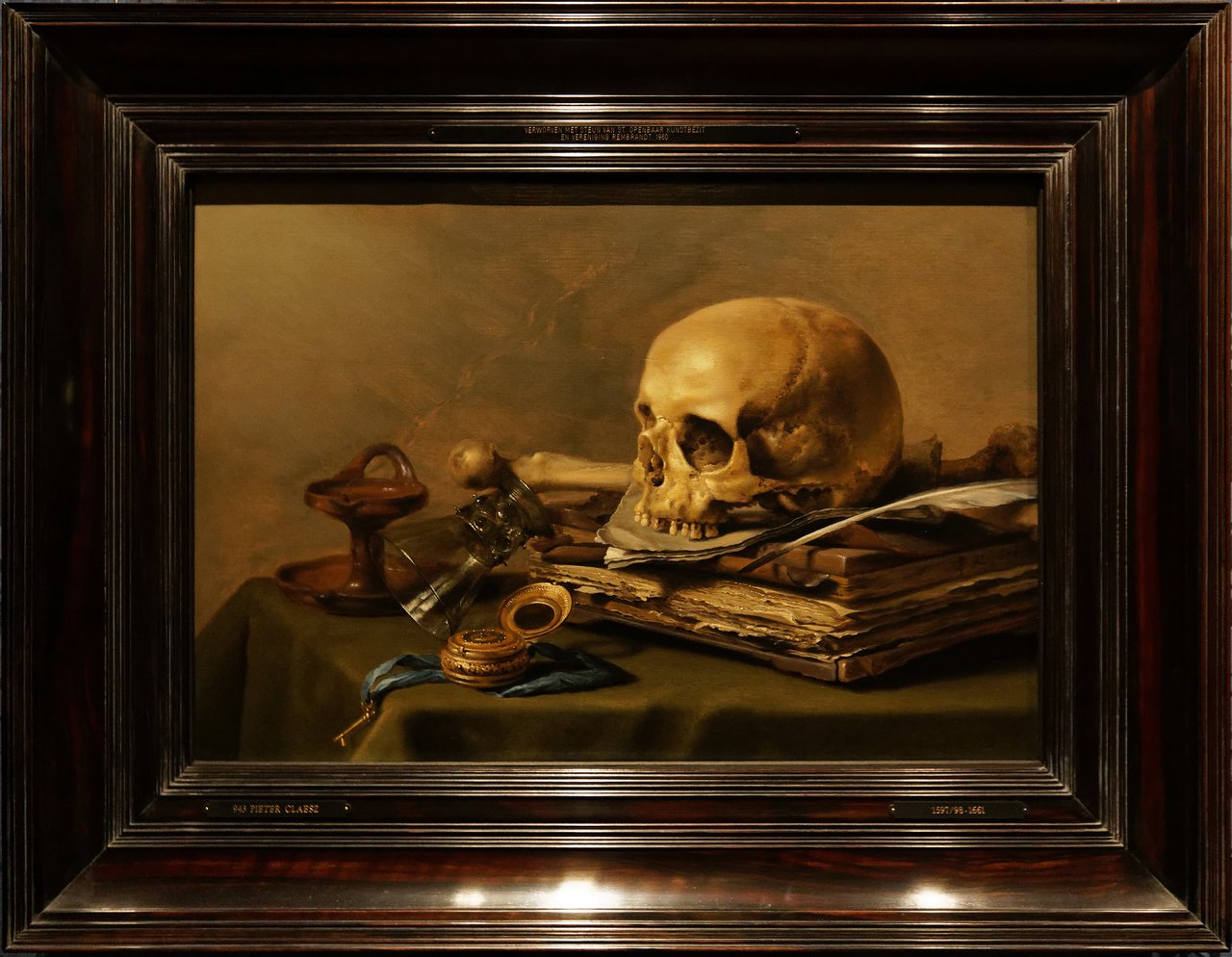
The Latin phrase vanitas vanitatum, omnia vanitas — "vanity of vanities, all is vanity" — comes from Ecclesiastes and condenses a theological anxiety that the Dutch Golden Age turned into a painting genre.[1][3] Vanitas still life emerged in Leiden and Haarlem in the early 17th century, reaching its peak intensity between roughly 1620 and 1670, precisely when the Dutch Republic was accumulating more portable wealth than any polity in northern Europe had seen before. That timing is not coincidental. The genre was invented to address an audience that had something to lose and knew it.
The object as loaded text
What makes vanitas painting formally distinctive is not any single object but the density of symbolic assignment concentrated into a single pictorial surface. A painter like Pieter Claesz, working in Haarlem from the 1620s onward, could assemble a skull, an overturned glass, a pocket watch, an extinguished oil lamp, and a scattered pen on a stone ledge and expect a literate viewer to decode each one without a caption.[1][2]
The skull (caput mortuum) needs no translation. The overturned vessel announces interrupted pleasure — the drink poured, the feast ended. The pocket watch, a luxury object in 1630, marks time passing at a measurable, commercial rate. The lamp without flame indexes the life that has gone out. The pen and book together represent the learned pursuits that survive neither their author nor their reader.[3]
This was not folk superstition or private cipher. It was a shared symbolic grammar, legible across social levels because it drew from sources — Ecclesiastes, Stoic philosophy, Flemish emblem books — that circulated widely in Protestant Dutch culture.[3][4] The painter was not making private meaning; they were citing a public text in oil.
Claesz and the monochrome compression
Pieter Claesz is among the genre's most rigorous practitioners not because he painted the most elaborate compositions, but because he stripped the vocabulary to its minimum.[1][2] His vanitas pictures from the 1620s and 1630s reduce color nearly to monochrome — ochre, ash, cream, and one or two warm accents — and concentrate on the surface quality of things: the slight condensation on a glass, the crumple of a page, the dull sheen of a skull that has long since lost its luster.
That tonal restraint is itself a statement. Claesz refuses the seductive color and abundance that other Dutch still-life specialists (Jan Davidsz. de Heem, for example, with his extravagant flower-and-banquet pronkstilleven) used to pull the viewer in.[2][4] Where those painters offered abundance first and then implicitly asked you to consider its fragility, Claesz begins at the end. The objects on his ledge are already cooling. Pleasure has already passed; what remains is the counting of what was there.
What the genre was actually saying to its buyers
Vanitas paintings circulated as domestic objects in prosperous Dutch households — purchased by the same merchants and professionals whose daily lives involved ledgers, inventories, commodity prices, and accumulated things.[4] Reading a vanitas on a private wall was therefore a peculiarly self-referential act. The viewer who bought the painting was, by definition, someone with enough prosperity to afford art. The art told them their prosperity was temporary and morally suspect.
This sounds like an uncomfortable loop, but 17th-century Calvinist theology made the loop productive. Material success could be read as a sign of God's favor; ostentatious attachment to it, however, was a spiritual risk. Vanitas painting offered a ritualized acknowledgment of that risk — a way of owning beautiful things while demonstrating awareness of their impermanence.[3][4] The picture on the wall was, among other things, proof that the owner had not lost their theological bearings in the noise of commerce.
That function also explains the market scale. Vanitas images were not luxury commissions for a few aristocrats; they were produced in volume, priced accessibly, and displayed in rooms where visitors would see them.[4] They operated as a form of publicly legible piety — the domestic equivalent of a church memento mori, but mobile, purchasable, and available to anyone with a bit of disposable income.
Time in three registers
One of the most sophisticated moves in vanitas painting is the way it handles time not as a single theme but as a layered set of registers operating simultaneously.
The first register is biological: the skull and the cut flower assert that living things decay. The second is historical: the books, the globes, the musical instruments (present in many elaborated vanitas compositions) suggest that knowledge and culture also erode — libraries are dispersed, songs are forgotten, empires pass.[3] The third register is transactional: the watch, the coins, the merchant's ledger (occasionally depicted) frame time as the period within which value can be extracted before the account closes.[2][4]
A painting that activates all three simultaneously — biological, historical, transactional — is not simply saying "you will die." It is saying: everything you have built, known, and traded will also cease. That is a larger claim, directed at an audience that had built something substantial and was investing in its own durability.
The genre after its peak
By the 1680s vanitas painting as a dominant mode had receded, absorbed partly into the broader still-life tradition and partly made unnecessary by the social conditions that created it.[3] The Dutch Republic's commercial supremacy was already contracting under English and French competition; the acute anxiety of accumulation that the genre addressed had found other forms. Flower painting, trompe-l'œil, and cabinet pictures of art collections took over much of the cultural work that vanitas had performed.
But the genre's vocabulary did not disappear. It submerged into the broader iconographic repertoire of Western painting and re-emerged in new contexts whenever artists needed a precise visual shorthand for transience: in 19th-century academic painting, in early photography (where the memento mori portrait became a mainstream genre), and in 20th-century conceptual art where artists like Andy Warhol used the skull motif with full awareness of its Dutch antecedents.[3]
What vanitas painting established was less a fixed set of images than a proof of concept: objects can carry mortality arguments with precision and at scale, and a viewer trained in the relevant grammar can read those arguments off a surface without text. That capacity — the encoded object as argument — is one of the more durable contributions of the Dutch Golden Age to the long history of how painting makes meaning.
Sources
- Mauritshuis, Vanitas Still Life (Pieter Claesz, c. 1630): collection record and provenance.
- Metropolitan Museum of Art, Heilbrunn Timeline of Art History, "Still-Life Painting in Northern Europe, 1600–1800."
- Wikipedia, "Vanitas" — iconography, theological sources, principal practitioners, and reception history.
- National Gallery London, Still Life: An Allegory of the Vanities of Human Life (Harmen Steenwyck): collection record.