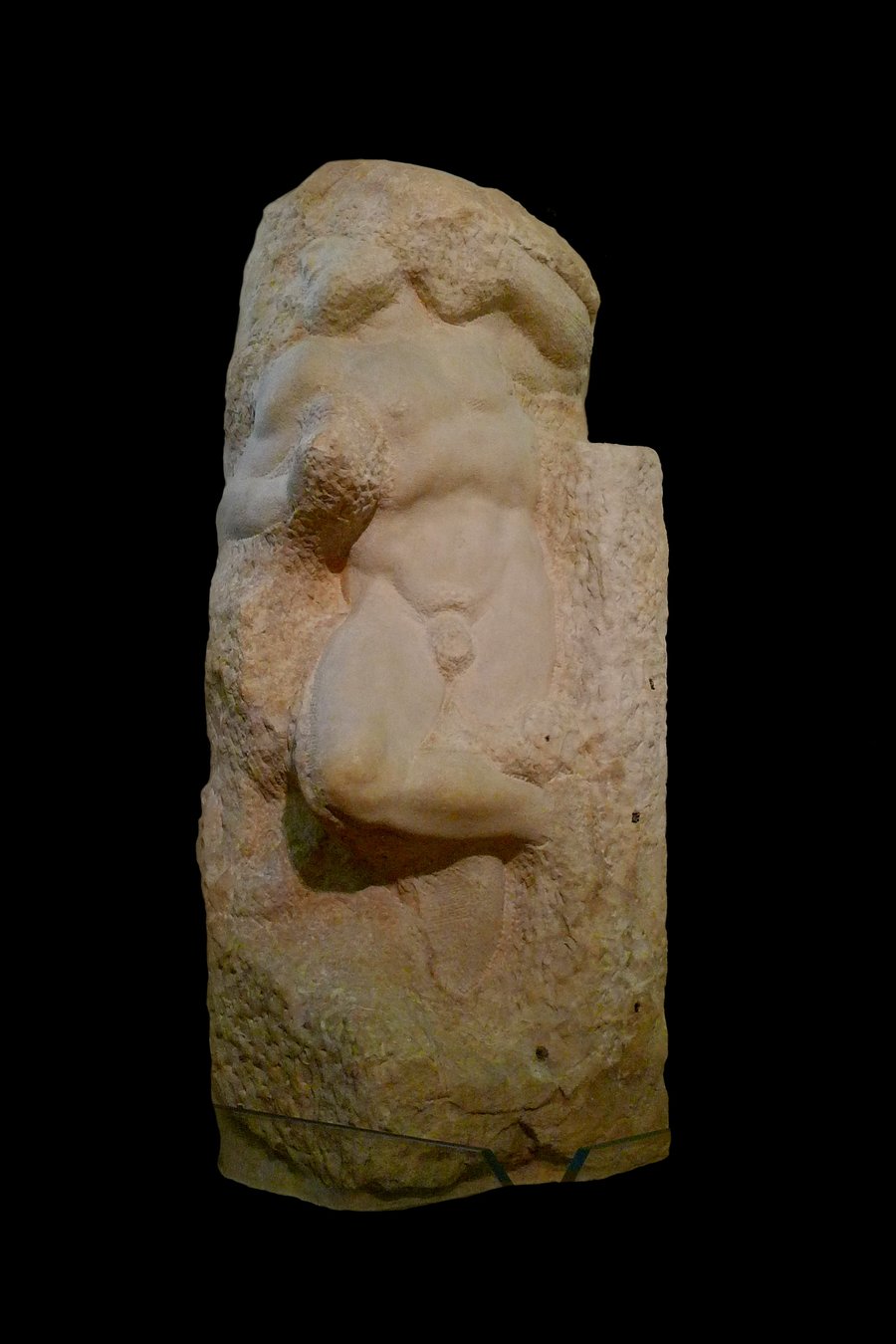
There is a particular friction that comes from looking at work that stops. Not work abandoned carelessly, but work halted at a point where the maker's hand is still visible in motion—where marble fades into rough stone and then back into stone, where a pencil contour floats without the paint it was waiting for. Michelangelo called this space of deliberate or enforced incompletion non finito, and Giorgio Vasari used the term in 1568 to describe statues that never reached their final surface.[1][2] What Vasari treated as a circumstantial fact about studio practice has since become something more demanding: a formal language in its own right, one that Cézanne and Klimt each extended into entirely different material fields.
1) Michelangelo's Prisoners: the body that will not clear the stone
The four marble figures known as the Prisoners or Slaves—Bearded Slave, Young Slave, Atlas Slave, Awakening Slave—have stood in the Galleria dell'Accademia in Florence since 1909.[1] Michelangelo carved them between roughly 1519 and 1534 for the tomb of Pope Julius II, a commission that went through decades of revision and was never completed to its original plan. The Prisoners were never delivered. They passed through Giorgio Vasari's hands and eventually into the Medici collection before arriving in Florence.
Looking at them—especially the Atlas and the Awakening Slave—the standard interpretive move is to read incompletion as metaphor: the figure struggling to emerge from the block, consciousness resisting matter, soul suspended in stone. That Neoplatonic reading has been attached to these works since the sixteenth century, and it is not wrong. But it risks turning a studio condition into a philosophical argument the works may not have been designed to make.[2][5]
What the Prisoners actually show is more concrete: a carving method. Michelangelo worked from the front plane of the block inward, releasing the figure progressively rather than roughing out the full form first. This means that in the unfinished areas, the stone is still carrying the form intact; the figure is not struggling through chaos but emerging from a calculated surface that the sculptor simply stopped excavating. The non finito here is a technical record as much as an aesthetic stance. It shows the tool marks, the transition from punched stone to carved surface, and the depth that was still to come.
The effect on the viewer is real regardless of origin. Rough stone reads as potential—as mass withheld, as time that did not run to completion. Whether that was intended by Michelangelo or retrospectively attached by Vasari and later interpreters does not diminish the visual argument the works now make.
2) Cézanne's late watercolors: the white ground that does work
Cézanne left hundreds of watercolors across his career, and many of the late ones—from the 1890s through to his death in 1906—contain large areas of unpainted paper.[3] The white ground is not a draft awaiting color. It is a structural and luminous element that Cézanne built his compositions around rather than filling over.
In these watercolors, patches of white hold planes in suspension. A few strokes of blue-green modulate a rock face; the paper between them reads as the light the rock reflects, or as the atmospheric space around the rock, or as both simultaneously. Cézanne was using the support as a color—not a neutral ground but an active participant in the chromatic system. The result is a form of non finito that operates differently from Michelangelo's: it is not a matter of work stopped short but of work where the decision to leave a surface unmarked is as considered as the decision to mark it.[3]
This changes what "unfinished" means. In Cézanne's practice, the visible ground is not evidence of incompletion but of restraint—a judgment that adding more paint would not improve the color argument being made. The white areas do not need filling; they are already doing the work that paint would otherwise do. The sensation of standing before one of these late watercolors—the lightness, the way mass seems to breathe around its edges—comes directly from that white working.
Later painters understood this. Cézanne's confidence with the unpainted support gave subsequent generations license to treat empty space as compositional decision rather than failure. That transmission runs through Cubism, through early abstraction, through watercolor-based practice in the postwar period.
3) Klimt's unfinished canvases: the pencil world underneath
When Klimt died in February 1918, several large canvases in his Vienna studio were unfinished. The Bride (c. 1917–18) and Lady with Fan (c. 1917–18) are among the most prominent: large formats in which areas of richly worked surface coexist with sections where only the pencil drawing remains, revealing the design stage that Klimt worked out in exacting detail before beginning to paint.[4]
These canvases show something the finished works do not: Klimt's structural foundation. His mature style—the gold-leaf application, the mosaic-like surface pattern, figures isolated from realistic spatial depth—reads in the finished works as a unified surface decision. In the unfinished canvases, it becomes possible to see that the ornamental and the figurative were being built in distinct operations, with the figure drawn first at high precision and the decorative field applied around it.[4]
The pencil drawings in the unfinished Klimt works are not preparatory sketches to be concealed. They are tight, finished contour drawings—hands, faces, and posture rendered with the care of finished portraiture. Around these drawn figures, the painted world was meant to accumulate in layers. Death stopped that accumulation, leaving the pencil world exposed.
This creates a different kind of non finito from Michelangelo's or Cézanne's. It is not a technique left visible or a support left exposed; it is a two-medium image in which the relationship between drawing and painting, normally invisible in the finished work, becomes the visual subject itself. The unfinished Klimts show how ornamental surface and psychological likeness were always two separate operations that the completed painting joined.
4) What the three cases share
Across stone, watercolor, and oil-on-canvas, non finito produces the same primary effect: it makes the viewer a participant in the completion of the work. When material stops short of resolution, the eye and mind continue the trajectory. The Prisoner's body completes its emergence in the imagination. The white ground in Cézanne reads as color, space, or both, depending on what the viewer projects. The pencil contour in Klimt closes a figure that paint never reached.
This participatory demand is not incidental—it is structurally built into the unfinished state. Non finito turns the object into a proposition: here is how far the work traveled; your perception takes it further. That proposition became more legible as twentieth-century art increasingly took viewer completion as a subject in its own right.
The three cases also share a technical transparency that finished work conceals. They reveal process—not as failure but as evidence—evidence of how Michelangelo carved inward through stone, how Cézanne thought about chromatic space without filling it, how Klimt sequenced his two-medium system. In each case, the unfinished state is more instructive than the finished one would have been.
5) Non finito as a model, not an accident
The history of reception matters here. Vasari was ambivalent about the Prisoners: he could describe their effect but treated their state as an accident of circumstance, not a choice to be emulated.[5] By the nineteenth century, Romantic aesthetics had made incompletion a positive value—the fragment, the ruin, the sketch were evidence of authentic creative effort rather than deficient studio practice.
Cézanne's late watercolors arrived alongside that reevaluation, and they gave it a technical rather than merely philosophical grounding. Here was an artist using incompletion as a compositional tool, not mourning a work left undone. The white ground was not a concession to time; it was a decision about color.
By the time Klimt's unfinished canvases were exhibited after his death, the interpretive ground had shifted enough that the pencil drawings could be read as a window into process—fascinating rather than embarrassing. What Vasari had tried to excuse, the twentieth century had learned to value as its own form of disclosure.
Non finito is now part of the Western art historical grammar. It marks the boundary between finish as social convention and finish as technical necessity, and it asks which of those two is actually required—and by whom.
Sources
- Galleria dell'Accademia di Firenze, "The Prisoners (Slaves) by Michelangelo."
- Wikipedia, "Non-finito."
- Heilbrunn Timeline of Art History, "Paul Cézanne (1839–1906)." The Metropolitan Museum of Art.
- Wikipedia, "Gustav Klimt."
- Giorgio Vasari, Lives of the Artists, trans. George Bull. Penguin Classics, 1987 — WorldCat record.