Mona Hatoum's art is strongest when the familiar refuses to stay harmless. A bed, a cot, a kitchen utensil, a locker, a map, a globe: these are not obscure materials. They belong to daily orientation, domestic work, shelter, and the ordinary grammar of rooms. Hatoum's move is to keep that recognition intact while changing the terms under it. The viewer still knows what the object is, but the object no longer promises what it used to promise.
That is why "home" in Hatoum's work rarely behaves like comfort. It behaves like an electrical system. The table might carry current. The child's cot might become a warning. The grater might enlarge into a divider. A glowing globe might stop looking like neutral geography and start looking like a network of alarm. Tate's 2016 survey described an expansive career across performance, video, sculpture, installation, photography, and works on paper, but its most useful summary is sharper: Hatoum challenges the languages of minimalism and surrealism to expose a world of conflict and contradiction.[1]
The biographical frame matters, but only if it does not flatten the work into illustration. Hatoum was born in Beirut in 1952 to Palestinian parents whose family had left Haifa after 1948. In 1975 she was visiting London when the Lebanese civil war broke out; stranded there, she stayed and studied art in Britain.[4] Those facts make displacement central, but they do not turn every object into a simple symbol of exile. Her art is more exact than that. It asks what displacement does to perception: how a room changes when belonging is uncertain, how a map changes when borders are lived rather than studied, how a household object changes when safety is no longer assumed.
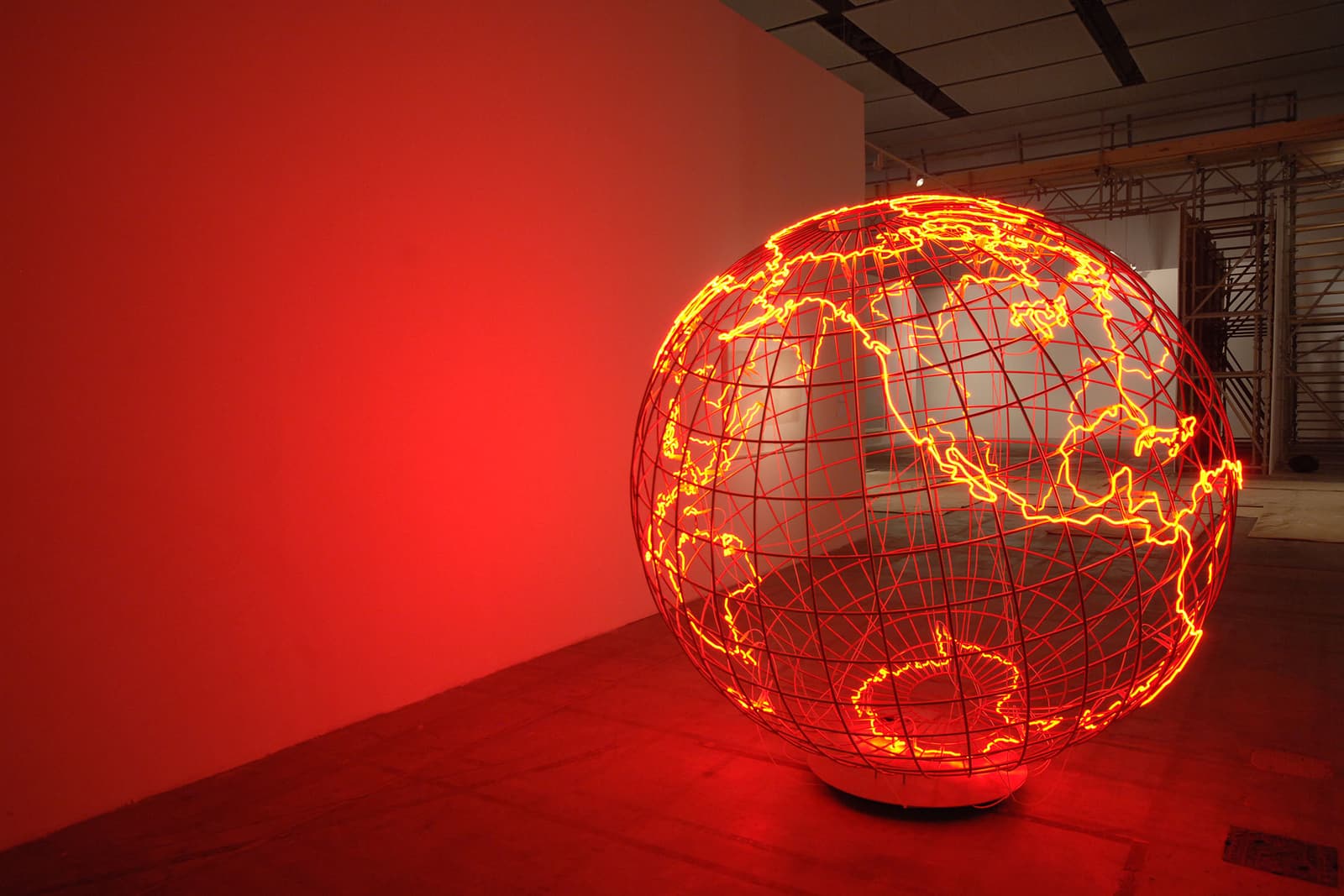
The image used here, a real installation photograph of Hot Spot, shows that logic at global scale.[5] A globe is supposed to orient the viewer. Hatoum's version glows red, its wire structure both descriptive and threatening. The world becomes a circuit, a cage, and a warning sign at once. It is not a diagram in the analytical sense; it is a photographed artwork that turns the clean abstraction of geography into bodily unease.
The Object Still Looks Useful
Hatoum's domestic objects disturb because they begin with use. The viewer recognizes them before the danger arrives. Tate's press material for the 2016 retrospective notes how furniture and familiar objects recur in her work, often modified or scaled up, to test the line between the familiar and the uncanny.[1] That line is the point. If the object became completely strange, the work would lose its pressure. It matters that the viewer first reads bed, table, grater, locker, or utensil.
Grater Divide makes this especially plain. The DACS artwork record identifies the 2002 piece as an installation in mild steel, 204 centimeters high, with variable width and depth.[3] The title's pun is almost too neat until the object does its physical work. A kitchen grater has been enlarged into a standing screen. What should be held in the hand now approaches the scale of furniture or barrier. The holes and cutting surfaces remain legible, but use has become threat.
That shift does not need a long explanatory caption to work. A grater already belongs to domestic labor, repetition, and the transformation of food by friction. Enlarged into a divider, it changes domestic scale into architectural scale. The household tool becomes a boundary. The hand-held surface becomes a wall. The object is still funny for a second, because the pun is visible, and then the joke hardens. Hatoum lets recognition and unease occupy the same instant.
This is why her relation to surrealism is practical rather than ornamental. She does not simply make dreamlike objects. She finds where ordinary objects already contain latent violence: the cut hidden inside the utensil, the confinement hidden inside furniture, the control hidden inside measured space. The surreal effect is not escape from reality. It is reality arriving through an object that has been made too honest.
Light Makes The Room Unreliable
Light Sentence is one of Hatoum's clearest works because it turns shadow into instability. Centre Pompidou's collection record lists the 1992 installation as wire mesh, electric motor, timer, light bulb, cables, and electrical wire, with variable dimensions.[2] Its detailed description notes thirty-six wire-mesh locker units arranged in a U shape, with a bulb whose slow movement projects shifting shadows and draws the viewer's own body into the work.[2]
The materials are blunt: lockers, mesh, bulb, motor. Nothing is luxurious. Yet the room becomes difficult to trust. A locker is a storage form, a school or workplace object, a modular unit of assigned space. Hatoum multiplies it, leaves it permeable, and then makes light move through it. The result is not one shadow but a whole nervous architecture of shadows. The gallery wall stops behaving like a stable backdrop. The viewer's body enters the moving grid and becomes part of the disturbance.
Tate's summary of Light Sentence emphasizes exactly this transformation: industrial wire-mesh lockers and a single moving bulb create shadows that make the gallery disorienting and unstable.[1] The phrase matters because instability is not only a subject of the work. It is the viewer's condition inside it. You do not merely understand that confinement, surveillance, or institutional order are themes. You feel the room stop supporting your assumptions about where you stand.
That is also why Hatoum's installations resist the clean authority of minimalism even when they borrow its forms. Repetition, grids, industrial units, and stripped-down materials are present. But instead of producing calm order, they produce unease. The grid does not rationalize the room. It flickers, traps, and implicates. Minimalism's cool object becomes a pressure system.
The Body Is Never Outside The System
Hatoum's work often begins from structures, but the body remains the measure. Tate's retrospective material connects her early performance and video work to a divided reality shaped by political and social control, and says the body has always been central to her practice.[1] That continuity matters. The later objects are not a retreat from bodily vulnerability into abstract sculpture. They are ways of making power act through space, furniture, electricity, and scale.
The Guardian interview usefully keeps the exile story concrete without overclosing it. It recounts Hatoum's Palestinian family history, her Beirut childhood, and the accident of being in London when war made return impossible.[4] It also records how she has lived with complicated identity rather than a single clean label.[4] That complication is visible in the art. The work does not offer a stable homeland image to compensate for loss. It makes instability itself the medium.
That is why maps and globes recur with such force. A map normally promises distance and management: borders reduced to lines, conflict converted into legible shape. In Hatoum's hands, mapped space becomes tactile, fragile, or electrically charged. Hot Spot does not let the globe remain a schoolroom object. Its red neon line makes the whole planet look overheated, exposed, and wired.[5] The world is not safely over there. It glows in the room.
The same logic applies to domestic interiors. Homebound, as Tate describes it, gathers kitchen utensils and household furniture connected by electric wire, with audible current running through the assemblage.[1] The title is perfect because it cuts in two directions. To be homebound can mean returning home, staying home, being confined at home, or being tied to the idea of home even when home is unsafe or unreachable. Hatoum turns that ambiguity into a circuit. Household things still sit in front of the viewer, but the current has changed their moral weather.
The Politics Are In The Materials
Hatoum's art can be called political, but the word is too weak if it means only that her work has political themes. The politics are in the material decisions. Wire mesh is not a neutral stand-in for control. It is a specific material that lets viewers see through confinement while still registering obstruction. Electricity is not only a metaphor for danger. It produces sound, light, dependence, shock, and the sense that contact has consequences. Enlarged steel is not only a visual joke. It changes a kitchen tool into a bodily obstacle.
This material precision keeps the work from becoming slogan art. The viewer is not asked to agree with an argument first and then admire an illustration. The viewer is asked to enter a room, recognize an object, feel the shift in scale or charge, and then understand why recognition has become uncomfortable. The argument arrives through use made unusable.
That is also why Hatoum's work has aged well. The conditions it studies - displacement, surveillance, household insecurity, borders, vulnerable bodies, unstable maps - have not softened. But the work does not depend on naming one crisis. It builds objects that let crisis enter perception as structure. A globe can be a warning system. A grater can be a partition. A locker can be a moving cage of light. A home can hum with danger.
The achievement is not that Hatoum makes ordinary things strange. Many artists do that. Her achievement is stricter: she makes ordinary things reveal the violence they were already capable of holding once the promise of safety breaks. Home, in her work, is not simply lost. It is rewired.
Sources
- Tate Modern, Mona Hatoum press release (May 3, 2016) - retrospective overview covering Hatoum's media, minimalism and surrealism, the body, Light Sentence, familiar objects, Homebound, and displacement.
- Centre Pompidou, "Mona Hatoum, Light Sentence" - collection record for the 1992 installation, including materials, acquisition, installation credits, and description of moving light and shadows.
- DACS Images, "Grater Divide, 2002 (ID: 17801) by Mona Hatoum" - artwork details for the mild-steel installation, dimensions, work type, and photo credit.
- Rachel Cooke, "Mona Hatoum: 'It's all luck. I feel things happen accidentally,'" The Guardian (April 17, 2016) - interview and biographical profile covering Beirut, Palestinian family history, London exile, and identity.
- Wikimedia Commons, "File:SB8 Hot Spot Mona Hatoum 1.jpg" - source page for the real installation photograph of Hatoum's Hot Spot used as this article's cover image.