Kintsugi is often flattened into a comforting sentence: breakage can become beauty. That is true as far as it goes, but it is too quick. The technique is not a poster about resilience pasted onto pottery. It is a slow material procedure in which lacquer, humidity, abrasion, metal powder, and judgment decide whether a damaged object can return with its history made legible.
That distinction matters because the gold is the part everyone sees, while the lacquer is the part that makes the repair possible. Britannica's technical account starts with the fundamentals: traditional kintsugi repairs ceramics with urushi, a natural lacquer, and a metal powder usually made from gold or silver.[2] The seams become beautiful because they have first become structurally persuasive. A crack is not merely highlighted. It is joined, filled, cured, cleaned, redrawn, and then brightened.
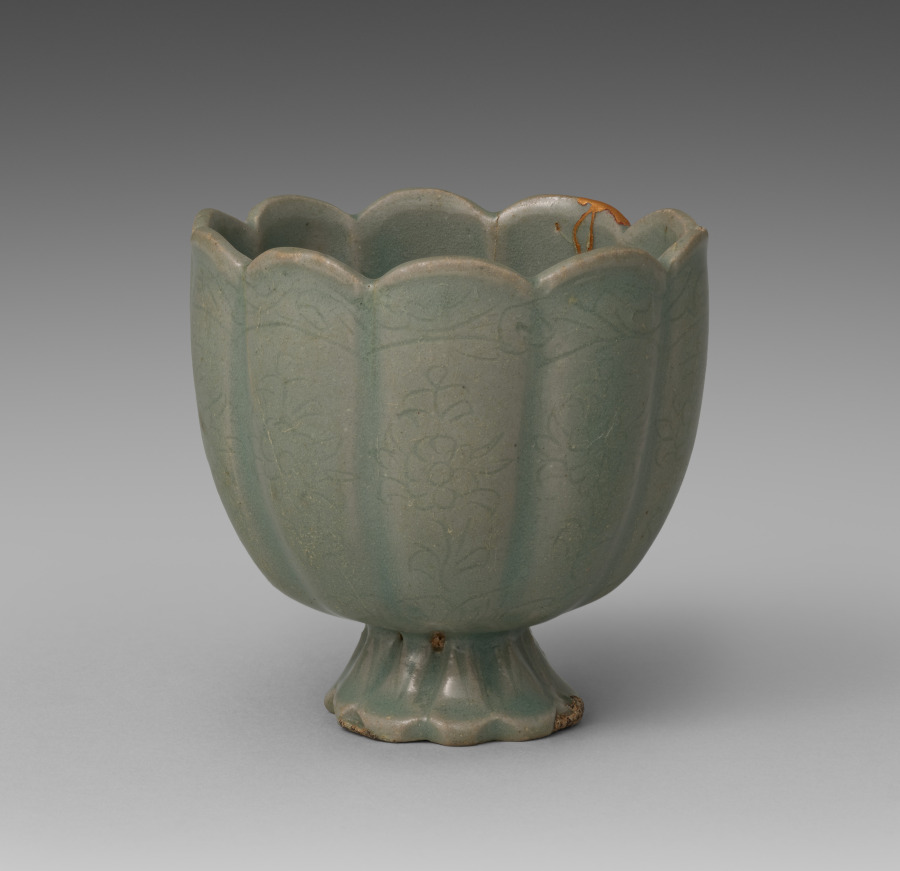
The Cleveland Museum of Art's Floral-shaped Cup with Incised Chrysanthemum Design is a useful small object for slowing the eye down. The cup itself is Korean, Goryeo dynasty, from the 1100s or 1200s, a pale celadon form with twelve lobes and incised floral decoration.[1] The kintsugi repair is not a huge lightning bolt across the body. It is a gold-colored mark on the upper rim, modest in scale but decisive in effect.[1] It turns damage at the lip into part of the cup's public surface.
Image context: the cover image is a real museum photograph of an actual repaired ceramic object, not a diagram, chart, generated visual, or symbolic stand-in. It belongs here because this article is about visible repair as material evidence: the rim, glaze, gold-colored join, and vessel shape all need to be seen together.[1][2]
The Repair Begins Before The Gold
The popular imagination jumps straight to the metallic seam. The craft sequence starts earlier and moves more slowly. In traditional practice, urushi is mixed with rice glue or flour glue to bind ceramic fragments, while missing areas can be rebuilt with a paste made from lacquer and filler.[2] The repaired object then has to cure under suitable conditions. Britannica notes that urushi requires special humidity and can take one to three months to harden in this process.[2] That waiting period is not decorative. It is part of the medium.
This makes kintsugi very different from a fast cosmetic fix. A quick glue repair tries to make the break disappear as efficiently as possible. Kintsugi asks whether the break can be stabilized and then given a new visible order. The artisan must decide where the join should be thin, where a chip needs a rebuilt edge, how much surface to abrade, and how the final line should sit against glaze, clay, and vessel profile.[2][3]
Japan House London's explanation is useful because it keeps the attention on urushi rather than treating gold as the whole story. It describes kintsugi as a Japanese repair technique that uses lacquer dusted with powdered gold to restore ceramics, and places it inside a longer culture of repair rather than a modern craft-kit shortcut.[3] The sequence is physical and ethical at once: preserve the object, but do not pretend nothing happened.
That is why the Cleveland cup feels so instructive.[1] The repair is small enough that a restorer could have tried to minimize it. Instead, the bright rim mark acknowledges the interruption. The cup remains a Goryeo celadon cup; the repair does not swallow its identity. But the repair becomes part of the object's biography, a later Japanese intervention on a Korean ceramic body.[1][2]
Gold Is A Line, Not A Disguise
Kintsugi's sharpest visual move is that it refuses the logic of camouflage. The final metal powder is applied over a prepared lacquer line, in a process related to maki-e, the Japanese lacquer technique of sprinkling or dusting metal powder onto wet lacquer.[2] This matters because the gold is not simply paint. It is a surface operation from lacquer culture brought to the problem of ceramic repair.
The result is neither pure restoration nor pure decoration. If the artisan hides too much, the object pretends to be unbroken. If the artisan overstates the seam, the repair can become a theatrical stripe detached from the vessel. Good kintsugi lives between those mistakes. It gives the damage enough visibility to matter, while letting the ceramic's original form, glaze, weight, and use remain in command.
On the Cleveland cup, that balance is especially quiet.[1] The celadon glaze still sets the emotional temperature: cool, pale, and rhythmic across the lobed form. The gold repair at the rim does not redesign the whole object. It changes the encounter at the most vulnerable place, the edge where hand, mouth, storage, and accident meet. The viewer reads a drinking vessel, then a damaged vessel, then a valued vessel whose damage justified care.
This is why kintsugi is an art of attention more than an art of sparkle. The line asks you to look at the exact site of breakage. It also asks you to compare different kinds of surface: fired glaze, exposed ceramic, lacquer, metal powder, and repaired contour.[1][2] The seam becomes a small index of decisions. How visible should repair be? How much past should an object carry forward? When does a practical mend become an aesthetic event?
Tea Culture Made Repair Aesthetic
The origin story is famously slippery. A common account links kintsugi to the late fifteenth-century shogun Ashikaga Yoshimasa, who supposedly disliked the metal-staple repair on a treasured Chinese tea bowl and prompted Japanese craftspeople to devise a more beautiful method.[2][3] The story should be handled carefully, because its documentary certainty is limited.[2] Its value is not that it gives a clean invention date. Its value is that it places kintsugi near tea utensils, connoisseurship, and the problem of how a repaired object should look.
Britannica connects the technique's spread to the period when Japanese tea ceremony developed, and to the aesthetics often summarized as wabi and sabi: value found in simplicity, age, imperfection, and impermanence.[2] That frame can become vague if treated as a mood word. In kintsugi, it becomes specific. A tea bowl is held, turned, seen at close range, and valued through use. A repair on such an object cannot hide in the background. It enters the ritual of handling.
The Smithsonian's National Museum of Asian Art object record for a Seto or Mino ware tea bowl shows how elaborate that life could become. The bowl has a bad break repaired with plain gold lacquer, and a rim chip replaced with lacquer carrying a gold cherry-blossom pattern.[4] That second move is important. Repair is not merely a line along a fracture; it can become a miniature pictorial decision. The missing edge is not denied. It is rebuilt as a site where lacquer skill and tea-object value meet.[4]
Seen beside that tea bowl, the Cleveland cup's modest rim repair looks less like a minor patch and more like a member of a larger visual language.[1][4] Kintsugi could travel across objects from Japan, Korea, China, and Vietnam, marking foreign ceramics with a Japanese repair practice.[2] The repaired object therefore often carries more than one geography. Clay, glaze, collecting, breakage, and repair may belong to different moments and places.
Visible Repair Changes Authorship
One reason kintsugi remains compelling is that it complicates authorship without erasing it. The original potter made the vessel. Time or accident broke it. A later artisan repaired it. A collector, tea practitioner, or institution preserved it. The final object is not reducible to any one of those hands.
That layered authorship is clear in the Cleveland cup. The body is Goryeo celadon, a Korean ceramic tradition associated with refined glaze and burial goods.[1] The repair is Japanese kintsugi, a later intervention that adds gold-colored emphasis to a damaged edge.[1][2] The museum object now asks the viewer to hold both facts at once. To look only at the cup's original dynasty is to miss the repair. To look only at the repair is to miss the ceramic body that made the repair worth doing.
This is the deeper reason kintsugi should not be reduced to metaphor. A metaphor can be applied to anything. A technique has limits. Traditional kintsugi depends on particular materials, curing conditions, hand skills, and surface decisions.[2][3] It belongs to ceramics and lacquer before it belongs to self-help language. Its emotional force comes from that specificity.
The repaired seam is beautiful because it is constrained. It cannot simply declare that damage is good. Some damage destroys an object. Some repairs fail. Some modern substitutions imitate the look without the urushi logic that gives the old method its material depth.[2][3] Kintsugi's strongest claim is narrower and more interesting: when an object is worth saving, repair can become part of its visible truth.
The Object Returns, But Not As Before
Kintsugi's final power lies in refusing two easy endings. It does not restore the object to an imaginary untouched past. It also does not let breakage have the last word. The repaired vessel comes back altered, not falsified.
That is what the gold line accomplishes when it is handled well. It is not a scar in the sentimental sense, and it is not a luxury accent in the shallow sense. It is evidence of a second making. The ceramic was formed and fired once; after damage, it entered another process of joining, curing, surface preparation, and metal-dusted finish.[2][3] The repaired object therefore contains more time than an unbroken one.
The Cleveland cup's rim repair makes that time visible in a restrained way.[1] You do not need a dramatic break for kintsugi to change the reading of a vessel. A small gold mark at the edge is enough to shift the cup from intact form to lived form. It tells the eye that the object has passed through use, accident, care, and renewed display.
That is why kintsugi still matters as art. It makes repair neither shameful nor triumphant. It makes repair precise. The gold catches attention, but the lacquer carries the argument: damaged things do not become meaningful because damage is automatically beautiful. They become meaningful when someone has the skill, patience, and judgment to make continued life visible.
Sources
- Cleveland Museum of Art, "Floral-shaped Cup with Incised Chrysanthemum Design" - object record for the Goryeo celadon cup used as the cover image, including the gold-colored kintsugi repair on the rim.
- Encyclopaedia Britannica, "Kintsugi" - technical and historical overview of urushi lacquer, metal powder, curing, maki-e relation, tea culture, and the Ashikaga Yoshimasa origin story's uncertainty.
- Japan House London, "Kintsugi: Japanese Repair Technique" - institutional explanation of kintsugi as lacquer-and-gold ceramic repair and its contemporary craft context.
- Smithsonian National Museum of Asian Art, "Seto or Mino ware tea bowl" - object record describing gold lacquer repair and a rim chip replaced with lacquer bearing a gold cherry-blossom pattern.