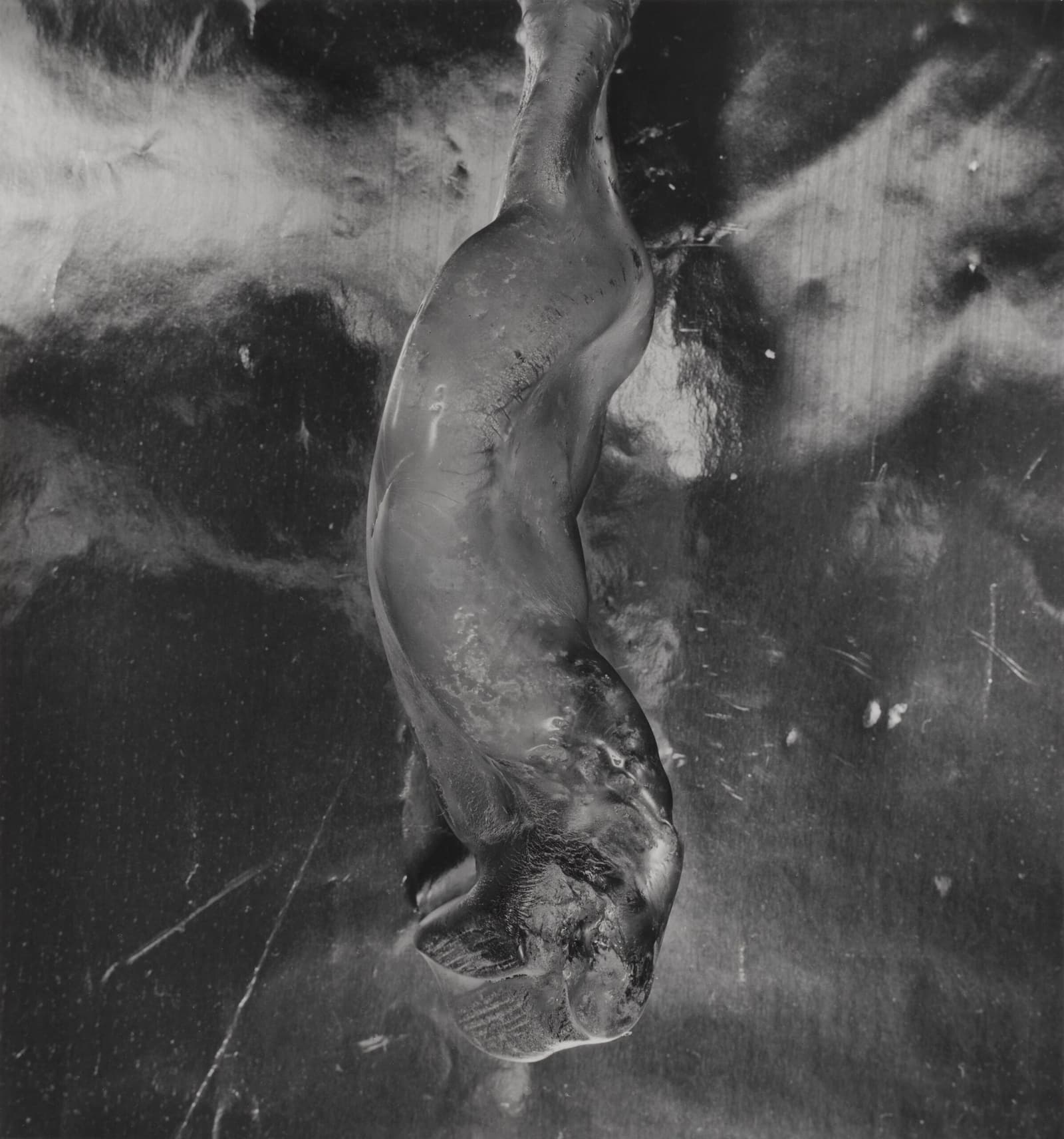
Shomei Tomatsu's photograph of a bottle melted by the Nagasaki atomic bomb is hard to name cleanly. The object is glass, but it looks almost fleshy. It is documentary evidence, but it refuses the dry stability of an exhibit label. It is a memorial image, but it does not behave like a finished monument. In the 1961 gelatin silver print held by SFMOMA, the bottle appears against a dark ground, twisted into a mass that seems to have survived by losing the ordinary grammar of a bottle: neck, body, base, use.[1]
That instability is the point. Tomatsu does not show the mushroom cloud, a ruined skyline, or a human body. He shows an object that was altered by heat, radiation, and fire, then preserved and photographed after the fact.[1] The photograph's force comes from delayed violence. We are not watching destruction happen. We are looking at a thing that destruction has already passed through, a remainder that keeps the event materially present without pretending to show the event itself.
Image context: the lead image is a real photographic artwork reproduced from SFMOMA's object record, not a diagram, chart, or generated visual. It fits this post because Tomatsu's argument is carried by the photograph's factual surface: damaged glass, black-and-white tone, studio-like isolation, and the uneasy conversion of a museum relic into an image that still feels physically unsettled.[1]
The object will not stay an object
SFMOMA's artwork record is plain about the photograph's facts: Bottle Melted and Deformed by Atomic Bomb Heat, Radiation, and Fire, Nagasaki was made in 1961, classified as a photograph, and printed as a gelatin silver print.[1] That plainness matters because the picture itself keeps pushing against plain description. A bottle should be an ordinary container, a manufactured object designed for repetition. Tomatsu presents one that has been forced out of repeatability. It can no longer hold liquid, sit upright, or disappear into daily use. It has become singular through damage.
The photograph sharpens that singularity by isolating the bottle. There is no street, no display case, no hand, no caption inside the frame to stabilize it. The viewer meets the thing almost as a body fragment. Its folds and contractions make it look wounded, but Tomatsu never lets that bodily association become literal. He keeps the object just enough like glass that metaphor remains uncomfortable. The bottle does not stand in for a victim in a simple symbolic exchange. It shows how extreme violence can make matter itself look injured.
That distinction keeps the photograph from turning sentimental. Tomatsu does not ask the viewer to admire survival or to consume devastation as pathos. The object is too strange for that. Its surface feels at once hardened and soft-looking, mineral and animal, dead and active. The photograph's close reading begins there: the image forces the viewer to sit with an object that has become expressive without having a face.
Nagasaki as stopped and ongoing time
The work belongs to Tomatsu's larger Nagasaki project, and that context changes the stakes. Princeton's record for a related Tomatsu portrait describes Nagasaki 11:02 as his best-known series and emphasizes that he documented people who survived the atomic blast of August 9, 1945.[2] The series title itself fixes attention on the stopped time of the bombing, while the photographs keep showing what came after that instant: scar tissue, damaged objects, memory, and ordinary life forced to continue.[2][5]
The bottle makes that duration visible in an especially compact way. The event that changed it was sudden. The object that remains is slow. The viewer encounters the bomb through a survivor of heat rather than through an image of blast. In that sense, the photograph works against the clean historical habits that convert catastrophe into a dated event. The date matters, but Tomatsu's picture insists that the aftermath did not end when the explosion ended.[2][5]
That is why the photograph is not simply a relic study. It belongs to a visual argument about a city trying to live after an event that could not be absorbed by reconstruction alone. A related Philadelphia Museum of Art record for Tomatsu's stopped-wristwatch image places that work in the same Nagasaki time field: a watch halted at 11:02, photographed in 1961, printed later, and preserved as a gelatin silver print.[6] The watch makes time literal. The bottle makes time material.
Beyond reportage
Tomatsu's importance in postwar Japanese photography rests partly on his refusal to let documentary language stay neutral. SFMOMA's Skin of the Nation exhibition described him as a central figure in Japanese postwar photography and framed the retrospective around the aftereffects of Nagasaki, the influence of American military and popular culture, and Japan's later economic boom.[3] A later Fundacion MAPFRE dossier likewise presents his work as spanning the key events of postwar Japan, from American bases and Nagasaki to later transformations in Japanese society.[4]
The melted bottle sits at the heart of that practice because it is documentary and anti-documentary at once. It records a real damaged object. It gives enough information to keep the referent clear. Yet the image is not content to function as neutral evidence. The lighting, cropping, tonal density, and isolation make the bottle visually aggressive. It seems to push out of classification.
That is why the photograph remains more disturbing than many explicit images of ruin. Ruins often announce themselves as ruins. This bottle resists category. It looks like a specimen, but also like an animal, a mask, a failed organ, a fossil from modern war. The image does not become surreal by escaping history. It becomes surreal because history has made ordinary matter look impossible.
The Art Platform Japan record for a work from 11:02 Nagasaki gives the series another kind of institutional grounding: artist, title, year, medium, dimensions, collection, and accession history.[5] That catalog precision is useful because Tomatsu's photographs keep moving beyond catalog precision. The bottle does not narrate the bombing. It lets a damaged object pull several meanings into one field: physical evidence, bodily analogy, museum relic, technological horror, and the stubborn opacity of survival.
The bottle as anti-monument
The temptation with a famous war image is to stabilize it too quickly: this means destruction, this means memory, this means never again. Tomatsu's photograph deserves those moral horizons, but it is stronger because it does not flatten itself into them. The bottle does not become a clean emblem. It remains awkward, misshapen, and hard to look at for long.
That awkwardness is an anti-monumental quality. A monument usually organizes attention upward or outward. It gives public grief a form that can be visited, named, and ritually contained. Tomatsu's bottle works in the opposite direction. It pulls attention down to a small damaged thing and makes scale feel wrong. The atomic bomb was vast; the photograph is intimate. The event was historical; the object is tactile. The destruction was collective; the bottle is almost private in its deformation.
This reversal is not a retreat from history. It is a way of making history harder to abstract. The photograph says that catastrophe can survive inside small things, and that small things can refuse the soothing distance of large historical language. When the viewer studies the bottle's warped form, the bomb is not only a geopolitical fact or a moral lesson. It is a pressure that changed the behavior of matter.
Why the image still unsettles
Tomatsu's photograph still feels alive because it does not solve the relation between beauty and horror. The print is formally powerful. Its dark tonal field, concentrated object, and sculptural volume make it compelling as an image. But that formal power is morally uneasy. The photograph is beautiful only if beauty is understood as intensity, not consolation.
That unease is central to Tomatsu's achievement. He makes the viewer look carefully without offering the comfort of mastery. Looking does not repair the object. It does not complete the mourning. It does not turn Nagasaki into a single lesson. Instead, the image trains attention on the stubborn residue of an event that resists closure.[2][3]
The melted bottle also clarifies why Tomatsu mattered beyond one famous photograph. His postwar Japan was not a stable subject waiting to be documented. It was a field of aftereffects, occupations, imports, urban changes, memories, and surfaces that often contradicted one another.[3][4][5] The bottle is a small object, but it teaches the larger method: photograph the trace where history has entered matter, then let the trace remain difficult.
That is the reason the image does not age into mere archive. It still asks the viewer to accept an uncomfortable double fact. The bottle is only a bottle. The bottle is not only a bottle. Tomatsu's photograph holds both truths in one black-and-white field, and refuses to let either one cancel the other.
Sources
- San Francisco Museum of Modern Art, "Shomei Tomatsu, Bottle Melted and Deformed by Atomic Bomb Heat, Radiation, and Fire, Nagasaki, 1961" - artwork record with image source, date, medium, dimensions, and collection details.
- Princeton University Art Museum, "Nagasaki" - object record for a related Tomatsu portrait from Nagasaki 11:02, with note on survivors, the August 9, 1945 blast, and continuing physical and psychological pain.
- San Francisco Museum of Modern Art, "Shomei Tomatsu: Skin of the Nation" - exhibition page on Tomatsu's postwar photography, Nagasaki aftermath, U.S. military and popular culture, and Japan's economic boom.
- Fundacion MAPFRE, "Shomei Tomatsu" - exhibition dossier on Tomatsu's biography, postwar Japanese subjects, American bases, Nagasaki work, and broader photographic career.
- Art Platform Japan, "TOMATSU, Shomei, 11:02 NAGASAKI (1966)" - collection record for a gelatin silver print from the series, with title, year, medium, dimensions, and Yamaguchi Prefectural Art Museum source data.
- Philadelphia Museum of Art, "Time Stopped at 11:02, 1945, Nagasaki" - collection record for Tomatsu's 1961 stopped-wristwatch photograph from the Nagasaki series.