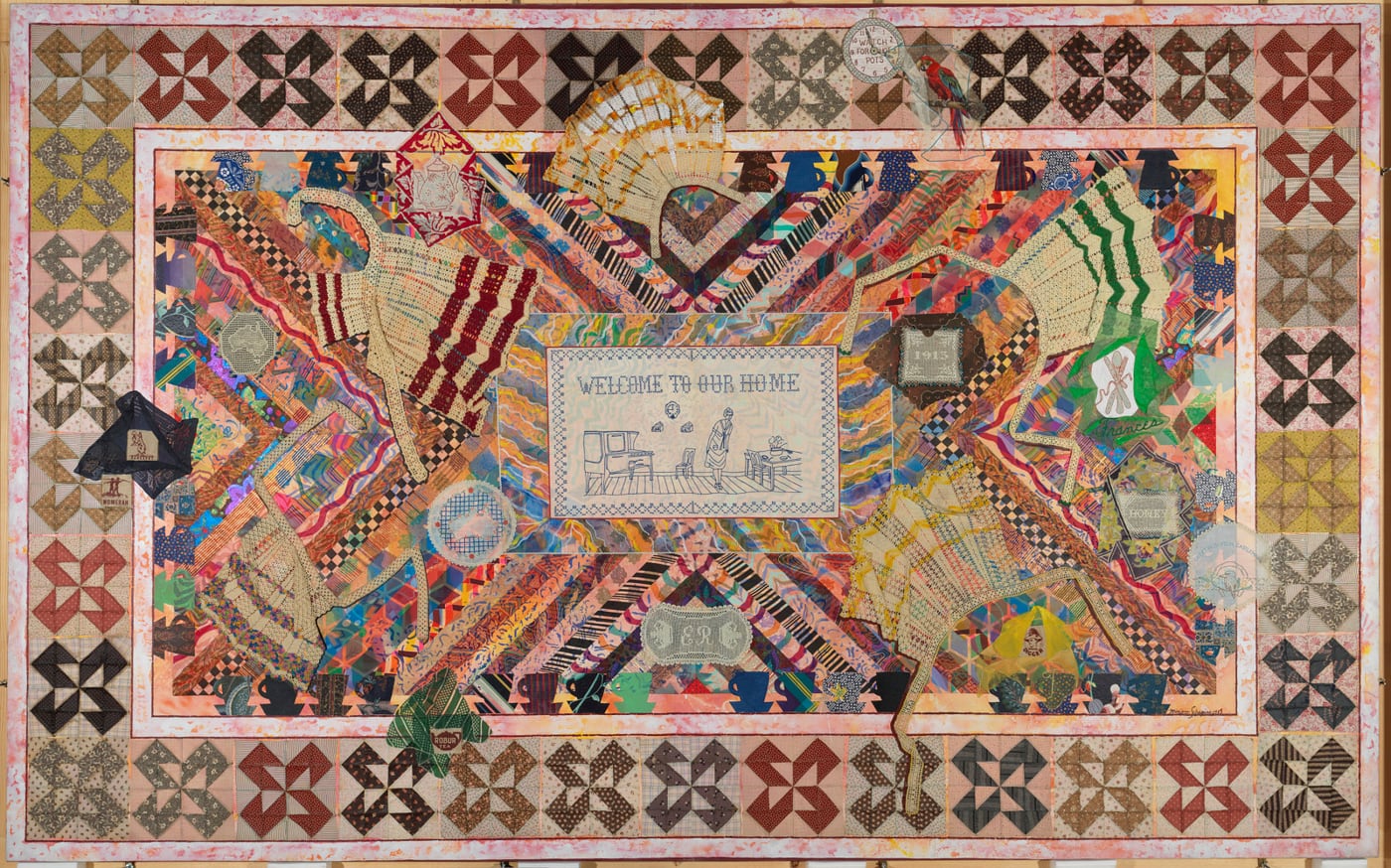
Image context: this post uses a real museum photograph of Miriam Schapiro's 1983 Wonderland from the Smithsonian American Art Museum, not a generated visual, diagram, or chart. The image matters because femmage has to be seen as material logic: the quilt-block border, aprons, teacups, fans, embroidery, plastic beads, painted fields, and central domestic scene all participate in the work's structure.[1]
Miriam Schapiro's femmages can look exuberant before they look rigorous. That first impression is part of their power. A viewer meets color, fabric, beads, quilt blocks, teacups, hearts, flowers, fans, aprons, and domestic fragments, then has to decide whether to treat them as decoration or as a serious pictorial system. Schapiro's answer was that the distinction had already been rigged. The materials historically dismissed as "women's work" were not weaker than modernist collage. They were one of collage's suppressed histories.[2][3]
That is why femmage is best understood as a technique, not just a feminist theme. Schapiro did not simply paste domestic signs onto painting to make a political point. She made saving, cutting, piecing, applique, stitching, layering, framing, and display into the grammar of the work. In Wonderland, the Smithsonian's object record identifies acrylic, fabric, and plastic beads on a canvas more than twelve feet wide; the domestic imagery is not small-scale sentiment smuggled into a painting, but an enormous field that reorganizes what counts as composition.[1]
The technical claim is blunt: femmage makes inherited material do structural work. A scrap is not only a symbol of home. A quilt block is not only a reference to craft. A border is not only a pretty edge. Each one changes how the surface holds attention, how memory enters form, and how a viewer reads value.
The Method Begins With What Was Saved
Schapiro and Melissa Meyer gave femmage its theoretical pressure in their 1977-78 essay "Waste Not Want Not: An Inquiry into What Women Saved and Assembled." The essay defines femmage through activities historically practiced by women with techniques such as sewing, piecing, cutting, applique, cooking, and related forms of assembly.[2] The point was not to invent a decorative brand. It was to name a long practice of making from saved things, personal materials, and domestic labor that art history had kept outside its heroic story of modern collage.
That corrective still bites because the standard collage origin story is so tidy. Picasso and Braque enter, paper fragments enter painting, and modernism learns to treat the surface as an assembled field. Schapiro and Meyer argued that the story becomes misleading when it ignores scrapbooks, quilts, cut paper, albums, valentines, needlework, and other forms of women's material culture that also depended on selection, attachment, layering, and memory.[2] Femmage therefore does more than add women to an existing canon. It forces the canon's technical terms to widen.
This is where the medium becomes exact. A saved fragment carries time differently from a painted mark. It arrives with prior use, touch, pattern, and memory already attached. When Schapiro folds it into a canvas, she does not erase that earlier life. She lets it press against abstraction. The resulting surface is neither pure painting nor simple craft display. It is a negotiated field where material history and formal arrangement remain visible at the same time.[1][2]
Collage Stops Pretending To Be Neutral
The National Museum of Women in the Arts describes Schapiro as a founding figure in Pattern and Decoration and notes that she used decorative conventions tied to quilting, embroidery, and applique to recover and elevate the work of women artisans of the past.[3] That description matters because it frames femmage as a recovery operation with formal consequences. Schapiro was not asking for domestic materials to be admired politely. She was asking them to change painting's operating system.
In a conventional hierarchy, painting owns composition, while fabric, pattern, lace, and ornament supply secondary surface pleasure. Femmage scrambles that chain. The patterned fabric can set rhythm. The border can behave like architecture. The stitched or collaged object can interrupt the painted field with a different kind of authority. The work's logic depends on the coexistence of incompatible value systems: museum painting, vernacular making, family memory, feminist critique, and the tactile knowledge of domestic craft.[3][4]
NMWA's discussion of Mechano/Flower Fan gives a compact example. The 1979 work combines acrylic and fabric collage on paper and uses the fan, an object strongly associated with women across cultures, as a site of bright color, geometric planes, and historical argument.[4] The fan is not simply a motif. It is a format that opens and spreads. Its shape lets Schapiro turn a gendered object into a compositional engine. The object that might have signaled demureness becomes a hinged field of assertion.[4]
That is the same move at a larger scale in Wonderland. The Smithsonian's description emphasizes the embroidered woman inside a home, surrounded by quilt blocks, aprons, and cutouts of teacups, and reads the work as a challenge to sexist dismissals of sentimentality and domestic creativity.[1] The strongest part of that challenge is technical. Schapiro does not hide the domestic signs in the name of seriousness. She enlarges them until the old accusation, that they are too decorative, becomes evidence of how much visual labor decoration can carry.
Scale Makes Sentiment Harder To Dismiss
One reason Schapiro's femmages resist condescension is scale. Wonderland measures 90 by 144 1/2 inches, according to the Smithsonian record.[1] That is not a modest keepsake format. It is a public wall-sized object with domestic imagery made large enough to confront the viewer physically. Sentiment does not disappear at that size; it becomes harder to patronize.
Brooklyn Museum's Tapestry of Paradise entry makes the same case through another work. The museum describes Schapiro as a trailblazing feminist artist who established the Feminist Art Program at CalArts with Judy Chicago in 1971, founded the Pattern and Decoration movement in 1976, and wrote the influential femmage text with Meyer.[5] In Tapestry of Paradise, Brooklyn reads the dense acrylic-and-collage surface as femmage made accumulative and large against an art history that had diminished women's achievements.[5]
The word "accumulative" is useful because femmage does not seek the purified authority of a single decisive gesture. It builds by gathering. One fabric fragment meets another; one border answers another; one inherited sign presses against one painted shape. The work's force comes from accumulation that refuses to become clutter. Schapiro's best surfaces are busy, but they are not careless. They turn fullness into method.
That fullness was also historically timed. The Yale University Press page for With Pleasure: Pattern and Decoration in American Art 1972-1985 describes the movement as a 1970s embrace of long-dismissed decorative forms and notes its use of media ranging from painting and collage to ceramics, sculpture, installation, and performance documentation.[6] Schapiro's femmage sits inside that broader challenge to postwar austerity. Against cool reduction, she offered heat, excess, fabric, pattern, and inheritance. Against the idea that ornament weakened seriousness, she made ornament carry seriousness.
The Border Is Not The Edge
Schapiro's borders are especially important. They can look like frames, but they rarely behave as neutral edges. In Wonderland, the quilt-block border is a major organizing device: repeated units create a rhythm that surrounds and stabilizes the more turbulent interior.[1] It does what borders in domestic textiles often do. It marks a threshold, announces care, and gives the field a social edge.
That matters because modernist painting often treated the frame as something to overcome or ignore. Femmage treats the edge as loaded. A border can remember quilting. It can invoke the labor of finishing and binding. It can turn a painting into something closer to a coverlet, banner, shrine, album, or household object without letting it stop being a painting. The edge becomes an argument about where art begins and where domestic culture supposedly ends.
The center of Wonderland sharpens that argument. The embroidered image and words welcome the viewer into a home, while the surrounding field keeps moving outward through fans, aprons, teacups, patchwork, and colorful scraps.[1] The home is not a closed private interior. It becomes a pictorial generator. Schapiro turns the domestic center into a centrifugal force that throws pattern across the canvas.
That is why femmage should not be reduced to a reclamation of craft alone. It is also a theory of space. It asks whether a painting can hold a room, a memory, a textile history, a set of inherited gestures, and a critique of the museum wall all at once. Schapiro's answer is yes, but only if the surface stops pretending to be neutral.
Technique As Art-Historical Repair
The Museum of Arts and Design's Surface/Depth exhibition page describes Schapiro's signature femmages as a hybrid of painting and collage inspired by women's domestic arts and crafts, and argues that the works helped expand the art world to include marginalized forms of craft, decoration, and abstract patterning associated with femininity and women's work.[7] That institutional language is useful because it names what the technique repairs. Femmage does not merely represent neglected labor. It changes the status of the labor inside the artwork.
This repair has limits, and Schapiro's work is stronger when those limits remain visible. A museum can honor a femmage, but it cannot fully restore the anonymous makers whose saved scraps, quilts, albums, and household objects were long ignored. A painting can cite domestic practice, but it cannot become the entire history of domestic practice. Schapiro's achievement is not that she solved those asymmetries. It is that she made them impossible to ignore at the level of material structure.[2][3][7]
That is why the work still feels contemporary. In a culture that constantly turns craft, care, and domestic labor into aesthetic mood boards, femmage insists on a harder question: who gets credited when material intelligence enters art? Schapiro's surfaces are beautiful, but they do not let beauty become amnesia. Every decorative element asks to be read as work, memory, selection, and claim.[1][2][5]
The best way to look at Wonderland is therefore not to ask where painting ends and craft begins. The better question is what becomes visible once that boundary stops governing the eye. Schapiro made femmage by refusing to treat fabric, beads, patterns, and domestic signs as supplements to art. She made them the structure. The result is not decoration added to a canvas. It is a canvas taught to remember what decoration had been made to hide.
Sources
- Smithsonian American Art Museum, "Miriam Schapiro, Wonderland" - object page for the 1983 acrylic, fabric, and plastic beads on canvas used as the article image.
- Melissa Meyer and Miriam Schapiro, "Waste Not Want Not: An Inquiry into What Women Saved and Assembled--FEMMAGE," Heresies 1, no. 4 (1977-78), hosted by LEAF at Bucknell.
- National Museum of Women in the Arts, "Miriam Schapiro" - artist profile on Pattern and Decoration, quilting, embroidery, applique, and the term femmage.
- National Museum of Women in the Arts, "Miriam Schapiro: Feminist and 'Femmagist'" - museum essay on Womanhouse, femmage, Mechano/Flower Fan, and Schapiro's use of textiles, paper, and painting.
- Brooklyn Museum, "Miriam Schapiro, Tapestry of Paradise" - object page on the Feminist Art Program, Pattern and Decoration, femmage, and the work's accumulative acrylic-and-collage surface.
- Yale University Press, With Pleasure: Pattern and Decoration in American Art 1972-1985 - publisher page for the MOCA/Yale volume on Pattern and Decoration, feminist methods, and Schapiro's femmage practice.
- Museum of Arts and Design, "Surface/Depth: The Decorative After Miriam Schapiro" - exhibition page on Schapiro's femmages and their role in reframing craft, decoration, and abstract patterning.