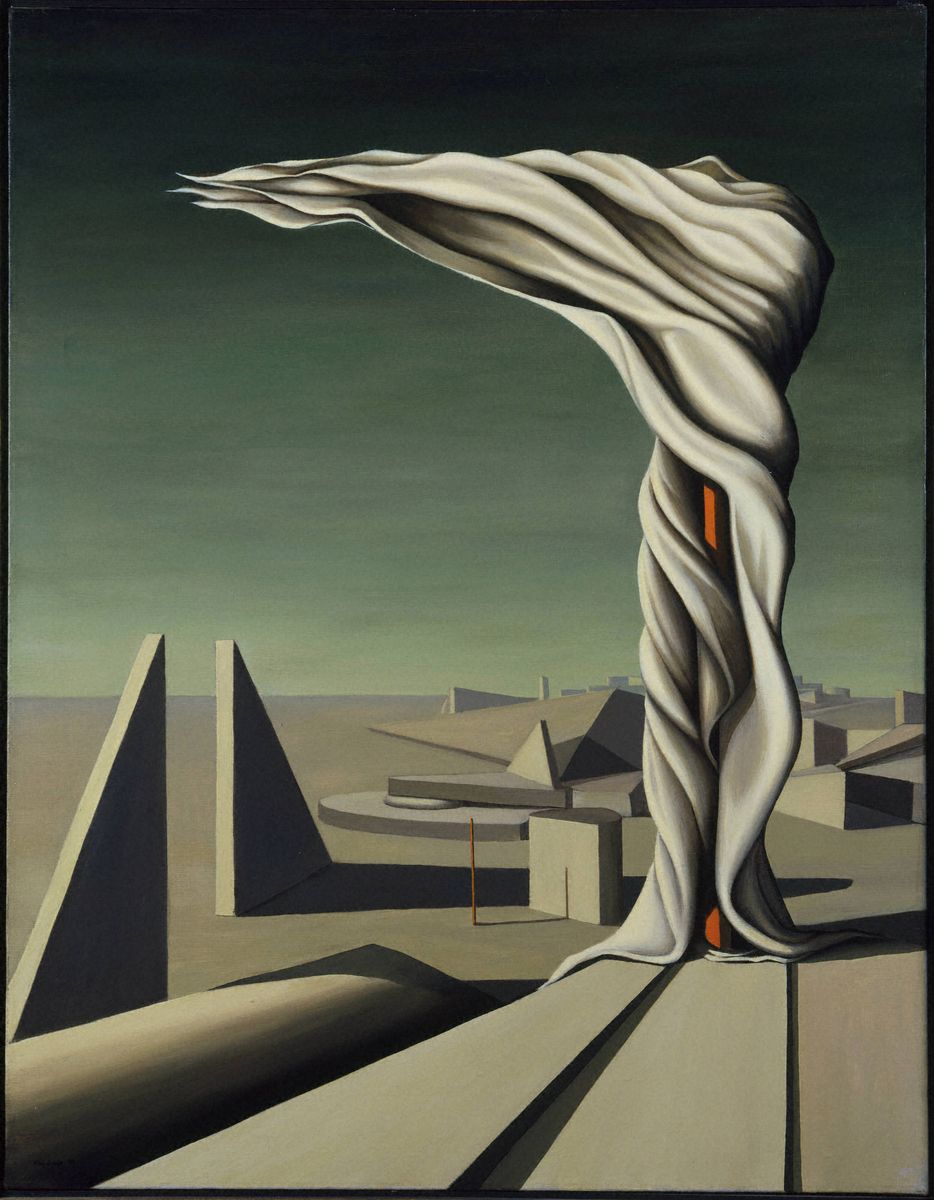
Image context: this post uses a real museum image of Kay Sage's 1944 I Saw Three Cities from Princeton University Art Museum, not a generated visual, diagram, or abstract placeholder. The image is the article's central evidence: Sage's painting makes a body, a ruin, a city, and a dream landscape occupy the same severe air.[1]
Kay Sage's I Saw Three Cities is a city painting that withholds the city. The title promises urban multiplicity, but the eye first meets a single pale figure, a hard foreground ledge, two slab-like forms, and a distance where buildings have thinned into fragments. Nothing moves. Nothing explains itself. The scene looks built and abandoned at once, as if architecture had survived the people who gave it a use.
That is the painting's tension. Sage does not make Surrealism erupt through soft fantasy. She makes it arrive through precision. Princeton identifies the work as a 1944 oil on canvas and places its central form in relation to Nike of Samothrace while also stressing its uncanny, neither-alive-nor-dead presence.[1] The comparison helps, but only if it is handled carefully. Sage's figure has the sweep of classical drapery, yet it does not lift into victory. It bends, leans, and stands guard over a terrain where triumph has become impossible to locate.
The Guardian Has No Body To Protect
The draped form dominates the painting, but it is hard to call it a person. It has the upright scale of a statue, the folds of fabric, and a dark vertical interior punctured by orange openings. It could be a monument, a machine, a wrapped figure, or the remnant of a winged body after the body itself has disappeared. Princeton's record names this ambiguity directly: the form recalls Nike, yet lacks the old statue's buoyant force.[1]
The difference is crucial. Nike of Samothrace once made motion feel victorious: wind, ship, body, and forward force fused into a public image of arrival. Sage keeps the wind-like drapery but removes the public certainty. Her guardian does not announce conquest. It faces left, away from the scattered city behind it, while the long horizontal fold extends like a warning arm or a flag that has forgotten its nation.
This is where the painting becomes more than a dream image. A guardian normally implies a threshold worth defending. Here, the threshold is almost empty. The foreground platform, the deep black shadows, and the broken geometry behind the figure suggest a civilization reduced to surfaces, ramps, walls, and distances. The sentinel stands, but the protected world has either not yet arrived or has already gone.
Architecture Does The Psychological Work
Sage is often described through architectural motifs, and I Saw Three Cities shows why that shorthand is useful but not enough. Whitney's artist page describes her as an American Surrealist and poet whose work is strongly associated with architectural themes.[2] NMWA similarly emphasizes her abstract architectural motifs, sharp edges, invisible brushwork, and landscapes of isolation.[4] In this painting, those traits are not background style. They are the mechanism.
The architecture is persuasive because it is so clean. The blocks, ramps, disks, and distant verticals seem measurable. Shadows fall with a dry, almost engineering precision. But the space they create is not habitable. There are no doors one could safely enter, no windows with social life behind them, no street that promises ordinary movement. The built forms behave like grammar after language has failed: straight lines remain, but speech has gone.
That explains the strange calm of the surface. Sage's brushwork does not advertise emotion. It makes emotion structural. The abandoned feeling comes from scale, intervals, and blocked movement. The foreground ledge pushes the viewer toward the guardian but also bars entry. The two slab forms on the left resemble open walls or a split pylon, yet their black interior shadow feels less like passage than stoppage. The circular platform in the middle distance promises order, then leads nowhere.
Exile Enters As Atmosphere
The painting's date matters. By 1944, Sage had left Europe, reached the United States with Yves Tanguy, and was working in the wartime Surrealist diaspora. A Hollis Taggart notice for Williams College Museum of Art's Kay Sage: Serene Surrealist summarizes her later 1950 Catherine Viviano Gallery exhibition, while Princeton notes that she helped French artists reach the United States after the outbreak of the war.[1][3]
That context should not turn I Saw Three Cities into an illustration of exile. The painting is stronger than that. It does not show ships, refugees, passports, or a recognizable destroyed city. It makes displacement atmospheric. Cities are present as distant facts, not destinations. The title counts three, but the image gives the viewer no stable way to distinguish them. The city becomes a plural memory rather than a mapped place.
This is one reason Sage's Surrealism differs from the more crowded dream theaters of some contemporaries. She does not need a swarm of symbols. She needs a terrain where built logic no longer guarantees belonging. The painting asks what happens when architecture remains legible but social meaning has been evacuated. The result is not chaos. It is worse: order without welcome.
Mechanical, Yet Not Inert
Smith College Museum of Art's note on Sage's Surrealist assemblages describes her late-1930s and early-1940s style as mysterious architectural forms in somber settings, realistically painted but aimed at impression and feeling rather than literal objects.[5] I Saw Three Cities makes that balance visible. The guardian's folds feel organic, almost muscular, but the body is also rigid, hollowed, and engineered. The city forms are dead matter, yet they seem to cast psychological force. Even the sky feels less like weather than a darkening surface applied to the mind.
The orange slits inside the guardian are easy to overlook because the painting is so subdued. They matter precisely because they are scarce. They are the only warm openings in a field of green, gray, cream, and black. They might suggest fire, interior light, wounds, or machinery. Sage keeps them unresolved. Their task is to prove that the wrapped form is not inert, without allowing it to become fully alive.
That suspended condition is the painting's emotional core. If the figure were simply a statue, the scene would become a ruin picture. If it were simply human, the painting would become a lonely narrative. Instead, it occupies the middle condition that Surrealism often sought: object and body, memory and machine, classical remnant and modern dread. The viewer cannot settle the figure, so the space around it cannot settle either.
The Mature Vocabulary Is Already Here
Smith College's description of Sage's personal Surrealist style helps explain why I Saw Three Cities feels so fully formed.[5] The painting already contains the grammar that would make her mature work recognizable: drapery becomes architecture, architecture becomes psychological weather, and the landscape becomes a mind without ordinary exits.
The connection is useful because it prevents a sentimental reading of the 1944 painting. I Saw Three Cities is not only wartime displacement, not only a woman Surrealist's private symbolism, and not only an elegant variant on de Chirico-like vacancy. It is a disciplined pictorial system. Sage finds a way to make the canvas feel deserted without making it loose. Every element is controlled, but the control does not comfort. It makes abandonment more exact.
That broader life matters because the painting's emptiness is not evidence of isolation from history. Hollis Taggart's WCMA notice keeps Sage's New York exhibition history in view, while NMWA emphasizes the path through Rome, Paris, Surrealism, and a circle that initially resisted her before she became active within it.[3][4] I Saw Three Cities translates that history into visual condition. The world has happened elsewhere, and the painting shows the mental architecture left behind.
Three Cities, One Pressure System
The title remains deliberately difficult. Why three cities? The painting does not let the viewer count them cleanly. Perhaps the cities are the visible clusters in the distance. Perhaps they are Italy, Paris, and New York, the places through which Sage's life and Surrealist networks moved. Perhaps the number matters less as geography than as multiplication: more than one city, more than one memory, more than one lost civic order.
The work's power lies in refusing to answer. The guardian does not guide us toward the cities. It blocks, watches, and leans. The architecture does not open into a route. It compresses the scene into thresholds and refusals. Sage's painting makes a civilization feel present only as pressure: in walls, shadows, empty platforms, and a draped form that looks old enough to be classical and strange enough to belong to a future no one survived.
That is why I Saw Three Cities still feels severe. It does not merely picture a dream landscape. It turns the dream landscape into an ethics of looking after catastrophe. Do not rush to populate the city. Do not soften the guardian into a symbol. Attend to the space as Sage built it: precise, deserted, guarded, and alive only in the places where architecture has learned to remember fear.
Sources
- Princeton University Art Museum, "Kay Sage, I Saw Three Cities" - object record, image source, object metadata, provenance, and curatorial description of the 1944 painting.
- Whitney Museum of American Art, "Kay Sage" - artist page identifying Sage as an American Surrealist artist and poet associated with architectural themes.
- Hollis Taggart Gallery, "Kay Sage: Serene Surrealist at WCMA" - notice for the Williams College Museum of Art exhibition recreating Sage's 1950 Catherine Viviano Gallery show.
- National Museum of Women in the Arts, "From the Vault: Kay Sage" - artist spotlight covering Sage's architectural motifs, invisible brushwork, isolation, early life, Paris move, and Surrealist circle.
- Smith College Museum of Art, "Your Move: Kay Sage's Surrealist Assemblages" - museum blog note on Sage's personal Surrealist style, architectural forms, somber settings, and realistic surfaces that convey feeling rather than literal objects.