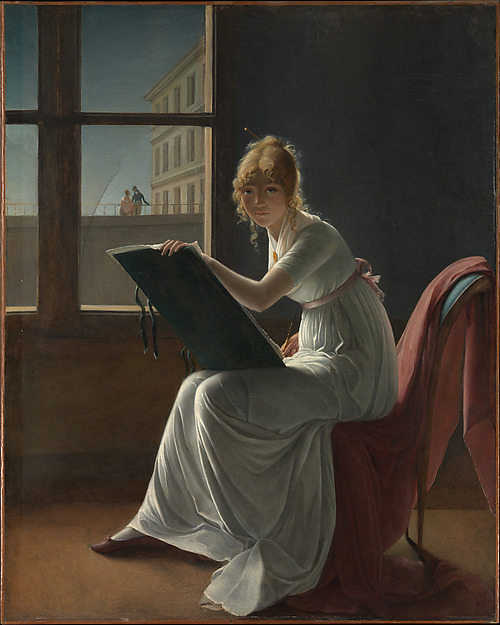
Image context: the post uses the Met's public-domain photograph of Villers's painting, not a generated reconstruction or a diagram, because the argument turns on visible details inside the original work.[1]
At first glance, Marie Denise Villers's 1801 portrait of Charlotte du Val d'Ognes seems to offer a controlled scene of grace: a young woman in white, a red sash at her waist, a drawing board across her lap, daylight pressing through a tall studio window. The composition is calm enough to be mistaken for simple elegance. But its calm is tense. Villers has made a picture about what it feels like for a woman artist to be seen while she is making something.
The painting now belongs to The Metropolitan Museum of Art, which identifies it as an oil on canvas by Villers and dates it to 1801.[1] It has often circulated under the descriptive label Young Woman Drawing, and that older title is useful because it names the action that gives the portrait its charge. Charlotte is not merely posed near artistic equipment. She has been drawing, has paused, and is still holding the terms of her work in place. The board across her knees is not a prop that flatters her refinement. It is the hinge between looking and making.
That hinge matters because so much of the painting tries to turn attention into pressure. Charlotte looks directly outward, but the look is not coquettish or theatrical. It is alert. Her head turns toward us while her body remains anchored by the board, the chair, and the luminous plane of the window. Villers refuses to separate the sitter's face from her labor. The viewer meets her at the instant when artistic concentration has been interrupted, and the interruption becomes part of the subject.
The window is the painting's most unstable instrument. It floods the figure with light, clarifying the satin-like folds of the dress and the red belt that cuts across the center. Yet it also opens the studio to a world beyond the sitter's control. Outside, two small figures appear on an architectural ledge. They are distant enough to remain ambiguous, but close enough to disturb the privacy of the room. The painting's interior is not sealed. It is a place of work exposed to public view.
That exposure is sharpened by the cracked pane. In a conventional studio portrait, a window might simply stand for clarity, reason, or the noble illumination of art. Here the window is damaged. Its broken geometry interrupts the smooth fall of light and makes visibility feel fragile. The young woman is brilliantly lit, but the device that lights her is imperfect. Villers makes the act of appearing in public look both necessary and risky.
The historical context gives that risk a social edge. The painting was shown at the Paris Salon of 1801, and its later attribution history shows how a public art system could display a woman's work while still failing to preserve her name securely.[2] Villers's picture does not illustrate that structure mechanically. It translates it into pictorial pressure: a woman artist inside a studio, a work surface in her lap, a viewer before her, and another public beyond the glass.
The clothing helps hold the contradiction. Charlotte's white dress and red sash align her with the fashionable neoclassical simplicity of the early nineteenth century, a style that made the body look unencumbered and antique-inflected while remaining very modern.[2] But Villers does not let the dress dissolve the sitter into fashion. The white mass of fabric catches the light; the red sash locks the composition; the hands and drawing board keep the eye from reading her only as a stylish figure. The portrait uses fashionable visibility, then redirects it toward artistic agency.
This is why the board feels so emphatic. It is almost blunt in its geometry, a pale rectangle cutting across the soft dress. Villers lets it interrupt the elegance of the costume. Its angle creates a private plane inside the painting, a surface we cannot fully inspect. Charlotte's face is open to us, but her drawing is not. That partial concealment is crucial. The viewer is invited to recognize the sitter as a maker without being allowed to possess the work she is making.
The portrait's attribution history deepens the point. The painting was long entangled with other names, including Jacques-Louis David, before modern scholarship re-centered Villers.[3][4] That history is not just a footnote. It repeats, outside the canvas, one of the canvas's own problems: how easily a woman's artistic authority could be redirected through a more familiar frame. When the work is seen as Villers's, its intelligence changes shape. The studio is no longer just a setting designed in the orbit of a male master. It becomes a space where a woman painter stages another woman's visibility as a question.
Villers also resists the sentimental answer. Charlotte is not triumphant in any simple way. The background is too exposed, the window too damaged, the viewer too implicated. The painting does not say that artistic recognition solves the conditions under which it is granted. It says that recognition arrives with scrutiny. To be seen as an artist is to gain presence, but also to become vulnerable to misreading, interruption, and appropriation.
That is the force of the direct gaze. Charlotte looks as if she has heard us enter, but not as if she has surrendered the room. Her posture keeps the scene balanced between invitation and refusal. The drawing board remains in her possession. The window admits the world, but it does not erase the studio. Villers's achievement is to make those tensions visible without turning them into allegory. The painting stays intimate and specific: a person, a board, a chair, a window, a crack in the glass.
More than two centuries later, the picture still feels startling because it refuses the easy category of "accomplished young woman." It shows accomplishment as a contested state. The sitter's skill is present, but partly hidden; her face is available, but not passive; the studio is bright, but not secure. Villers made a polished portrait that behaves like an argument. Its beauty is inseparable from its unease.
Sources
- The Metropolitan Museum of Art Collection API, object 437903.
- Fashion History Timeline, "1801 - Marie-Denise Villers, Marie Josephine Charlotte du Val d'Ognes".
- Journal18, Anne Higonnet, "Through a Louvre Window".
- The Public Domain Review, "Marie-Denise Villers's Portrait of Charlotte du Val d'Ognes, or Young Woman Drawing (1801)".