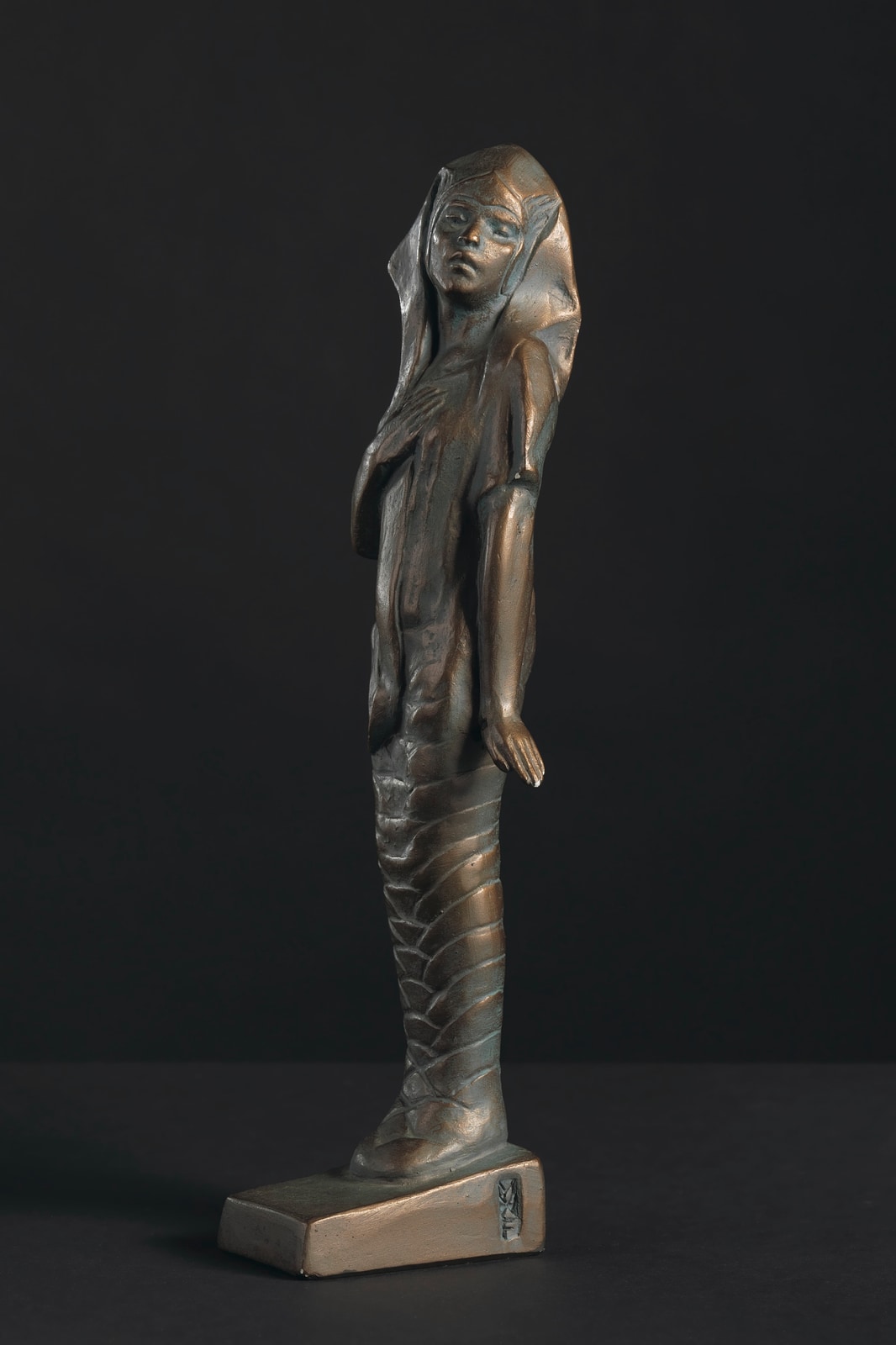
Image context: Fuller's small painted-plaster Ethiopia refuses the tidy posture of a statuette. The figure's lower body remains wrapped as if mummified while her chest, arms, and veiled head emerge into motion. One hand rests over her heart; the other reaches downward; her face turns to the side. The work pictures awakening without pretending that release has already been completed.[1][2]
Meta Vaux Warrick Fuller repeatedly received assignments to turn Black history into a shape the public could grasp. For the Jamestown Tercentennial Exposition of 1907, that shape was a sequence of miniature historical scenes. For the National Emancipation Exposition of 1913, it was a group of bodies stepping beneath the grasp of a tree-like hand. After the 1918 lynching of Mary Turner, it became a woman shielding a child from flames and reaching hands. For the America's Making Exposition of 1921, it was Ethiopia: a single figure not yet free of her wrappings.[1][5][6][7]
This was public sculpture under pressure. Each commission asked Fuller to compress an enormous argument—about slavery, citizenship, racial violence, African heritage, or national belonging—into bodies legible at a glance. She answered with allegory, but not with easy victory. Her figures hesitate, brace, lean, grieve, and emerge. Fuller made historical progress visible by keeping its resistance inside the form.
Paris taught her to leave the pressure on the surface
Fuller was born in Philadelphia in 1877 and trained at the Pennsylvania Museum School of Industrial Arts before living in Paris from 1899 to 1903. There she studied sculpture at the Académie Colarossi, drawing at the École des Beaux-Arts, and painting with Raphaël Collin. Her work entered Paris exhibitions, and her encounters with Auguste Rodin helped confirm a sculptural language in which modeled surfaces and bodily strain could carry psychological weight.[2][3][4]
The 1902 bronze The Wretched already rejects uplift as a default ending. Its compact mass gathers several suffering figures: one reaches toward someone lost, another hides his face, an old man confronts poverty, a child bears illness, and a philosopher suffers through understanding the others. In a 1949 letter, Fuller corrected a mistaken optimistic title attached to the work. There was, she insisted, “no glint of hope” in it.[3]
That refusal matters because Fuller is often placed into a smooth origin story: Paris-trained pioneer, precursor to the Harlem Renaissance, maker of affirming Black monuments. All of those descriptions contain truth, but the early sculpture is harsher. It established her interest in the body as a place where history is not summarized but endured.
A 1910 warehouse fire in Philadelphia destroyed the body of sculpture she had stored there, work extending back through her student and Paris years. A battered scrapbook survived. Its clippings, photographs, and exhibition traces now make possible a partial reconstruction of a career whose objects were materially vulnerable from the start.[4] Fuller would go on making monuments about historical memory after losing much of her own artistic past.
A world's fair made progress into a procession
The federal commission for the 1907 Jamestown Tercentennial asked Fuller to create quarter-life-size tableaux tracing Black life from the arrival of enslaved Africans in Virginia through emancipation and into modern citizenship. A contemporary announcement described scenes of cotton labor, escape, the founding of an African Methodist Episcopal church, military service, schooling, farming, mechanical work, banking, domestic life, religion, and college commencement.[5]
The sequence gave Black achievement a long, visible history at an exposition whose segregated “Negro Building” also revealed the limits of recognition. Historian W. Fitzhugh Brundage argues that the tableaux used the era's language of racial progress while giving African American historical memory a commanding material presence.[9] That double condition is essential: Fuller gained an unusually large public platform, but the platform expected Black life to be staged as a disciplined ascent toward standards the nation claimed to own.
Even so, the tableaux shifted agency. Enslaved people did not wait in one undifferentiated scene for freedom to arrive from outside. They escaped, organized worship, defended communities, learned, built, farmed, and entered professions. History became a procession of actions. The surviving photographs cannot restore the lost installation's full spatial effect, but they preserve Fuller's basic move: progress had to be embodied by people doing it.
Emancipation steps forward without leaving danger behind
In 1913, Fuller made a monumental plaster group for the fiftieth anniversary of the Emancipation Proclamation. It avoided the familiar broken-shackle scene in which a kneeling Black figure receives freedom from a white benefactor. Fuller placed a young Black man and woman upright beneath a gnarled, hand-like form. Behind them, an allegorical figure of Humanity lowers her head and guides the man forward.[2][6]
The young woman's movement is decisive. Her weight shifts into a step while the man's feet stay together and his open hands register uncertainty. Neither body is presented as a grateful accessory to Abraham Lincoln. They must enter freedom themselves. At the same time, the form above them still looks capable of grasping. In her 1914 explanation, Fuller distinguished emancipation from the end of racial hatred and lynching.[6]
The sculpture therefore refuses two consolations. It does not deny the legal rupture of emancipation, and it does not confuse that rupture with completed freedom. The rough modeling leaves Fuller's hand perceptible in the surface; the figures look pushed into being rather than polished into a distant classical past. What they gain is not a finished world but the physical possibility of stepping into one.
Mary Turner stops the progress narrative
Six years later, Fuller made In Memory of Mary Turner: As a Silent Protest Against Mob Violence. Turner, pregnant in 1918, had publicly denounced the lynching of her husband in Georgia and was then murdered by a mob. Fuller's painted-plaster memorial shows a woman holding an infant and recoiling from flames and hands that reach up from the base.[7]
The sculpture does not translate terror into a generalized symbol of sorrow. Its title keeps Turner's name attached to a specific act of racist reprisal, while its form catches protection and attack in the same instant. The mother leans away, but there is no safe edge beyond the composition. The Museum of African American History identifies the work as among the earliest sculptures by an African American artist to confront lynch-mob brutality directly.[7]
Set beside Emancipation, Mary Turner breaks any simple march from bondage to liberty. A proclamation can change law; it cannot by itself disarm a mob. Fuller did not abandon allegory, but she forced allegory to answer to a named life and a recent crime. Historical movement could be reversed. The body that stepped forward in 1913 could still be seized in 1918.
Ethiopia awakens slowly enough to remember
The 1921 America's Making Exposition celebrated the contributions of immigrant groups to the United States. Du Bois and James Weldon Johnson commissioned Fuller for its “Americans of Negro Lineage” section. Rather than illustrate a catalogue of music and industry, she produced Ethiopia, a figure linking African American aspiration to ancient Egypt and to Ethiopia as a symbol of African resistance to colonial rule.[1]
The small painted-plaster version in the Smithsonian collection looks like aged copper. From the hips down, the body is bound in mummy-like wrapping. Above that boundary, the figure has awakened: her shoulders turn, her right hand meets her chest, and her veiled head looks over the left shoulder. Fuller did not make liberation a discarded casing lying harmlessly at the feet. The past still carries the figure's weight.[1]
Art historian Renée Ater reads the work's setting as productively contradictory. Ethiopia offered Black viewers a history extending beyond enslavement and the United States, yet it appeared inside a “melting pot” exposition that asked excluded groups to demonstrate their value to the nation. The sculpture could assert cultural depth while also being recruited into an assimilationist display.[2]
Fuller's form holds that contradiction better than a triumphant pose would. Awakening is present, but so are enclosure and backward sight. The hand over the heart can suggest self-possession without becoming a salute to uncomplicated arrival. Even the copper-like finish performs a transformation: humble plaster adopts the public gravity of metal while remaining a small, fragile model.[1]
The profile is larger than its monuments
Fuller's exposition works dominate her reputation because they make public claims at historical scale. They were not the whole practice. The Danforth Art Museum's permanent Fuller collection includes intimate family portraits, religious reliefs, self-portraits, process pieces, molds, and late works; it spans roughly seventy years and re-creates the attic studio she used in her Framingham home around 1920.[8] The range prevents “pioneer” from hardening into a single heroic assignment.
It also clarifies what connects the public works. Fuller was not simply illustrating a prewritten story of Black advancement. She was testing how a body might carry history without becoming a passive emblem. The Jamestown figures act across a sequence. The pair in Emancipation step under pressure. Mary Turner braces against an attack. Ethiopia rises while still wrapped.
Read together, these works make movement more important than arrival. Their dignity does not depend on pretending damage has vanished. Fuller sculpted freedom as a tense bodily condition: a turn, a reach, a guarded child, a foot beginning to move. Her figures do not wait for history to declare them finished. They awaken before triumph—and keep the unfinished work visible.
Sources
- Smithsonian National Museum of African American History and Culture, “Meta Vaux Warrick Fuller's Ethiopia” — official digital-exhibit page, visual record, commission context, Pan-African framing, and source page for the article image.
- Renée Ater, “Remaking Race and History: The Sculpture of Meta Warrick Fuller” and “Making History: Meta Warrick Fuller's Ethiopia” — the art historian's summaries of Fuller's exposition strategy and the work's Pan-African and assimilationist tensions.
- Maryhill Museum of Art, Art by Women: Celebrating the Centennial of the 19th Amendment (2020), pp. 3–4 — The Wretched, Paris training, Fuller's 1949 account of its figures, and the early-work fire.
- Framingham State University, Meta Vaux Warrick Fuller Catalogue Raisonné, “Scrapbook” — archival account of the 1910 warehouse fire, the surviving scrapbook, Fuller's Paris record, and major later works.
- Framingham State University, Meta Vaux Warrick Fuller Scrapbook, “Negro Exhibit for Jamestown,” New York Evening Post (March 16, 1907) — contemporary announcement of the federal tableaux commission and its planned historical scenes.
- Framingham State University, Meta Vaux Warrick Fuller Scrapbook, “In Memory of Emancipation,” Philadelphia Press (January 18, 1914) — contemporary description of the 1913 group and Fuller's explanation of its figures, restraining hand, racial hatred, and lynching.
- Framingham State University, Meta Vaux Warrick Fuller Catalogue Raisonné, “In Memory of Mary Turner: As a Silent Protest Against Mob Violence” — object record, 1919 date, medium, dimensions, imagery, ownership, and historical context.
- Danforth Art Museum at Framingham State University, “The Meta Vaux Warrick Fuller Collection” — permanent-collection overview, studio reconstruction, process material, and works spanning Fuller's career.
- W. Fitzhugh Brundage, “Meta Warrick's 1907 ‘Negro Tableaux’ and (Re)Presenting African American Historical Memory,” The Journal of American History 89, no. 4 (2003) — scholarly study of the Jamestown installation, racial-progress framework, and public-memory stakes.