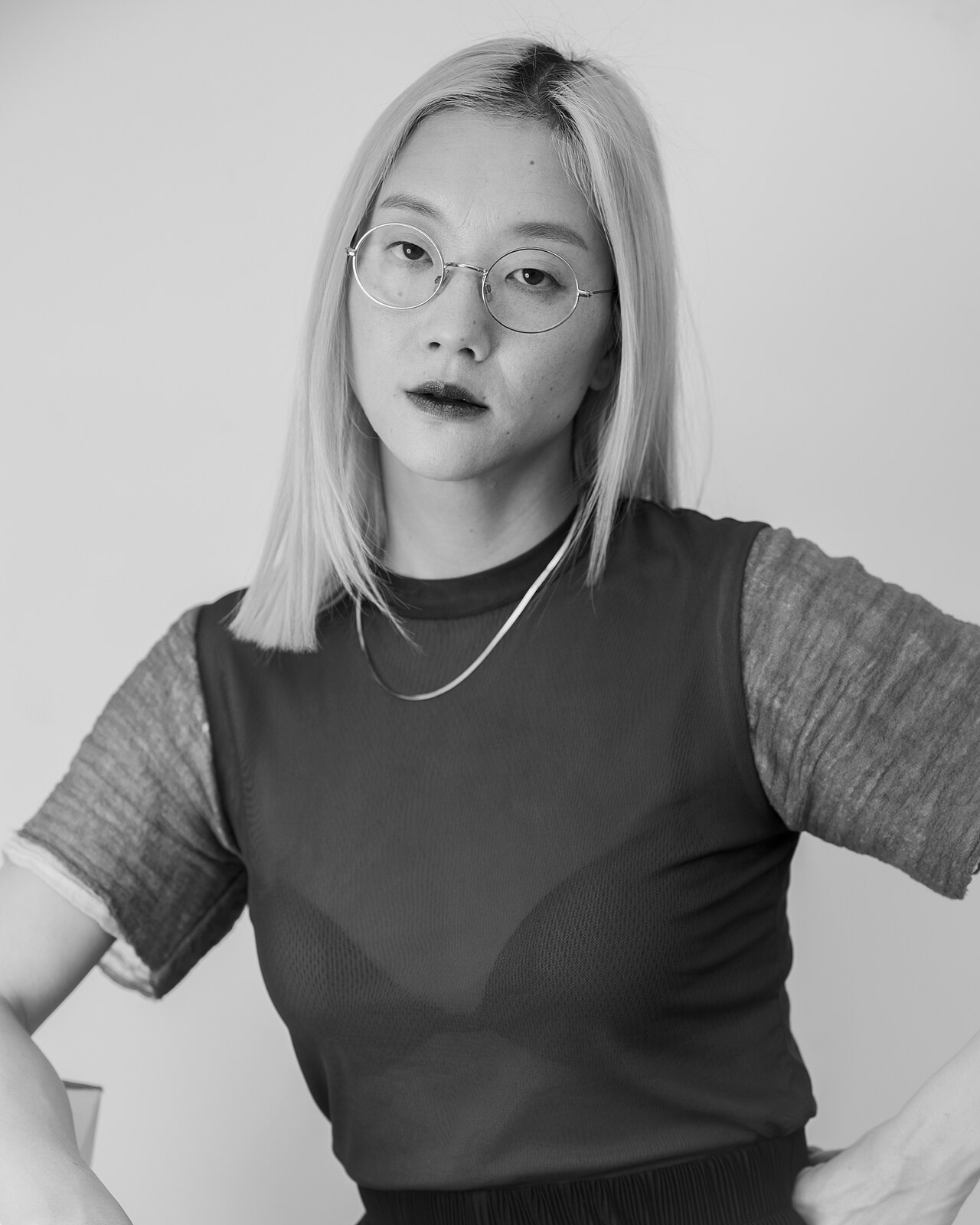


Image context: the cover is a 2022 photographic portrait of Christine Sun Kim, not an illustration of the works discussed below. Its direct gaze is useful precisely because this collection is not a story about an abstract category called “the Deaf experience.” It concerns an artist making deliberate formal choices about notation, collaboration, scale, and address.[9]
Sound is often presented as an innocent physical fact: vibration enters an ear, and culture begins afterward. Christine Sun Kim reverses that order. Her drawings, performances, and public works ask us to notice the culture already built around sound—the rules governing whose language is prestigious, whose voice seems unmediated, whose repetition counts as inconvenience, and who must arrange access before a conversation can start.[3][4][5]
That makes “a Deaf artist who visualizes sound” an inadequate description. Kim is not supplying pictures as substitutes for missing audio. She is examining a social field organized through hearing-centered norms. Musical notation, American Sign Language (ASL), interpretation, captioning, and the architecture of institutions all become ways to test how meaning is assigned and who performs the labor of carrying it.[4][6]
The two films in this collection, released six years apart, make that argument at different scales. A 2017 Rubin Museum film stays close to The Sound Of, a series of spare drawings made with the dynamic marks of Western musical notation.[1] Art21’s 2023 film moves among Kim’s studio, interpreters, family, exhibitions, and a mural at the Queens Museum.[2][7] The second does not leave the first behind. It reveals the wider access system that was already compressed inside those black marks.
Film 1: notation becomes social pressure
The Rubin film gives the eye almost nothing extraneous. Kim signs beside five black-and-white works while the camera isolates their repeated letters, staff-like rows, and emphatic titles. The marks look authoritative because many viewers have learned to recognize them as music even if they cannot read a score. Kim borrows that authority, then redirects it toward experiences that are not primarily acoustic.
The clearest example is The Sound of a Waiting Room (2017). In ordinary notation, p and pp tell a performer to play softly or very softly; fp calls for loudness followed immediately by softness; sfz marks a sudden emphasis. Rubin curator Risha Lee reads Kim’s sequence as initial composure, mounting impatience, a possible check at reception, embarrassment, and the sudden announcement that the doctor is ready.[3] On that reading, the work’s “sound” is not a hidden noise waiting to be decoded; it is the pressure that one person’s state exerts on another’s inside a shared situation.
Repetition does much of the formal work. One dynamic mark has a conventional definition; a page full of them becomes a population. Difference appears relationally—this sign is louder, softer, more abrupt, or more restrained than the marks around it. The drawings therefore make intensity legible without pretending that loudness belongs only to the ear. Waiting, obsessing, and changing emotional temperature can all have crescendos because people experience them through bodies, expectations, and time.[1][3]
This is an appropriation of institutional language, not a lesson in reading music. Western notation carries educational status and a long written history, while ASL is often wrongly diminished as merely practical or expressive. Kim has contrasted those unequal reputations directly: ASL and music are nuanced systems with rich histories and social value, yet only one is routinely granted cultural prestige.[4][5] Putting everyday social states into musical dynamics transfers some of that prestige while exposing its arbitrary distribution.
The move also unsettles the fantasy of direct reception. A score is already mediated: symbols require conventions, readers, and performers before they become music. Kim’s page never lets a hearing viewer stand outside mediation and claim immediate ownership of sound. Everyone must read relations among signs. The work is accessible through sight, but its sharper claim is that hearing has never been interpretation-free.
That is why the film should not be summarized as “making the inaudible visible.” Such a phrase keeps audible sound as the original and treats the drawing as a translation made afterward. Kim instead makes behavioral pressure, anticipation, and hierarchy primary material. The notation does not compensate for an absent sound; it demonstrates how narrow the hearing-centered definition was.[3][4]
Film 2: the score expands into an access system
Art21’s film begins with Kim describing life as many small echoes accumulating into one large echo. The image recurs in the repetitions built into ASL and in the interpreters who render her signed words in spoken English. An echo sounds secondary in common speech, but the film refuses that ranking. Repetition is where timing, trust, authorship, and difference become perceptible.[2][7]
The setting has widened too. Kim presents at REDCAT in Los Angeles; installs large canvases at Somerset House in London; works with her husband, Thomas Mader, and their daughter, Roux; considers debt after living in Berlin and New York; and visits Time Owes Me Rest Again (2022), her mural at the Queens Museum. Drawings such as Why I Do Not Read Lips and Shit Hearing People Say to Me use the visual familiarity of information graphics, but the point is not neutral explanation. Their blunt humor makes repeated social demands visible: read lips, clarify, adapt, absorb another person’s assumption, and do it again.[2][7]
Before watching, notice who is permitted to be part of the artwork’s production. Interpreters do not appear as transparent utilities tucked outside the frame. Family members, installers, audiences, and institutional spaces alter how a work is made and received. Kim has described choosing an interpreter as choosing the sonic identity her voice will “wear,” a process that requires close collaboration rather than word-for-word substitution.[4] The film turns that normally concealed dependency into both subject and method.
The interpreter scenes complicate the idea of a single, self-contained artistic voice. Spoken English follows Kim’s signing, but it is not a frictionless copy. Pace, personality, comic timing, and trust pass through another person. Hearing audiences encounter a voice that is authored by Kim and materially realized through collaboration. Rather than treating that condition as a deficiency, the film makes it an unusually honest model of communication: all speech relies on learned codes and other people, though some speakers are allowed to forget that fact.[2][4]
Kim’s graphic forms likewise change jobs as the film moves outward. Musical staffs organize collaborative family drawings. Pie-chart conventions give shape to familiar indignities. At the Queens Museum, motion lines trace where the hands meet the body in the five ASL signs behind Time Owes Me Rest Again, while the English title occupies the wall. The film then moves to Captioning the City, where caption-like phrases enter Manchester’s buildings and sky. Both projects center communication normally pushed to the margins, but neither makes access automatic or ASL universally legible. A private obligation to explain becomes a public claim on architecture and attention.[2][7][8]
Scale matters here because visibility is not simply a reward for a successful artist. Kim connects visibility to what a culture accepts as ordinary. Captioning the City relocates caption-like language from a screen to public architecture, prompting viewers to ask why captions are present and who might want them.[2][8] Time Owes Me Rest Again makes ASL-derived movement monumental in shared museum space. Neither guarantees understanding; both refuse the default assumption that these forms should remain supplemental or small.
Rest deepens the argument. Access is often imagined as a technical feature—hire an interpreter, add captions, complete a checklist. Time Owes Me Rest Again points to the time and bodily energy that precede those features: requesting them, explaining why they are necessary, following up, and entering spaces built around hearing people’s preferences. Kim has described institutions and infrastructures as largely reflecting hearing experience, while her Art21 film links the exhaustion of demanding rights to pandemic life in Corona, Queens, and to broader struggles to be recognized.[5][7]
The film’s discussion of debt makes a similar expansion without dissolving Deaf specificity. Kim contrasts Berlin’s free daycare, relative affordability, and public support with friends in the United States working multiple jobs to make ends meet.[2][7][8] Debt is numerical, but its pressure is social: it changes what time belongs to you, what risks are available, and whether rest feels deserved. That returns us to the waiting-room drawing. In both films, Kim uses familiar systems—musical dynamics, information graphics, financial language—not because they are neutral, but because their authority can be redirected toward unequal distributions of patience, labor, and autonomy.
From an acoustic property to a public rule
Seen together, the films offer a precise shift in scale. The Sound Of compresses a situation into notation, allowing marks for volume to register anticipation and social pressure.[1][3] Friends & Strangers opens the page back out into the world: an interpreter voices a signed sentence, a family adapts the musical staff, an institution decides whether access is routine, and a mural makes ASL-derived movement monumental in shared museum space.[2][7][8]
The continuity is more important than a story of artistic “progress.” The early drawings already contain politics, and the later works retain formal economy and play. What changes is our view of the system around them. Notation turns out to be one access protocol among many: it grants some people fluency, asks others to translate, and carries the authority of the culture that standardized it. Kim’s achievement is therefore not to prove that sound can be seen. That conclusion would leave audible sound as the unmarked norm and congratulate visual art merely for approaching it. Her work starts from a more disruptive premise: sound is already visual, bodily, linguistic, institutional, and collective.[4][6] Once that premise is accepted, access no longer looks like assistance added to a complete world. It becomes a way of deciding what the shared world is—and who gets to define its rules.
Sources
- Rubin Museum of Himalayan Art, “Christine Sun Kim: The World Is Sound / The Sound Of” — official YouTube film on Kim’s 2017 drawing series.
- Art21, “Christine Sun Kim in ‘Friends & Strangers’” — official YouTube film following Kim’s studio, talks, collaborations, exhibitions, and public mural.
- Risha Lee, “Mediated Voices,” Rubin Museum of Himalayan Art, 2017 — analysis of The Sound of a Waiting Room, musical dynamics, mediation, and sound etiquette.
- Paulette Beete, “Art Talk with sound artist Christine Sun Kim,” National Endowment for the Arts, 2017 — email interview on hearing-centered definitions of sound, ASL, interpreters, captions, and collaboration.
- Liam Otten, “Q&A with Christine Sun Kim,” Washington University in St. Louis, 2021 — interview on notation, the status of ASL and music, and hearing-centered institutions.
- Smithsonian American Art Museum, “Christine Sun Kim” — institutional biography on translation, the multisensory social world of sound, notation, sign-language glossing, and communication hierarchies.
- Art21, “Christine Sun Kim in ‘Friends & Strangers,’” 2023 — official film page with work titles, locations, production context, and Kim’s discussion of visibility, access, debt, and rest.
- PBS, “Friends and Strangers,” Art21, Season 11, Episode 3 — full episode transcript documenting Kim’s discussion of interpreters, debt, the Queens Museum mural, and Captioning the City.
- Wikimedia Commons, “Christine Sun Kim by Ériver Hijano” — source record, authorship, date, original resolution, and CC BY-SA 4.0 license for the cover photograph.