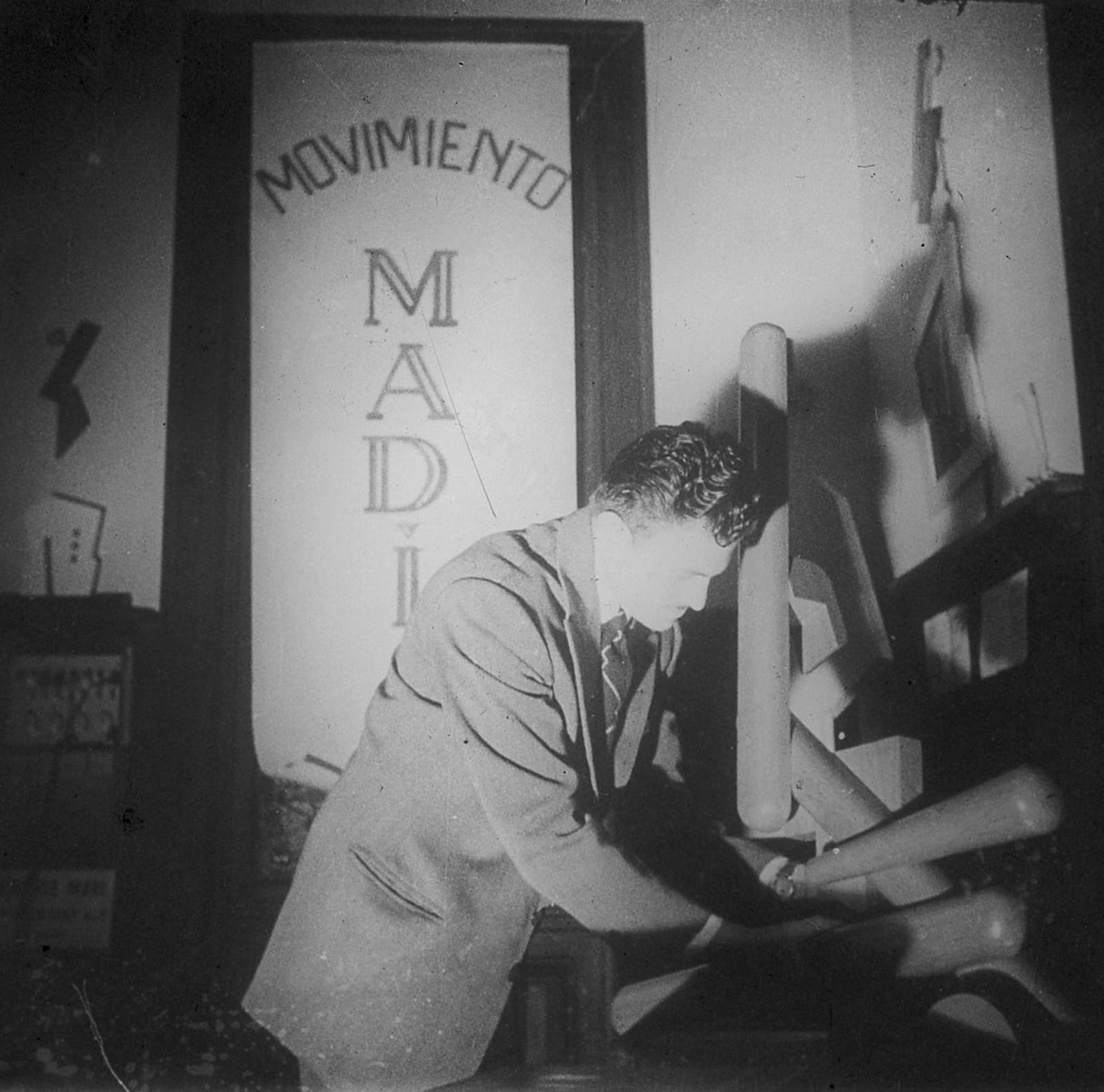
Image context: this 1946 archival photograph catches Gyula Kosice bending over Röyi at Madí's inaugural exhibition in Buenos Aires, one hand at a joint as he repositions its wooden arms. It is more than a founder portrait. The sculpture has no final silhouette: its members can be turned into another configuration, making change—not one privileged pose—part of the object.[3][6][9]
A conventional picture frame performs a quiet trick. It announces where the artwork stops, but it also asks to be ignored. However unruly the image inside may be, the rectangle remains a neutral-looking container, a dependable window hung against the wall.
Madí refused that neutrality. In Buenos Aires and Montevideo during the 1940s, its artists made paintings with projecting, notched, stepped, and angled boundaries. They built sculptures that could rotate or be rearranged. They treated manifestos and little magazines as designed objects, then invited poetry, music, theater, dance, and architecture into the program. The movement's most consequential idea was also its simplest: if every line and color belongs to a composition, why should the outer edge escape responsibility?
The rectangle was still pretending to be a window
The argument appeared before Madí had a name. In the single 1944 issue of Arturo: Revista de Artes Abstractas, Uruguayan artist Rhod Rothfuss published “El marco: un problema de la plástica actual” (“The Frame: A Problem of Contemporary Art”). Abstract painters had rejected the duty to reproduce visible reality, he argued, but the regular frame retained an older pictorial habit. It still suggested that the image was a cropped portion of something continuing beyond its edge—the logic of a window surviving inside nonrepresentational art.[1][2]
Rothfuss's answer was the marco recortado, or cutout frame. The support should be structured according to the composition, so its perimeter becomes active rather than given in advance. In a shaped painting such as his 1946 Composición Madí, enamel-covered wood narrows, widens, and steps outward with the geometry painted across it. The color does not fill a container after the fact; color and object share one contour.[1][7]
This was not merely a decorative irregularity. Rotate or crop a composition inside a rectangle and the frame remains indifferent. Alter the boundary of a Madí painting and the entire relation among wall, object, and internal shape changes. Negative space enters the composition from the room. A corner becomes as deliberate as a band of red or black.
The move also changed the category of the thing. From the front, Composición Madí can still be called a painting. Its enamel surface and assertive wooden profile, however, make it behave like a shallow relief. Madí did not dissolve painting into sculpture so much as expose how much objecthood a painting had always concealed.
One magazine opened several futures
Arturo was an origin point, not a unified movement in miniature. Its editorial group brought together Carmelo Arden Quin, Rothfuss, Kosice, and poet Edgar Bayley; Tomás Maldonado designed its cover, and contributors ranged across visual art and poetry. The journal opposed representation with “invention”: a work should not extract or stylize a subject from the world, but establish a concrete reality of its own.[1][2][5]
That shared rejection quickly produced disagreements. From the Arturo circle emerged the Asociación Arte Concreto-Invención, Madí, and, soon afterward, Perceptismo. Their geometric surfaces can look like a single school from a distance, but the positions were not interchangeable. The Asociación pursued a more rationalist, explicitly political concrete art; Madí retained geometric rigor while making more room for Dada-like play, physical movement, and three-dimensional experiment.[2][4][5]
Madí announced itself publicly at the Instituto Francés de Estudios Superiores in Buenos Aires from August 3 to 6, 1946. Arden Quin, Kosice, and Rothfuss were its leading figures, but the first movement roster was broader: it included Martín Blaszko, Diyi Laañ, Elisabeth Steiner, Esteban Eitler, Paulina Ossona, and others working across several disciplines.[3] Remembering that larger company matters. A movement that claimed to unite the arts should not be reduced to three signatures simply because three names became easiest to canonize.
Rigor learned how to play
Kosice's Röyi makes Madí's difference tactile. Conceived in 1944, the sculpture consists of eight turned wooden pieces connected at seven joints. Those pivots allow its parts to swing into many arrangements; Kosice proposed that viewers themselves transform it. The photograph at the top catches one configuration, but the work is not the configuration. It is the organized possibility of passing from one to another.[5][6]
That distinction separates change from spectacle. Röyi has no motor and does not simulate life. Its mobility is legible in bolts, joints, weight, reach, and the participant's hand. Geometry becomes a verb: align, fold, spread, balance. The viewer does not decode a hidden story but tests the object's real constraints.
The same play operates in the cutout paintings. Their flat color and hard edges can be exacting, yet their profiles sometimes resemble emblems, mechanical parts, or pieces from a game whose rules have not been supplied. Madí understood that rigor need not produce solemnity. A work could be materially exact and still flirt with surprise, nonsense, or rearrangement.[4][5]
This is why the familiar label “geometric abstraction” is slightly misleading here. Madí artists did not think they were abstracting geometry from some prior scene. They called for actual invention: line, plane, color, volume, movement, and interval would constitute the subject rather than describe one. The pleasure comes from meeting a thing that does not apologize for being made up.
The manifesto exceeded the gallery wall
The text circulated for the first Madí exhibition proposed an art suited to industrial civilization and contemporary dialectical thought. It called for a new ordering of values and for the artistic disciplines to be joined in a larger shock to reality.[3] That language can sound grander than the small painted boards and mimeographed sheets that carried it. The mismatch was productive. Madí's claim to scale began with portable things.
Its publishing practice made the ambition visible. Early flyers borrowed the cheap, distributable format of political handbills. After 1947, Arte Madí Universal used typography, altered orientation, collage, and die-cutting rather than treating the page as a transparent carrier of doctrine.[2] The active edge had migrated into print. A manifesto about refusing passive containers could not arrive in a passive container.
Nor did synthesis mean making every art look like a shaped painting. The 1946 statement distinguished disciplines while bringing them into one program: movement belonged literally to dance and sculpture; interval could organize music; architecture entered as space rather than painted representation.[3] Madí's unity was methodological. Each art was asked to work through its own materials, then to enter modern life without borrowing authority from narrative likeness.
That program joined play to a serious social confidence. Madí's artists believed nonfigurative form could correspond to a transformed world, not merely decorate one. Yet their “universal” visual language was never politically neutral just because it avoided recognizable symbols. It emerged in the Río de la Plata, from young Argentine and Uruguayan artists arguing with European constructivism, local realism, Marxist thought, wartime upheaval, and one another.[2][4] The movement's geography is part of its form: this was not a delayed copy of a European center, but a Southern Cone avant-garde proposing its own route through modernity.
A split became a second life
Madí did not remain one stable circle. Arden Quin moved to Paris in 1948 and later established the Centre d'Études et de Recherches madistes, active from 1951 to 1958. Kosice continued to drive the movement in Buenos Aires, while Rothfuss's career joined its Uruguayan and Argentine contexts. The split generated rival emphases and self-narratives, but it also helped Madí enter the Salon des Réalités Nouvelles, Galerie Denise René, and networks well beyond the Río de la Plata.[4][8]
The movement's later international expansion makes any single checklist unreliable. Not every Madí work is movable; not every one has a jagged edge. The durable principle is a refusal of inherited limits presented as natural. The rectangle, the static sculpture, the polite page, and the separation of disciplines all became available for redesign.
That is also the right boundary for Madí's legacy. Shaped paintings and participatory sculptures have multiple histories; resemblance alone does not prove that every later artist descended from Rothfuss or Kosice. The stronger claim is specific. In 1944–46, Madí's circle articulated and exhibited a coherent alternative in which the support followed the composition, the object could change state, and the audience could become physically responsible for one of those states.[1][3][6]
Return to the archival photograph and Kosice is not simply standing beside a finished answer. Röyi waits in one temporary arrangement, as much instruction as monument. Madí's breakthrough was to make that provisional condition exact. The edge no longer framed the argument. The edge—and what it allowed the object to do—was the argument.
Sources
- ICAA/Museum of Fine Arts, Houston, Rhod Rothfuss, “El marco: un problema de la plástica actual” (1944) — archival record and synopsis of the cutout-frame argument in Arturo.
- Getty Research Institute, “An Archival Trail: Concrete Art in Argentina” — Arturo, the marco recortado, Madí's flyers and magazines, and the movement's split from other concrete-art groups.
- ICAA/Museum of Fine Arts, Houston, Movimiento Madí, first-exhibition statement (1946) — archival synopsis, exhibition dates, interdisciplinary program, and membership.
- Moderna Museet, “Introduction: Concrete Matters” — Southern Cone concrete-art context and Madí's playful, irregular, three-dimensional distinction.
- Museum of Fine Arts, Houston, “Gyula Kosice and the Rise of the Argentinean Avant-Garde” — Arturo, Madí's formation, shaped works, interactivity, and collection examples.
- Rodrigo Alonso, “Gyula Kosice: Röyi, 1944,” Daros Latinamerica Collection — construction, seven articulations, viewer reconfiguration, and artwork provenance.
- Museum of Fine Arts, Houston, Rhod Rothfuss, Composición Madí (1946) — object metadata, medium, dimensions, provenance, and exhibition history.
- Museo Nacional Centro de Arte Reina Sofía, “Arte MADÍ” — Paris expansion, the Centre d'Études et de Recherches madistes, and the movement's international afterlife.
- Wikimedia Commons, archival file page for “Kosice junto a Röyi” — 1946 photograph at Madí's inaugural exhibition, with source and file metadata.