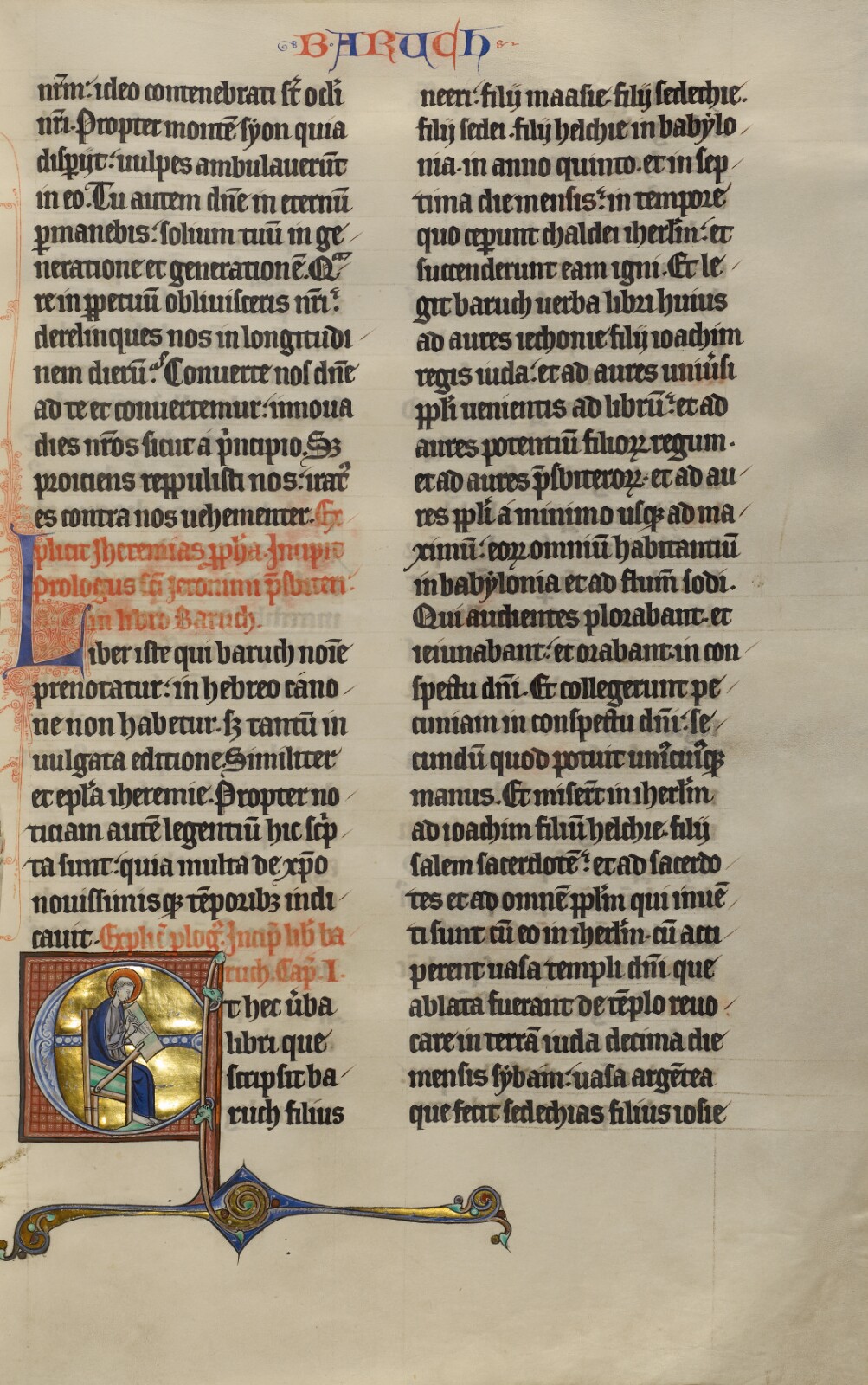


A medieval manuscript can reach a screen looking impossibly finished. The skin has become a pale rectangle, the script an orderly texture, and the gold a patch of yellow that never changes when the viewer moves. That digital stability is useful for study, but it suppresses the object's first drama: before a page could carry words or shine, it had to survive a workshop.
The support was not neutral paper. It was animal skin repeatedly soaked, scraped, stretched, and dried until it became parchment. Its dimensions affected the book's format; its surface had to accept ruling, ink, adhesive, metal leaf, and paint. Even after the book was bound, its colors remained materials capable of fading, darkening, corroding, or injuring the page beneath them.[1][2][3]
The two Getty Museum films below recover those two timescales. Making Manuscripts follows a book's manufacture from hide to binding.[1] The Alchemy of Color and Chemical Change in Medieval Manuscripts narrows its attention to pigments, then extends the story beyond the workshop into centuries of chemical change.[2] One film is about order; the other is about matter that does not stop having a history.
The cover image provides a compact bridge between them. In Initial E: Baruch, made about 1270, the prophet writes with a quill while a penknife in his other hand steadies the parchment on a sloped desk. The gold ground confers radiance, but the tools keep that radiance attached to work.[4] The image is not merely a medieval scene of authorship. It is a picture painted on the very kind of surface whose manufacture it evokes.
Video 1: a page begins under tension
The opening film is best watched from the edges inward. Before looking at initials, miniatures, or jewel-like colors, notice the perimeter of the skin on the stretching frame. It has the irregular outline of a body rather than the right angles of a page. The familiar rectangle has to be cut from that shape; the book begins with material limits, not an empty design canvas.[1]
The transformation is deliberately repetitive. Skins from sheep, goats, or calves were soaked in limewater to loosen hair, cleaned, rinsed, and pulled taut. A rounded knife reduced the wet hide toward an even thickness while the maker kept adjusting the tension as it dried.[1][3] Scraping does not act alone here. Pressure across the frame is what lets the blade meet a stable surface. The page's smoothness is therefore the result of opposing forces: the knife removes, the frame pulls, and the drying skin resists both.
That sequence changes how the finished object looks. A pale margin is no longer simply blank space around text. It is valuable prepared skin. A large folio implies a large usable area; a small book allows more leaves to be cut from a hide. The Metropolitan Museum of Art's account notes that one skin might yield two or three bifolia—folded sheets that become eight to twelve pages—though the number depended on the book's size.[5] Scale was consequently a material decision before it became a visual one.
Once the film reaches writing, geometry replaces the hide's irregular contour. Lines are ruled so the script can proceed evenly, and the cut of a quill's nib helps determine whether letters appear rounded or angular, open or compressed.[1][3] This is the point at which writing becomes visibly graphic. The scribe is not pouring language into a transparent container. The width and angle of a hand-cut tool shape the text's rhythm, while the ruled field sets its measure.
Initial E: Baruch makes that tool-consciousness unusually clear. Getty's catalog describes the penknife in Baruch's left hand as holding the parchment down while his right hand writes with the quill.[4] The knife is not an incidental studio prop. A quill needs reshaping, parchment can resist the moving hand, and a correction may require scraping. The seemingly serene page depends on small acts of control.
The film then distributes the finished effect across several kinds of labor. Writing, drawing, gilding, painting, sewing, and covering do not collapse into one magical gesture. Gold leaf is laid over an adhesive ground and burnished; colors follow; completed sheets are ordered into gatherings, sewn to supports, and attached to boards.[1][3] The crucial viewing lesson is cumulative: an illuminated book is less like a single painting than a compact architecture. Surface, image, sequence, hinge, and cover have to cooperate before the reader can turn one page.
Video 2: color is a recipe—and a future
The second film begins where a casual description of the first might end: with “color” as if it were one category of decoration. Instead, it separates hue from substance. A red, green, white, or imitation gold could be the outcome of grinding, binding, heating, corrosion, fermentation, or a reaction among ingredients. To name the color is not yet to know what the paint is.[2][6]
Vermilion gives the film its clearest example of color as an event. Sulfur and mercury are mixed and heated until a reaction produces a material that becomes deep red when ground. Other recipes follow different routes: copper exposed to acidic fumes can produce verdigris, while tin and sulfur, used in the presence of mercury, can yield the yellow compound called mosaic gold.[2] These are not neutral powders selected from a shelf. The desired appearance emerges from transformed matter, and some of the ingredients are hazardous.
The film's rapid list is worth slowing down because each recipe gives the painted page a different future. A mineral ground to powder, an organic dye extracted from a plant, and a compound made by corroding metal may look equally vivid at the moment of application. They do not necessarily respond equally to light, moisture, pollutants, or neighboring materials. Getty's exhibition research describes manuscript colorants derived from plants, minerals, and metals, with some pigments produced through heating or exposure to corrosive and reactive agents.[6]
That is why the film's most important turn comes after manufacture. Chemical transformation can continue centuries after a painter has put down the brush. Light may fade a color; atmospheric exposure may darken another; verdigris can corrode the parchment or paper that carries it.[2] The work's current appearance is evidence, but it is not a transparent copy of its first appearance. A darkened passage may record a reaction rather than an artist's choice.
Lead white sharpens this problem. Getty identifies it as the most common white in manuscripts, used for flesh, filigree, highlights, flowers, letters, and borders. It is brilliant and opaque but toxic, and exposure to air pollution can convert it into dark gray lead sulfide.[7] The change does more than remove brightness. It can reverse a modeled face or hand, turning what began as a highlight into a shadow. Looking carefully therefore requires restraint: not every dark mark should be interpreted iconographically before its material condition is understood.
Gold behaves differently again. The first film shows gilding as a stage of making; the second pairing helps explain why a flat screen cannot fully reproduce its effect. Getty's technical account describes gold leaf laid over an adhesive and burnished until it shines.[3] Unlike a pigment whose color is primarily read from light absorbed and reflected at its surface, polished metal redirects surrounding light as the page or viewer moves. In a digitized still, that mobile relation becomes one fixed exposure. What looks like yellow in a thumbnail was engineered to make reading a bodily encounter.
The book is finished; its materials are not
Together, the films replace the fantasy of the manuscript as an immaculate picture with a more compelling object. The first reveals a chain of constraints: an animal's skin sets an area, the frame creates tension, the knife establishes thickness, ruling organizes script, and gatherings give pages an order.[1][3] The second reveals that this carefully built structure carries unstable compounds whose transformations may outlast every maker.[2][6][7]
That pairing also changes the role of conservation. It is not an attempt to make an old page look generically new. Researchers identify materials, distinguish original decisions from later reactions, control light and environment, and sometimes model how a changed color may once have appeared.[2] Their work extends the manuscript's original collaboration: parchment maker, scribe, illuminator, binder—and, centuries later, scientist and conservator.
Return finally to Baruch's tiny working hands. The image joins sacred authority to material attention: one hand advances the words, the other manages the page.[4] The gold may announce transcendence, but the penknife insists on friction. That tension is the collection's central insight. Medieval illumination did not escape matter. It made matter—skin, feather, ink, clay, metal, mineral, plant, egg white—carry meaning, then entrusted that meaning to materials that would continue to change.
Sources
- Getty Museum, “Making Manuscripts,” YouTube video — official film tracing parchment preparation, page planning, writing, illumination, and binding.
- Getty Museum, “The Alchemy of Color and Chemical Change in Medieval Manuscripts,” YouTube video — official film on pigment recipes, degradation, analysis, and preventive conservation.
- J. Paul Getty Museum, “The Making of a Medieval Book” — institutional account of parchment making, quill writing, gilding, paint preparation, gatherings, and binding.
- J. Paul Getty Museum, “Initial E: Baruch” — collection record and source of the archival manuscript image used as this article's cover.
- Metropolitan Museum of Art, “From Animal to Art: The Story of Parchment” — material account of hides, folio yield, scale, and parchment as a visible support.
- J. Paul Getty Museum, “Getty Presents The Alchemy of Color in Medieval Manuscripts” — research overview of plant, mineral, metal, synthesized, and gilded materials.
- Stacy Suaya, “Seeing the Light,” Getty News — curatorial and conservation history of white supports and lead white in manuscripts.