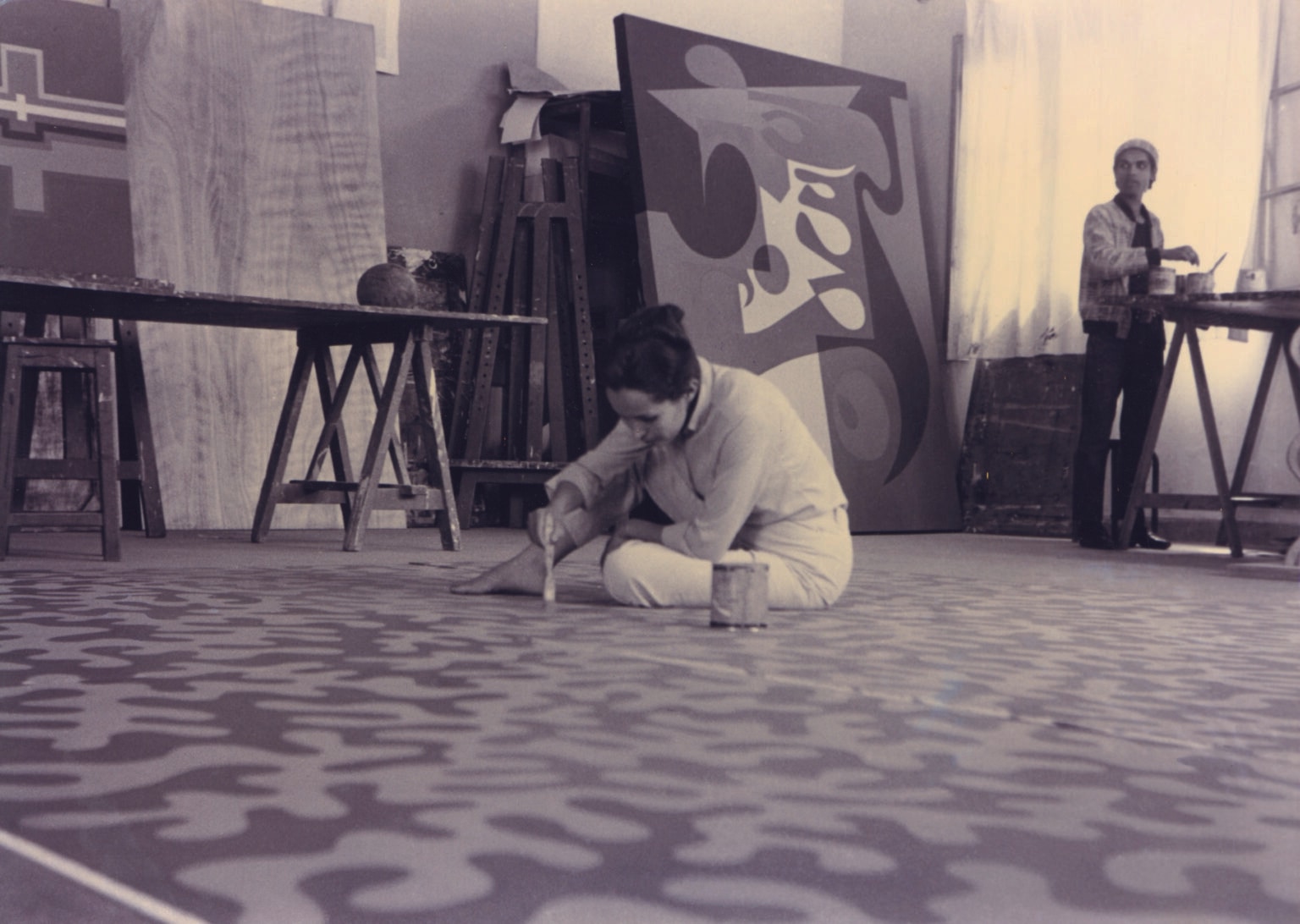
Image context: this article uses one real archival photograph of Malika Agueznay making Symbole féminin in 1968. It shows the movement where its ideas became physical—not as a finished style on a museum wall, but as an artist reaching across a work still in progress.[2]
In the photograph, Malika Agueznay has almost entered her painting. Seated on the studio floor, she extends a brush across a broad panel of organic forms that curl, divide, and gather again. Geometric paintings lean behind her; another person stands at a table near the window. The image does not offer the usual portrait of an art movement: no row of founders, no manifesto held toward the camera, no masterpiece isolated from the room. It shows a student making a decision at scale.[2]
That is a useful way into the Casablanca Art School. During its pivotal years in the 1960s, the school did not produce one signature look so much as a linked set of places in which modern art could be learned and argued over. The classroom was one. The printed page was another. In 1969, a public square became one too.[1][2][5]
Its artists are often introduced through recognizable forms—Mohamed Melehi's hard-edged wave, Mohammed Chabâa's geometric signs, Farid Belkahia's shaped skins and hammered copper. But the movement's more radical form was a curriculum. It treated Moroccan visual culture as knowledge rather than ornament, design as social practice rather than a lesser cousin of painting, and exhibition-making as a conversation that did not need to wait behind a gallery door.
Independence changed the assignment
Morocco regained independence in 1956. The École des Beaux-Arts in Casablanca, founded under the French protectorate in 1950, carried forward a hierarchy in which European academic models stood at the center and local forms were pushed toward the category of craft, folklore, or anonymous decoration. By the middle of the next decade, a faculty assembled around director Farid Belkahia was rewriting that hierarchy. Melehi taught experimental painting, collage, sculpture, and photography; Chabâa developed graphic arts, decoration, and calligraphy; Toni Maraini reframed art history through Africa and the Mediterranean; and Bert Flint brought sustained research into rural arts, rugs, and jewelry.[2][5]
This was not a simple choice between “Moroccan tradition” and “Western modernism.” Members of the group had studied and worked in Prague, Rome, Madrid, Paris, and New York. Melehi had already shown in MoMA's 1963 Hard Edge and Geometric Painting exhibition before returning to Casablanca. Belkahia had encountered both European academies and the Bauhaus.[5] Their project was not cultural quarantine. It was a change in authority: imported conventions would no longer decide in advance which objects counted as art, which histories counted as modern, or which audience the artist should address.
Chabâa made the distinction explicit in a 1966 position paper. He rejected the tidy opposition between abstraction and realism and argued instead for visual research adequate to Morocco's inherited forms and future.[3] That move matters. The School did not mine a frozen past for decorative motifs that could freshen an international style. It treated geometry, weaving, metalwork, calligraphy, architecture, and painted ceilings as active systems of thought.
Pattern became a research method
Rugs and jewelry entered the classroom as more than things to sketch. Students studied how repetition organizes a surface, how a sign changes through use, how a material carries technique, and how abstract form already lived in homes, mosques, clothing, and tools. Field research in the High Atlas, Anti-Atlas, and Souss regions extended the lesson beyond the school building.[2][5]
Each teacher translated that research differently. Chabâa redirected classical calligraphy toward typography and poster design. Melehi asked students to reinterpret the organization of Amazigh carpets through mural-scale thinking. Flint's collection opened questions about symbolism and the long movement of forms across Saharan and Mediterranean routes. Maraini's art-history course displaced Europe as the automatic center of the map.[5]
This approach could have hardened into a new orthodoxy—a demand that “authentic” Moroccan art must always display a approved repertoire of ancestral signs. The best work resisted that trap. The shared method generated difference. Belkahia abandoned the standard stretched canvas for copper, animal skin, and shaped supports. Melehi's wave joined bodily rhythm to the clean repeatability of graphic design. Chabâa moved among painting, furniture, murals, architecture, and the printed page.[5]
Agueznay's seaweed forms make the point especially well. As a student from 1966 to 1970 and one of very few women in the painting studio, she absorbed the School's commitment to sustained motif and local visual research without imitating her teachers' hard edges. Her forms bend and proliferate; sand, thick ink, cut wood, and paint preserve touch. She connected their organic curves to her own female perspective inside an overwhelmingly male modernist scene.[2] The cover photograph records both inheritance and refusal: a movement becomes durable when a student can use its questions to produce an answer the founders did not already own.
The page became another studio
The School's public ambitions were visible before a painting reached the street. Its artists worked through the magazines Maghreb Art, Souffles, and later Integral. Melehi established a photographic workshop; Chabâa became a central graphic designer for Souffles. In Maghreb Art, photographs of carpets, jewelry, and painted ceilings met critical writing in carefully designed sequences.[5]
Print changed the scale of the argument. A painting might remain singular, but a journal, catalogue, poster, or photograph could circulate a way of seeing. Graphic design was not merely publicity added after the serious work was complete. It joined word, image, and reproduction into an accessible form of painting. The Sharjah Art Foundation's later reconstruction of the movement accordingly places typography, magazines, interiors, murals, film, and archival photographs beside canvases rather than beneath them.[1]
This is why “school” should be heard in more than the institutional sense. The Casablanca Art School built channels through which looking could be taught. A page could compare a rural woven pattern with a contemporary composition without treating one as raw material and the other as cultured achievement. A poster could carry abstraction into ordinary circulation. Design made pedagogy portable.
In 1969, the exhibition lost its door
The decisive test came with Présence Plastique. In May 1969, six artists associated with the School hung paintings in Jemaa el-Fna, Marrakech's intensely public square. The action challenged the official Salon du Printemps, held in a state venue that required identification to enter and retained colonial categories for Moroccan artists. The outdoor display lasted ten days and replaced controlled admission with encounter: passersby could stop, question, dismiss, or debate what had appeared in front of them.[1][2]
The gesture was repeated the next month at Place du 16 Novembre in Casablanca, where students including Agueznay also exhibited. Related displays later reached Casablanca high schools.[2][4] These were not attempts to make abstraction instantly transparent. A painting does not become democratic just because it is outdoors. The more consequential change was structural. The artists surrendered the gallery's preselected audience and made explanation part of the event. Exhibition became public pedagogy rather than the final certification of objects already approved elsewhere.
The same logic expanded at the first Cultural Moussem of Asilah in 1978. Artists worked on walls with local assistants, and the festival developed through encounters linking Morocco with practitioners from Africa, West Asia, Europe, and the Americas.[1][4] The white gallery wall had not simply moved outside. It had become a shared working surface.
A movement is not a logo
Recent scholarship describes the Casablanca Group as a constellation rather than a sealed collective. That correction prevents three famous men and one famous wave from swallowing a larger history of teachers, students, writers, makers, printers, architects, and public collaborators. A major 2023–24 exhibition organized by Tate St Ives and Sharjah Art Foundation included 21 artist-activists across generations and arranged the history through both “platforms” and “patterns”: collective making, public art, Afro-Amazigh heritage, everyday design, graphic work, and international solidarity.[1]
The distinction is exactly right. A pattern can be recognized while its elements continue to vary. A platform matters because of what other people can do on it.
The Casablanca Art School's strongest legacy is therefore not a visual logo. It is the relation it built among research, form, medium, and audience. The carpet in a field notebook, the experiment in a studio, the photograph on a magazine page, and the painting in a square were not separate episodes. Together they formed a public curriculum—one that asked not only what modern Moroccan art should look like, but where its knowledge came from, how it traveled, and who had the right to meet it.
Sources
- Sharjah Art Foundation, “The Casablanca Art School: Platforms and Patterns for a Postcolonial Avant-Garde (1962–1987)” — exhibition history covering the movement's artists, public platforms, visual sources, media, and international networks.
- Holiday Powers, “Opening the Path for a Feminine Abstraction: Malika Agueznay and the Casablanca School,” post at MoMA (May 17, 2023) — school history, Agueznay's testimony and practice, Présence Plastique, and source page for the archival cover photograph.
- Mohammed Chebaa, “For an Authentic Culture,” in Modern Art in the Arab World: Primary Documents, post at MoMA — English translation of Chebaa's 1966 position paper on abstraction, representation, heritage, and visual research.
- Toni Maraini in conversation with Morad Montazami, “The Asilah Cultural Moussem: Tricontinental Meeting Points,” post at MoMA (September 24, 2025) — firsthand context on the 1969 outdoor exhibitions, public pedagogy, collaborative murals, and later international exchange.
- School of Casablanca, “CASA” — research archive on the School's faculty, curriculum, fieldwork, publications, applied arts, materials, and individual practices.