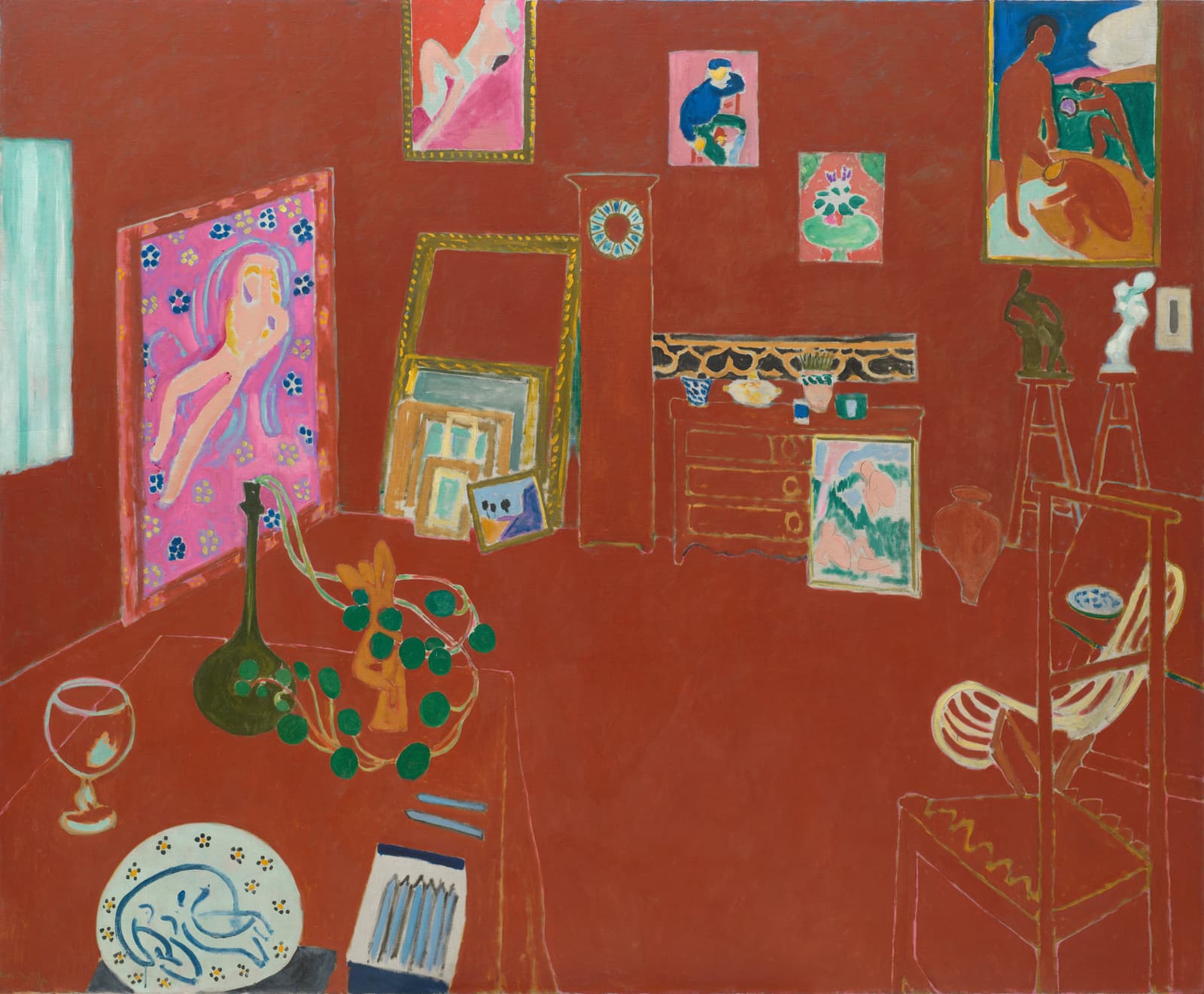
Most people remember The Red Studio through one blunt fact: the room is red.[2][3] But Matisse's 1911 painting matters because the red does not simply decorate the room or even obliterate it. It places the room in a state of suspension. Furniture, clock, table, and picture frames remain legible, yet they no longer behave like solid objects sitting securely in a believable interior. They read as traces, reserves, and islands of attention inside a field that keeps insisting on the canvas as canvas.[3][5][6]
That is why the picture still feels radical in person. It is not a monochrome stunt. It is a studio painting that refuses to choose between room and surface, self-portrait and inventory, depth and flatness. Matisse turns a private workspace into a painting about what painting can still do after perspective has been challenged but not fully abandoned.[2][4][6]
Image context: the hero image uses the full canvas because the argument depends on the whole room being held together at once. The red field matters, but so do the clock, the table, the chair legs, and the smaller paintings and sculptures that make the studio read like Matisse's own portable museum.[2][4][7]
1) It is a real studio, but not a documentary room
MoMA's exhibition materials are useful on the basic point that can get lost beneath the painting's fame: The Red Studio is a picture of Matisse's real studio in Issy-les-Moulineaux, outside Paris.[2][4] The room existed. The objects existed. The works hanging inside it existed too. The 2022 exhibition reunited the painting with surviving paintings, sculptures, and a ceramic that appear inside the composition, making visible how deliberately Matisse built this interior as a map of his own production rather than as a casual snapshot of atelier life.[2]
That matters because the painting is often discussed as if it were only a triumph of color. Color is central, but the room is already conceptually charged before the red takes over. This is a studio that behaves like a workshop, a storage space, a showroom, and a private memory theater at the same time.[2][4] The works inside the room are not background clutter. They are the evidence that Matisse is painting a space already full of earlier decisions.
Seen that way, the picture becomes a strange kind of self-portrait. Matisse never appears bodily, yet his presence is everywhere: in the furniture arranged for work, in the clock and table that mark duration and labor, and in the paintings and sculptures that let one finished work look back at another. The studio is the artist, translated into objects.[1][2]
2) The red came late, which changes everything
One of the most important things to know about The Red Studio is that the red was not the painting's starting point. MoMA's verbal description and the 2022 Heritage Science study both describe evidence of pink, blue, and ochre beneath the final surface.[3][5] On the tacking edges and across the picture plane, those earlier colors still peek through. Matisse first built a more conventionally differentiated room, then made the bold late move to cover walls, floor, furniture, and parts of the composition in Venetian red.[3][5]
That sequence is not a technical footnote. It is the painting's drama. The flatness of the work is not the innocent condition of a blank surface. It is a second-order decision laid over an earlier room. The pale lines that seem to outline the furniture are not white contours painted on top of the red; they are gaps intentionally left when the red paint was applied over the earlier composition.[3][6] In other words, the room is drawn through absence. Matisse defines things by not painting certain slivers.
This is why the painting feels at once airy and compressed. The red flattens the room aggressively, but the underlying composition keeps pressure on that flatness. You can feel the earlier architecture still pushing upward through the final decision. The painting therefore stages a conflict, not a solution: description persists inside abstraction, and abstraction never quite finishes off the room.[3][5][6]
3) The objects do not sit in the room; they float as arguments
Once the red arrives, the room's contents stop behaving like normal furnishings. They begin to function more like citations. The table on the left, the clock, the chair, the chest of drawers, and above all the smaller artworks read as independent statements pinned within the field.[2][3] They are still "in" the studio, but the red strips them of ordinary weight.
This is especially clear with the works by Matisse that hang on the walls or lean within the composition. Because they retain stronger local color than much of the room around them, they appear to hover. The studio becomes a place where paintings live among other paintings without ever settling into a single hierarchy.[2][4] The room is simultaneously container and catalogue.
That double status gives The Red Studio unusual emotional force. The picture is private, but it does not feel confessional. It feels ordered, even ceremonial. Matisse has not shown us a messy workday. He has shown us a mental room in which earlier works remain active presences. The painting is less "here is my studio" than "here is how a studio becomes a field of relations among finished objects, unfinished seeing, and the next act of making."[2][4][5]
4) Perspective breaks down, but space refuses to die
Smarthistory's account of the picture is helpful because it insists on the thing every viewer feels: Matisse is dismantling perspective, yet we still read the place as inhabitable.[6] The table tilts upward so its surface is offered to us almost as a display board.[3][6] Chair lines widen where they should recede. Architectural junctions are weakened or missing. Shadows barely do any traditional work.[3][6]
And yet the room does not collapse into pure pattern. The eye still walks it. The left wall recedes. The far corner still exerts a pull. The table remains somewhere between tipped plane and usable furniture. This is one reason the painting keeps its tension more than a century later. If Matisse had simply erased space, the picture would become a design exercise. If he had preserved space intact, the red would become atmosphere. Instead he lets both systems keep interrupting each other.[3][6]
That interruption is the real subject. The Red Studio is about the instability of figure and ground, object and field, painting and room. The red pushes forward as a surface, but it also becomes the air of the studio. The reserve lines belong physically to the lower layer, yet visually they define the objects that seem to stand above it.[3][6] Matisse turns looking into a constant re-sorting operation.
5) Why the painting still feels modern
MoMA notes that for years after its creation the painting was met with bafflement or indifference before later becoming recognized as a foundational work of modern art.[2] That delayed reception makes sense. The work does not offer modernity as one clean manifesto. It offers a room in which the old ambitions of painting and the new doubts about illusion are forced to live together.
That is why the painting still lands harder than a simple "flatness" slogan would suggest. Its achievement is not that it destroys representation once and for all. Its achievement is that it makes representation visibly provisional. The studio remains readable, but only under pressure from a red decision that is always threatening to turn everything back into surface.[3][5][6]
A quick museum sequence helps clarify the painting's logic:
- Start with the red field and notice how much of the room it absorbs.[2][3]
- Then move to the reserve lines and ask which objects are being defined by omission rather than addition.[3][6]
- Finally, trace the smaller artworks inside the studio and read the room as a painting about paintings.[2][4]
Read in that order, The Red Studio stops being merely a famous red canvas. It becomes a theory of painting staged as an interior: a place where objects, memories, and prior works are held inside one total color without ever being fully dissolved by it.
Sources
- The Museum of Modern Art, collection entry for The Red Studio (1911), including medium, dimensions, and provenance.
- The Museum of Modern Art, Matisse: The Red Studio exhibition page (2022).
- The Museum of Modern Art, verbal description transcript for The Red Studio.
- The Museum of Modern Art, "Introduction to Matisse: The Red Studio" audio transcript.
- Abed Haddad et al., "Exploring the private universe of Henri Matisse in The Red Studio," Heritage Science 10, 168 (2022).
- Beth Harris and Steven Zucker, "Henri Matisse, The Red Studio," Smarthistory.
- Wikimedia Commons, file page for L'Atelier rouge, par Henri Matisse.