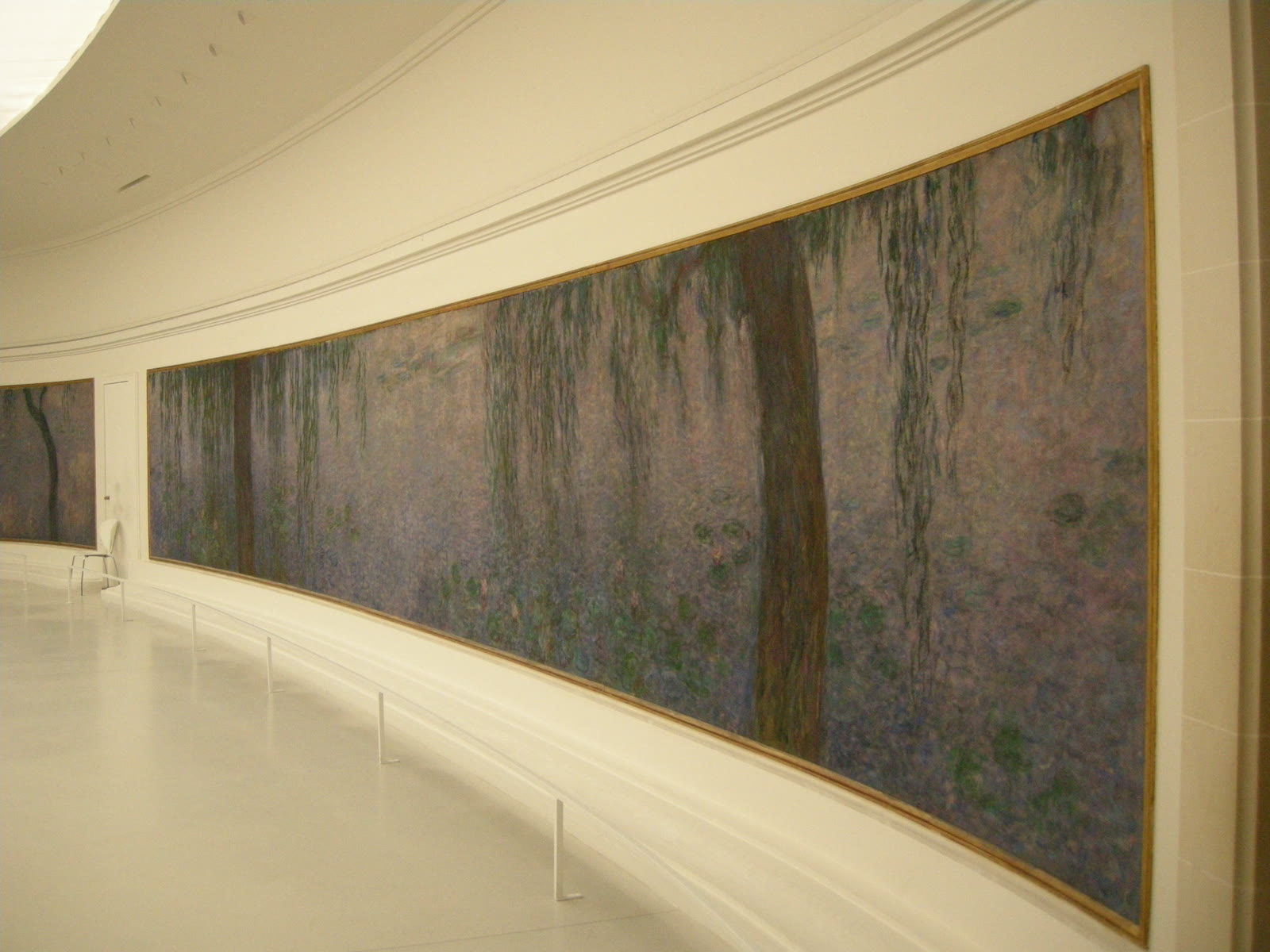
Claude Monet's late Water Lilies are often consumed as atmosphere first: pale blues, floating greens, a refuge image for calendars, tote bags, meditation playlists, and museum gift shops.[3][5] That familiarity can hide the real difficulty of the project. At the Musee de l'Orangerie in Paris, the paintings are not arranged like a sequence of framed masterpieces. They operate as a room-sized installation with curved walls, controlled natural light, and a walking rhythm that asks the viewer to read painting as environment.[3][4] The point is not simply that the works are large. The point is that they were conceived to alter how a body occupies space.
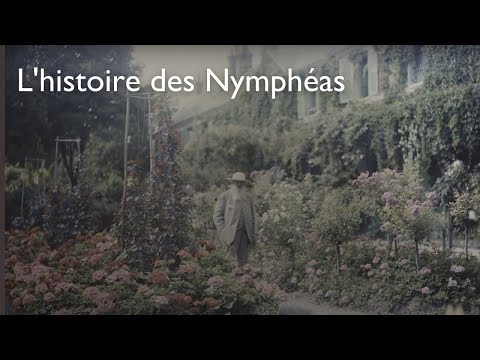
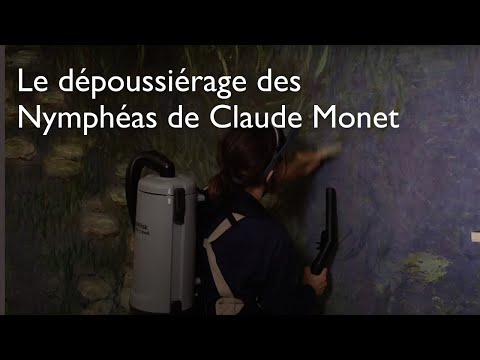
That is why these two Musee de l'Orangerie videos belong together. The first, "L'HISTOIRE DES NYMPHEAS," reconstructs the cycle as a historical and architectural project: Monet's long work on the panels, the post-World War I gift to France, the specific Orangerie setting, and the ambition to create a horizonless, enveloping experience.[1][3][4] The second, "LE DEPOUSSIERAGE DES NYMPHEAS DE CLAUDE MONET," looks narrower at first, almost backstage in its emphasis on dusting and surface care.[2] In practice it completes the argument. It shows that the rooms are not a one-time artistic idea preserved behind glass. They remain legible only through repeated custodial labor.
Both videos are in French, but they are still useful for an English-language article because their visual evidence is strong and their institutional provenance is clear.[1][2] The writing below carries the explanatory burden either way. Before watching, the key premise is simple: Monet's late cycle is most powerful when treated as a built viewing condition rather than a collection of scenic pond pictures. One video explains how the condition was designed. The other shows what it takes to keep that condition alive.
Image context: the cover uses a real photograph of one Orangerie room from Wikimedia Commons rather than a cropped reproduction of a single panel. That choice matches the article's claim. The work being discussed is not only pigment on canvas, but a specific bodily encounter with curved walls, diffuse light, and painted surfaces that unfold as you move.[7]
Video 1: the history video restores the cycle's architectural ambition
The first Orangerie video matters because it pushes against the habit of treating Water Lilies as a soft-focus epilogue to Impressionism.[1] The museum instead frames the cycle as a deliberate spatial gift, tied to a public and historical setting. The official Orangerie history page makes the stakes explicit: Monet's "Grande Decoration" was offered to France after the First World War, then installed in two oval rooms at the Orangerie after years of planning, with the museum opening the full ensemble to the public in 1927, months after the artist's death.[3] Once that background is in place, the paintings stop looking like oversized decorations and start reading like a civic environment built around duration and recovery.
The strongest contribution of the video is that it gives the rooms back their structure.[1] That sounds basic, but it is exactly what flattened reproductions erase. In books and online images, a Monet panel becomes a bounded rectangle, easy to read as a standalone painting. Inside the Orangerie cycle, the edges behave differently. The works wrap, bend, continue, and hand visual energy from one section of wall to another. The museum's "In Discovery of Claude Monet's Water Lilies" page stresses this continuity by describing a sequence meant to surround the viewer rather than confront the viewer from a single frontal position.[4] The effect is closer to an environment than to a gallery of separate pictures.
This is where the late work begins to look less like summary and more like invention. The Met's object record for a related late Water Lilies painting notes how radically Monet had pared away stable landmarks, producing broad surfaces of color and reflection with little horizon and no secure depth scaffold.[5] At the Orangerie, that pictorial change becomes architectural. The rooms turn the late style into a bodily proposition: the eye can drift, but it cannot quite finish the scene. There is no single anchor point from which the whole thing resolves. Instead the visitor accumulates the work through slow motion, side vision, and repeated adjustment to scale.[1][3][5]
One reason the video is more than a museum primer is that it makes this room-logic visible without overselling immersion as spectacle.[1] There is no techno-futurist rhetoric here, no attempt to market the cycle as a proto-digital installation. The stronger claim is more historical and more precise. Monet used paint, curvature, and daylight to create a viewing field that loosens the border between image and setting. That is why the Orangerie rooms still feel modern. They offer an immersive condition without requiring theatrical tricks beyond architecture, sequence, and the instability of reflected water.
Video 2: the dusting video shows that maintenance is part of the work's meaning
If the first video explains what Monet and the museum built, the second explains what must keep happening for the rooms to remain perceptible as artworks rather than as tired historical surfaces.[2] Dusting sounds minor until you watch the conservators move carefully across those immense painted fields. The scale alone changes the interpretive frame. These are not jewels in vitrines. They are wall-bound, light-sensitive, materially vulnerable environments that share space with visitors every day. Surface care is therefore not an afterthought. It is a condition of intelligibility.
The dusting video is strongest when it quietly destroys the fantasy that great paintings persist by inertia alone.[2] The Orangerie's own programming around the rooms points in the same direction. Even a live event such as "Dance among the Water Lilies" is framed around moving with, through, and in response to the cycle, which only works because the rooms remain visually coherent enough to sustain close public attention.[6] In other words, activation and preservation are not separate institutional departments accidentally occupying the same building. They are two sides of the same task: keeping the paintings available as an environment rather than allowing them to recede into dull mural background.
That matters for interpretation because late Monet is so often discussed in purely stylistic terms. The standard story runs through dissolving form, atmospheric color, and the approach to abstraction.[5] All of that is true, but the dusting video adds a harder material layer. A room-scale painting cycle does not simply "mean" openness, light, or contemplation in the abstract. It has to keep performing those qualities on actual surfaces. Dust accumulation, uneven attention, poor lighting, and exhausted wall presence can all lower the work's pressure. The conservators in the video are therefore not protecting a message that already exists independently of them. They are helping maintain the conditions under which the paintings can still do what Monet designed them to do.[2][3]
This is also why the video feels surprisingly contemporary. Museums increasingly talk about care, but here care is not presented as soft institutional virtue. It is technical, repetitive, and tied directly to viewer experience.[2] The result is a better understanding of why the Orangerie rooms still matter. Their serenity is not passive. It is produced. The calm that visitors feel is supported by architecture, by historical framing, and by ongoing maintenance labor that keeps the cycle from slipping into flatness.
What the two videos reveal together
Viewed together, the pair gives a cleaner account of Monet's late achievement than either video can provide alone. The history video shows that the Orangerie cycle was conceived as a room-sized act of public address after wartime rupture.[1][3][4] The dusting video shows that the cycle survives in the present only because museums keep renewing the clarity of that address through care.[2] One video is about artistic and architectural intention. The other is about transmission across time.
That pairing also sharpens a broader art-historical point. Water Lilies is often recruited as a universal symbol of calm, but the Orangerie rooms are more demanding than that slogan suggests. They ask viewers to accept slowness without narrative payoff, scale without one master view, and beauty that depends on maintenance rather than permanence.[1][2][3][5] Seen this way, Monet's late project does not merely anticipate abstraction. It anticipates installation art's deeper lesson: an artwork can be something you enter, circle, and re-encounter under managed conditions rather than something you finish in one glance.
That is why these videos are worth embedding. They return practical structure to a body of work that is too often dissolved into mood. The first says that Monet built rooms, not just panels. The second says that rooms like these remain meaningful only if institutions keep caring for the surfaces that carry them. Between architecture and upkeep, the Orangerie cycle stops looking like an afterlife of Impressionism and starts looking like one of modern art's clearest demonstrations that seeing is always staged, and staged again.[1][2][3]
Sources
- Musee de l'Orangerie, "L'HISTOIRE DES NYMPHEAS - L'histoire des Nympheas - FR," YouTube video.
- Musee de l'Orangerie, "DEPOUSSIERAGE DES NYMPHEAS - Le depoussierage des Nympheas de Claude Monet - FR," YouTube video.
- Musee de l'Orangerie, "History of the Water Lilies cycle."
- Musee de l'Orangerie, "In Discovery of Claude Monet's Water Lilies."
- The Metropolitan Museum of Art, "Claude Monet, Water Lilies, 1919."
- Musee de l'Orangerie, "Dance among the Water Lilies."
- Wikimedia Commons, "File:Musee de l'Orangerie, ninfee di Monet 03.JPG."