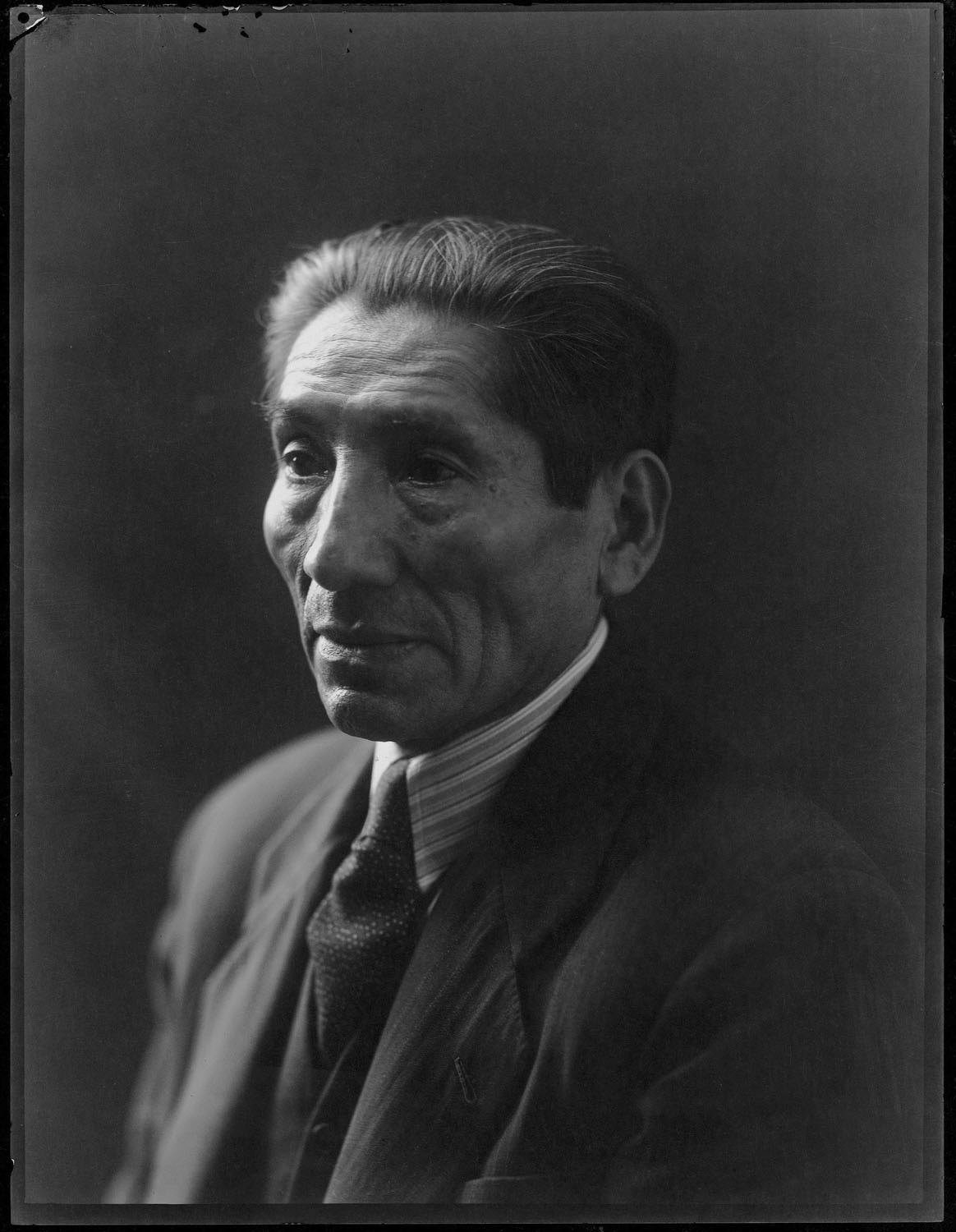
In a 1956 self-portrait, Martín Chambi gives us almost nothing with which to build a legend. There is no camera, no Andean ruin, no picturesque costume. A dark suit, striped shirt, and tie establish the occasion. Light separates his face from a nearly black field, and his gaze passes just to one side of the lens. The photograph is formal without becoming stiff: a practiced portraitist submitting himself to the same interval of scrutiny he created for other people.[1]
That restraint matters because Chambi is often introduced through an irresistible biography. He was born into a Quechua-speaking family in the Peruvian highlands, learned a technology associated with foreign companies and urban studios, and became one of the first Indigenous photographers from Latin America to achieve broad international recognition.[2][3] Every part of that story is significant. Taken as a slogan, however, it can turn him into the very thing his best portraits resist—a representative “type,” asked to stand for a whole people.
Chambi’s achievement was more unruly. He ran a business, courted clients, sold postcards, worked as a press photographer, traveled with heavy glass plates, joined Cusco’s intellectual life, and repeatedly photographed himself. His archive includes landowners and campesinos, immigrant families and local celebrities, workers, weddings, festivals, archaeological sites, street life, and social unrest.[2][4][7] He did not simply preserve an old Andes before modernity arrived. His camera was one of the instruments through which a modern Andes became visible to itself.
The profession was a route into the city
Chambi was born in Coasa, in the Puno region, in 1891. He first encountered photography around the mining company where his father worked, then traveled to Arequipa and trained in the studio of Max T. Vargas. After establishing an early practice in Sicuani, he settled with his family in Cusco in 1920; the central body of his work was made there over the next three decades.[2][3]
This route is sometimes narrated as a passage from Indigenous tradition into imported modern technology. The geography was more complicated. Early twentieth-century Cusco was not a sealed remnant of the Inca past. Rail connections brought travelers, magazines, fashions, political ideas, and new commercial networks through Arequipa and Buenos Aires. The city’s artists and writers were debating indigenismo—the place of Indigenous people and culture in the idea of Peru—while tourism and archaeology created new appetites for images of the region.[7]
A photographic studio sat directly inside those changes. It was a room where social position could be displayed, adjusted, or aspired to. Chambi used natural light to photograph prominent Cusco families, but the studio’s public was wider than its wealthiest clients.[7][8] People came to mark marriages, friendships, professional standing, fashionable clothes, and family continuity. A sitting recorded an occasion; it also recorded the fact that the sitters had chosen how to enter the photographic record.
Chambi’s technical control made that choice look consequential. Dark grounds hold bodies forward. Carefully directed light turns a face, a worn textile, or a polished shoe into evidence. Full-length poses give a sitter room rather than reducing the person to an ethnographic specimen. The same apparatus could serve a society portrait, a press assignment, or a portrait made at Chambi’s own initiative. Its meanings changed with the person in front of it.
One backdrop, unequal lives
The 1925 portrait of Juan de la Cruz Sihuana makes the stakes plain. Sihuana, an Indigenous man from the province of Chumbivilcas who stood nearly seven feet tall, almost touches the photograph’s upper edge. He wears a poncho, a chullo, patched trousers, and slight sandals. The studio’s painted cloth and controlled lighting belong to a portrait tradition historically associated with status, yet his direct gaze and extraordinary scale make the arrangement his own. Crucially, the title keeps his name: he is Juan de la Cruz Sihuana, not an anonymous “Andean type.”[5]
Art historian Natalia Calderón distinguishes a portrait, which attends to an individual, from a “human type,” which extracts shared traits and makes one body stand for a category. European and American image-makers had long represented Indigenous people through the second logic. Chambi altered that inherited gaze because an Indigenous photographer was now making images from within the society being pictured. Calderón is equally careful not to claim a clean escape: Chambi continued to use conventions through which Indigenous bodies could be generalized and consumed as types.[6]
Sihuana’s portrait contains both possibilities. Naming him and placing him within the contemporary portrait studio grant a specificity denied to anonymous postcard figures. But the photograph’s emphasis on his height, traditional clothing, and material poverty could still satisfy an exoticizing viewer. Smarthistory’s Danielle Stewart argues that the image both individualizes and romanticizes him; formal dignity does not cancel the unequal circumstances between photographer, sitter, and audience.[5]
That unresolved tension is more illuminating than the easy claim that Chambi simply “gave dignity” to his subjects. Dignity is not a lighting effect that a photographer bestows. What Chambi could do was make the usual hierarchy of visibility unstable. The studio practices used to confirm elite identity also became available for a named Indigenous sitter. The old category remained in view, but it no longer fully contained the person.
The camera left the studio
Chambi’s public extended beyond the people who crossed his threshold. He photographed Cusco’s streets, celebrations, workers, architecture, and surrounding archaeological landscape. He also sold hundreds of postcards and is credited with helping popularize the format in Peru. His photographs of Machu Picchu, made repeatedly from 1917 onward, converted difficult travel, large equipment, and patient looking into small images that could move through shops, albums, mail routes, and foreign collections.[2]
That circulation had a double edge. Postcards helped package the Andes for tourists, inviting the region to be read as scenery or an intact remnant of the past. They also let a Quechua photographer participate in deciding which views would represent Cusco to distant audiences. The same photograph could be a commodity for outsiders and a local claim about what deserved to be seen.
Chambi’s broader archive refuses to leave Cusco in historical costume. It contains women posing with a new car, sports teams, workers in a telephone exchange, carnival dress, foreign families in a chichería, and friends dancing among the stones at Machu Picchu. After the 1950 earthquake, he photographed broken streets and buildings that would have to be reconstructed.[7] Ruins in these pictures are not automatically dead, and technology is not automatically foreign. Old stone, new machines, leisure, labor, disaster, and performance occupy the same civic present.
This is why “insider” is useful only if it describes a working relationship, not a mystical privilege. Chambi knew languages, people, rituals, ambitions, and social distances that an itinerant photographer could miss. He was also a commercial professional selecting, staging, and distributing images. Proximity gave him access and responsibility; it did not make his camera neutral.
The self-portrait declares authorship
Chambi understood that he belonged in this field of representation. In his better-known 1928 studio self-portrait, he stands in profile with his face emerging from shadow, holding a glass-plate negative above a developing tray. The photograph shows both the image-maker and the material from which another image will be made. MoMA reads the work as an affirmation of artistic agency, and its staging is exact: Chambi is not merely someone who operates a camera but someone who examines, chooses, and authors appearances.[4]
The 1956 self-portrait strips away the demonstration. The plate and tray are gone; the composed professional remains.[1] Read together, the two images refuse the fantasy of an invisible documentarian. Chambi enters his own archive as technician, proprietor, Indigenous subject, urban intellectual, aging man, and artist. No single identity exhausts the others.
His self-portraits also clarify what is at stake in the portraits of other people. To face Chambi’s lens was not simply to be collected as evidence of a culture. It was to occupy a deliberately made image in a society where the distribution of visibility was unequal. The promise was never that photography would abolish those inequalities. It was that the photographed person might exceed the label prepared for them.
The archive keeps changing the picture
Chambi died in Cusco in 1973. His international canonization accelerated afterward. Edward Ranney worked with Chambi’s family to preserve and print the glass negatives; Ranney and Chambi’s son Víctor made the prints shown in MoMA’s 1979 Projects: Martin Chambi and Edward Ranney, an exhibition of roughly sixty-five photographs. The show framed Chambi’s natural-light portraits and highland documentation as an insider’s account of Cusco’s layered social world.[7][8]
The scale now looks much larger. The Asociación Martín Chambi’s digital catalogue describes a collection of 40,000 negatives alongside personal objects, period photographs, publications, and other records.[9] That abundance complicates the myth of the solitary master. Chambi’s studio included assistants and family members; his children Víctor and Julia photographed, printed, organized, and helped preserve the work. “Estudio Martín Chambi” names an author, but it also names a durable workshop.[7]
Digitization creates a final reversal. Images once made to circulate as prints or postcards can now be searched alongside their object data, places, processes, and—when research has recovered them—the names of sitters. An archive can still flatten people into categories. At its best, this one restores connections among faces, commissions, streets, families, and historical events that a selection of masterpieces cannot hold.
The many faces in Chambi’s studio do not add up to a frictionless portrait of Peru. They reveal a society divided by race and class, captivated by ancient inheritance, and actively inventing modern forms of public life. Chambi’s art lives in those crossings: portrait and type, commerce and self-representation, archaeological past and civic present, individual author and family workshop.
The quiet authority of the 1956 self-portrait comes from knowing that history. Chambi does not pose as a bridge between two neatly separate worlds. He looks like what he was: a modern artist already at work inside a world with far more than two sides.
Sources
- Museo Nacional de Bellas Artes, Buenos Aires, “Retrato de Martín Chambi,” 1956 — collection record for the black-and-white self-portrait used as this article’s cover, including medium, dimensions, and inventory number.
- The Metropolitan Museum of Art, “Martín Chambi: Panorama of Machu Picchu,” circa 1930s — collection essay on Chambi’s early encounter with photography, apprenticeship, Cusco studio, postcards, and sustained work at Machu Picchu.
- Cátedra UNESCO, Universidad de San Martín de Porres, “Martín Chambi,” 7 April 2021 — institutional biography and career timeline from Coasa and Arequipa to the Cusco studio.
- Museum of Modern Art, “Martín Chambi: Self-Portrait, Cuzco Studio,” 1928 — object record and gallery text on the glass-plate self-portrait and Chambi’s artistic agency.
- Danielle Stewart, “Martín Chambi, Juan de la Cruz Sihuana, Cuzco Studio.” Smarthistory, 5 November 2021, mirrored by Humanities LibreTexts — close reading of the portrait’s studio conventions, individualizing force, and unresolved indigenista tensions.
- Natalia Calderón, “The Impossibility of the Portrait of the Indian and the Imposition of the Human Type as a Means of Representation.” Aisthesis 75, June 2024 — analysis of portrait, type, and their transformation in Chambi’s photography.
- Silvia Spitta, Out of the Archive and Into the Streets: El Cusco de Martín Chambi, chapter 3, “Martín Chambi: The Photographer, the City, and the Archive” — digital monograph on self-representation, urban modernity, the 1950 earthquake, family workshop, and archive history.
- Museum of Modern Art, “Projects: Martin Chambi & Edward Ranney,” March 1979 — original exhibition release describing the natural-light studio, highland work, print history, and approximately sixty-five photographs shown.
- Asociación Martín Chambi, “Catálogo Digital de la Colección Fotográfica Martín Chambi” — official searchable catalogue and collection overview for 40,000 photographic negatives and related holdings.