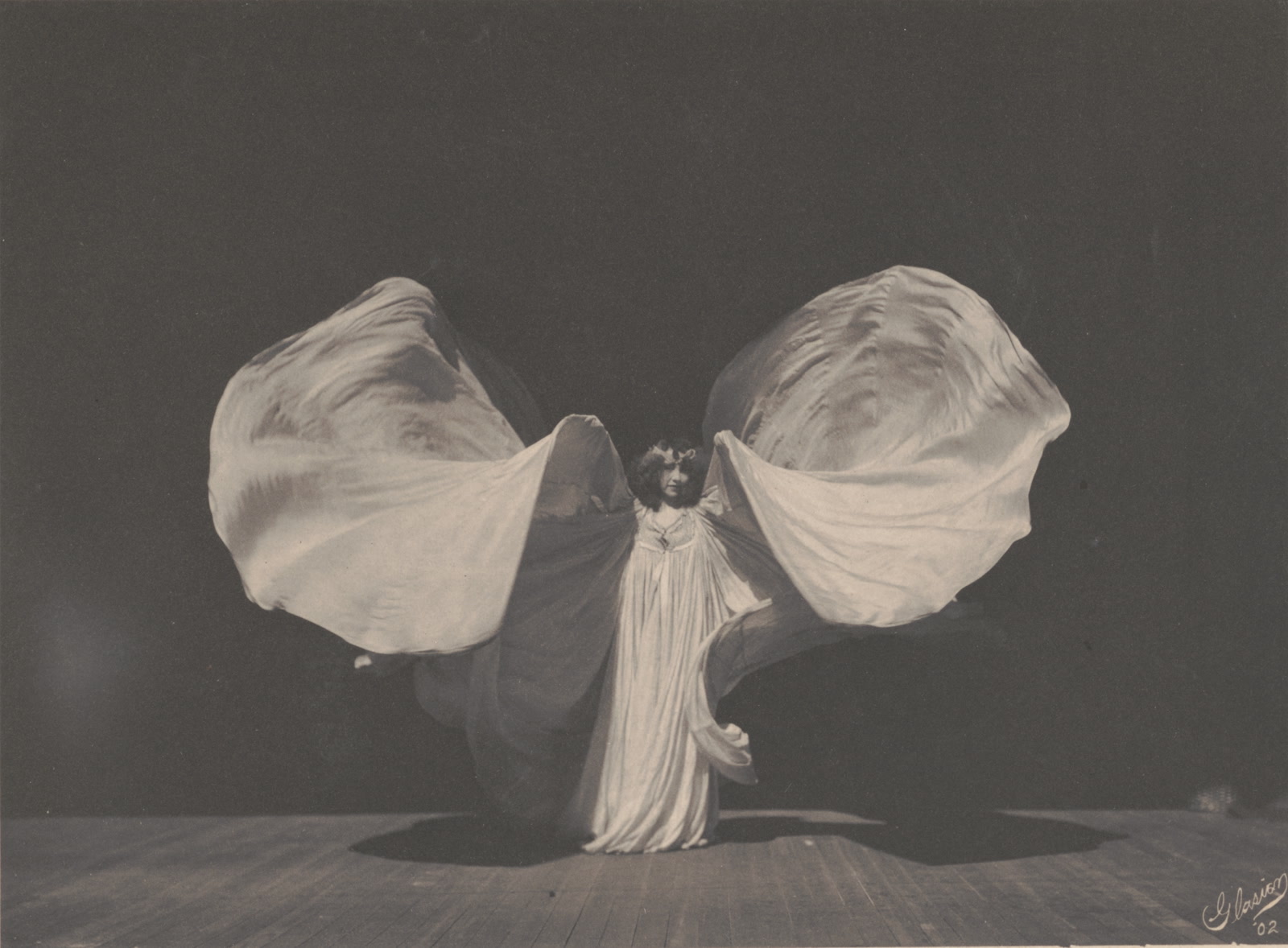
In Frederick W. Glasier's 1902 portrait, Loïe Fuller is almost the least visible part of her costume. Her face floats above a small dark bodice. Below it, pale fabric rises on either side until one dancer occupies nearly the entire frame. The Library of Congress calls the shape a butterfly, but the photograph also resembles a shell, a cresting wave, or a pair of enormous leaves.[1]
That instability was the point. Fuller's Serpentine Dance did not present a fixed image for spectators to identify. It continually replaced one image with another. Silk became wing, flower, cloud, or flame; colored light altered those forms before the eye could settle; the body that produced them repeatedly disappeared.
The effect can look effortless in a surviving photograph. It was anything but. Fuller constructed a medium from elements that usually belonged to separate trades: garment making, dance, lighting, stagecraft, and mechanical invention. Long wands extended her arms. Translucent silk converted motion into volume and light into color. Black surroundings concealed the means of production. Projectors, glass floors, and mirrors changed where illumination seemed to come from. A large technical crew made the solo possible.[2][6]
To understand Fuller's achievement, it helps to stop treating the costume as decoration. It was a responsive apparatus—one that could not make an image until a performer put it under continuous physical control.
The costume was a lever system
Fuller's Serpentine Dance grew out of an accident of theatrical attention. During an 1890 New York play, she performed a hypnotized woman in a light silk skirt under green illumination. The play failed, but the scene drew notice. Fuller lengthened the skirt, devised a more spectacular way to make it billow, and developed an abstract solo without a narrative. At the Folies-Bergère in Paris, where she debuted on 5 November 1892, flexible wands and the force of her arms sent several meters of fabric turning through projected electric color.[2]
Accounts of the mature costume describe more than one hundred yards of translucent, iridescent silk manipulated with bamboo rods.[3] Fuller's 1894 US patent makes the underlying logic unusually legible. Its drawings show a dancer surrounded by a garment assembled from lightweight triangular sections. Inside the fabric are hand-held wands—straight or curved, with bamboo and aluminum proposed as suitable materials—attached near the lower edges of the cloth. Moving the wands makes the garment rise in waves and hold temporary poses.[5]
A rod does not merely make an arm longer. It turns a small motion at the hand into a much larger sweep at the far edge of the silk. That extension gives the performer scale, but it also increases the work required to accelerate, stop, and redirect the cloth. Fuller's shoulders and wrists had to control the rods while her stance countered their changing pull. The silk followed with its own delay: it continued curling after a wand changed course, so one gesture could overlap the next.
The patent therefore documents a choreography of forces as much as a garment. Its diagrams isolate parts because a patent must explain a repeatable mechanism. In performance, however, no one saw “rod,” “panel,” and “handle” separately. Fuller made them read as a continuous form. The device amplified her movement without automating it.
Glasier's photograph preserves the apparatus at the instant of a held pose. The cloth makes the dancer monumental, while the face at its center restores a sense of scale.[1] What the still image cannot record is the transition into or out of that shape. It shows the reach of the system, not the labor of keeping it alive.
White silk was also a screen
Fuller's fabric was not just material to be sculpted. It was a moving projection surface. On a darkened stage, colored light struck silk whose pale, translucent body could catch, transmit, and mix illumination.[2][3] Color did not have to be sewn into the costume. It could arrive, intensify, vanish, and return differently while the garment remained physically the same.
This changed what a costume could do. Conventional stage clothing helps define a character and retains its color as that character moves through changing light. Fuller's silk behaved more like an image carrier. Its identity was provisional: green in one moment, perhaps violet or red in the next, with folds producing areas of saturation, shadow, and glow. Because the cloth was never flat, each wave reorganized the projected image.
Henri de Toulouse-Lautrec grasped that mutability in his 1893 lithograph Miss Loïe Fuller. Rather than establish a single definitive color scheme, he made some sixty impressions in varied combinations, occasionally adding metallic pigment.[4] The print series does not reconstruct one performance exactly. It conveys something more important about the medium: a Fuller dance did not possess one final color.
The same quality frustrated photography. A camera could record the spread of the costume, as Glasier did, but a naturally lit still could not reproduce silk changing under colored projection on a black stage. The Metropolitan Museum of Art notes that Samuel Joshua Beckett's outdoor photographs of Fuller show her movement and costume yet cannot capture the colored-light spectacle that made her famous.[3] Documentation divided the work into recoverable pieces. The rods survive in patents, poses in photographs, and chromatic possibility in prints; the full event existed only when those pieces operated together.
Darkness did technical work
Fuller's black stage was not empty space. It was an active material. By suppressing scenery, operators, and the boundaries of the room, darkness removed the visual evidence that explained the effect. Spectators could see illuminated fabric while losing sight of the body and hardware that caused it. The result was not simply a woman wearing a large dress but a bright form that seemed to move under its own power.[2]
Fuller kept expanding the possible routes between light source, dancer, and audience. An 1894 patent for stage effects proposed a false floor made partly or entirely of glass, with electric or calcium lights and reflectors beneath it. Light could travel upward through transparent sections rather than coming only from the usual front or wings. Other elements in the design used silvered or darkened surfaces to conceal supports and make a performer appear suspended.[6]
Her 1895 theatrical-stage patent pursued multiplication. Large silvered glass planes set at angles could reflect the dancer into several apparent figures; optional mirrored surfaces above and below extended the illusion. The specification also placed lights behind shields, used a black setting and dark auditorium to hide unwanted information, and imagined vertical beams as pillars of fire.[7]
These patents are a catalogue of Fuller's stage research, not proof that every mechanism appeared in every performance of the Serpentine Dance. Their value is more precise: they show what she believed could be composed. Light was not an atmosphere added after choreography. Its direction, reflection, concealment, and multiplication belonged to the work's structure.
That structure demanded coordination. Fuller trained and directed roughly thirty lighting technicians and stagehands for her performances, according to the Musée d'Orsay.[2] The number complicates the romantic image of the solitary dancer. What looked like an apparition was produced by a distributed ensemble: one performer adjusting cloth in real time, with operators adjusting light and machinery around her. The image was live because the system was live.
Disappearance did not mean disembodiment
Fuller was celebrated for making her body vanish, but her method never escaped the body. It intensified what the body had to do.
The rods extended her visible reach while transferring their leverage back into her hands. The silk hid her legs while making balance more consequential. Darkness erased the stage's stable coordinates, so the fabric had to define its own moving space. Lighting could turn cloth into flame, but only if Fuller delivered the surface at the angle and instant the beam required. Her disappearing act depended on muscular decisions that spectators were encouraged not to notice.
This distinction separates the work from a mechanical special effect. The patents describe devices, yet the medium was the relationship among device, material, and practiced action. A wand lying inside silk produces nothing. A projector aimed at an empty stage produces only a beam. Fuller's art was the continuous calibration that joined them.
The photograph makes this paradox visible if we look past its butterfly silhouette. Fuller's feet are planted beneath a great fan of cloth; her head and torso occupy the narrow hinge between two raised masses.[1] The costume seems to exceed her, but its symmetry reveals that it is being actively held. The human figure is both concealed by the image and responsible for every part of it.
That is why it is too narrow to classify Fuller as only a dancer who adopted new technology, or as an inventor who used dance to demonstrate machinery. Her unit of composition was the feedback loop: move the wand, watch the silk answer, meet it with the next movement, and place that changing surface into light. Technique was not hidden beneath the artwork. Technique was the artwork's temporal form.
A medium that could be copied but not contained
Fuller's success quickly produced imitators. From 1896 onward, colored films of serpentine dances circulated widely in Europe and the United States, often performed by other dancers.[2] That history makes attribution treacherous: an early film labeled with the famous dance may preserve Fuller's visual idea without preserving Fuller.
The copying also exposes the double edge of her inventions. The system had a recognizable grammar—pale fabric, arm extensions, darkness, changing color—and that grammar could travel without its author. Patents could name particular garment and stage mechanisms.[5][6][7] They could not contain the timing, endurance, judgment, and coordination through which Fuller made those mechanisms cohere.
Yet imitation should not reduce her to a source of motifs. It demonstrates that she had produced a medium robust enough to become a convention. The Serpentine Dance offered a new way to build an image in public: not by fixing pigment to a surface, and not yet by projecting a finished strip of film, but by controlling matter and illumination moment by moment. The image had no single original state. It was an event.
Glasier's portrait gives that event a memorable emblem. Fuller stands inside a fabric butterfly, apparently transformed.[1] But the deeper transformation took place among categories. A dress became a screen; a rod became an anatomical extension; darkness became scenery; illumination became color in motion; a solo became the visible edge of collective technical labor.
Fuller made the dancer disappear so that a new kind of image could appear. The great irony is that the more autonomous the silk looked, the more completely the effect relied on her. Its freedom was engineered, rehearsed, and held aloft by hand.
Sources
- Library of Congress, “Loie Fuller, full-length portrait, standing, facing front; raising her very long gown in shape of butterfly,” Frederick W. Glasier, circa 1902 — archival photograph, catalog metadata, and rights advisory.
- Musée d'Orsay, “Qui était Loïe Fuller?” — institutional account of the Serpentine Dance's development, Paris debut, lighting methods, technical crew, stage experiments, patents, and imitators.
- Metropolitan Museum of Art, “Samuel Joshua Beckett: [Loie Fuller Dancing]” — object record and curatorial essay on Fuller's silk costume, bamboo rods, colored light, dark stage, mirrors, and the limits of still photography.
- Museum of Modern Art, “Henri de Toulouse-Lautrec: Miss Loïe Fuller,” 1893 — collection record and curatorial account of Fuller's innovations and the lithograph's varied color impressions.
- US Patent 518,347, “Garment for Dancers,” patented 17 April 1894 — Fuller's primary specification and drawings for the lightweight garment, internal wands, attachments, and wave-like effects.
- US Patent 513,102, “Mechanism for the Production of Stage Effects,” patented 23 January 1894 — Fuller's primary specification for transparent stage flooring, concealed supports, lights, and reflectors.
- US Patent 533,167, “Theatrical Stage Mechanism,” patented 29 January 1895 — Fuller's primary specification for angled mirrors, hidden lighting, black surroundings, and multiplied stage images.