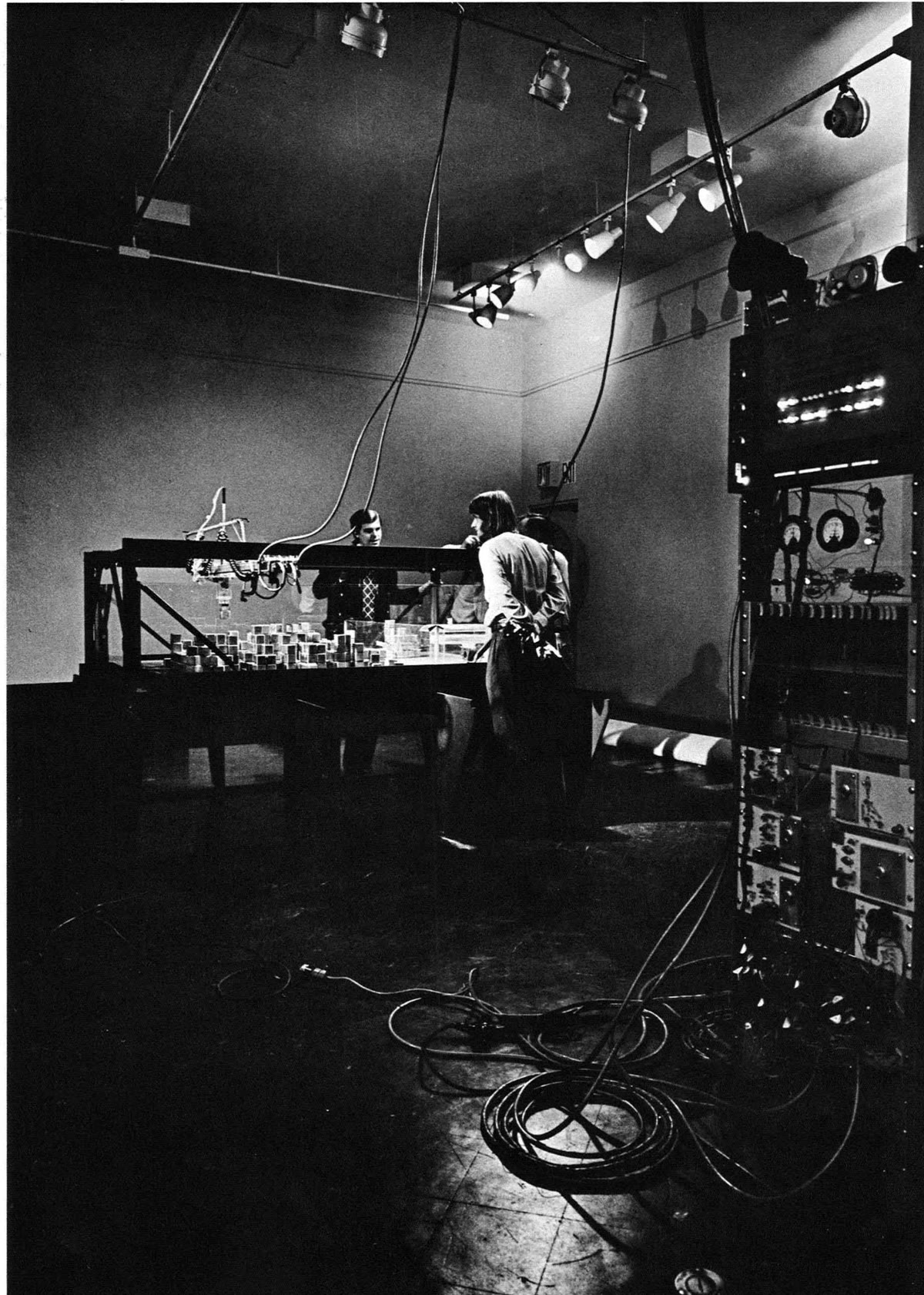
The first surprise in the archival photograph is how much room SEEK needs. Cables descend from the ceiling. An electronics rack rises at the right. A gantry stretches over a glass enclosure filled with small metal-faced cubes, while several people gather at its edge. The gerbils—the living inhabitants on whom the experiment depended—are too small to command the picture. The machine, its makers, and its infrastructure dominate the gallery.[1]
That imbalance is more than a quirk of documentation. It is the central problem SEEK made visible. The installation could detect a displaced block, decide whether to restore or accept its position, and send an electromagnet to move it. What it could not do was establish why a gerbil had moved the block, whether the new arrangement served the animal, or whether the animal experienced the machine's reply as accommodation, obstruction, or threat.[1][2][3]
SEEK is often introduced as an early intelligent environment. A sharper description is that it was an environment with a very precise vocabulary for being surprised. Its artistic force lies in the distance between those two claims.
A block world enters the museum
The Architecture Machine Group at MIT developed SEEK under Nicholas Negroponte and Leon Groisser for Software: Information Technology—Its New Meaning for Art, curated by Jack Burnham at the Jewish Museum in New York from September 16 to November 8, 1970. The exhibition then traveled to the Smithsonian Institution in Washington. Its catalogue refused a neat division between technical demonstration and art show: it treated information processing, instructions, responsive situations, and human behavior as material through which visitors could reconsider what an artwork might be.[1]
SEEK made that proposition unusually physical. A five-by-eight-foot superstructure carried a moving carriage with three degrees of freedom. At its working end were an electromagnet, microswitches, and pressure-sensitive devices. An Interdata Model 3 computer with 65,536 single bits of shared instruction-and-data memory directed the apparatus. Below it sat a colony of gerbils among five hundred two-inch, metal-faced cubes.[1][2]
The arrangement turned an abstract computing problem into a public scene. The computer held a representation of the block field. The gerbils pushed through the field, knocked cubes out of line, and made the stored representation stale. The machine then tried to reconcile what Negroponte later called its model of the world with the real world.[2]
That reconciliation contained an interpretation. A slightly crooked cube could be realigned. A substantially displaced cube could be accepted in its new location, then set straight on the assumption that the animals wanted it there. In other words, SEEK did not merely repair a geometric discrepancy. It translated displacement into preference.[2]
The move is ingenious because it avoids restoring every disturbance to a fixed master plan. It is also perilous because the system has no independent access to desire. The machine can register that the world changed; its designers decide what that change means.
A user model without the user
The exhibition catalogue cast the gerbils as a miniature stand-in for unpredictable people. If a machine could cope with these animals overturning its orderly block world, perhaps future architecture machines could become responsive to changing, context-dependent human needs. The project therefore joined a modest mechanism to an expansive promise: intelligent environments might learn not simply to execute instructions, but to negotiate with their inhabitants.[1]
Yet the mechanism and the promise operated at different scales. Architectural historian Nathalie Kerschen reconstructs six operating modes—generate, degenerate, fix, straighten, find, and error detection—and notes that the apparatus worked mainly on the orientation and placement of cubes. Its sensing and action were real. So was the gap between manipulating an inhabitant's surroundings and understanding the inhabitant.[3]
The gerbils were legible to SEEK only through consequences that appeared in the block field. Curiosity, shelter-seeking, agitation, fatigue, and fear did not exist as distinct states within that field. This does not mean the machine misclassified those experiences; it means they were unavailable for classification at all. The animal entered the computation as a source of local displacement.[3]
That boundary changes how the word “responsive” should be heard. A thermostat responds to temperature. A door responds to a sensor. Neither response is reciprocal in the social sense. SEEK could answer an altered cube position without recognizing the animal as a living center of perception whose needs might not be expressible as cube geometry.
The distinction is not a demand that a 1970 computer should have possessed impossible powers. It is a demand that we keep separate what a system detects, what its operators infer, and what its subjects experience. SEEK blurred those layers in its rhetoric even as its exposed hardware made the blur available for inspection.[1][3]
Failure is evidence, not absolution
The primary catalogue describes a lively environment in which unpredictable animals provoke elementary forms of machine response. Later accounts are much darker. Kerschen's scholarly reassessment and the University at Buffalo's retrospective both describe technical breakdown, animal distress, fighting, and illness. Their details come through a chain of recollection and later publication, so they should not be collapsed into one perfectly documented incident report. They nevertheless establish an ethical boundary that the optimistic catalogue does not: the gerbils were not metaphorical users. They were captive animals inside a machine's trial.[3][5]
It would be easy to turn that breakdown into a flattering avant-garde story. The disorder “defeated” computation; life proved more unruly than the model; failure became the masterpiece. That reading extracts another benefit from the animals while making their welfare secondary again.
The more responsible conclusion is narrower. SEEK exposed the cost of treating a measurable trace as a sufficient account of its producer. A changed block could be evidence of preference, play, collision, escape, stress, or several things at once. The machine's action did not resolve that ambiguity. It merely operationalized one interpretation of it.[2][3]
This is why the work's limitation cannot be assigned to weak processing power alone. A faster arm, richer memory, or better block detection might have made SEEK more reliable at its chosen task. None would automatically have supplied the missing question: what counts as a good response for the being who has to live with it?
Why the gallery mattered
If SEEK had remained inside an engineering laboratory, its block handling might read as one prototype among many. In a museum, the entire relation became available to view: living colony, computed model, corrective mechanism, technicians, crowd, sponsor, and institutional frame. The artwork was not the robotic arm alone, nor the cubes, nor a visual pattern produced at the end. It was a contested loop unfolding in public.[1]
The 1970 photograph preserves that reading better than a clean technical rendering could. The apparatus does not look autonomous. Thick cables lead away from it; people stand close enough to intervene; the computer rack occupies as much visual weight as the habitat. What the catalogue calls an intelligent exchange appears as labor, wiring, enclosure, and attention. The photograph restores the dependencies that the word “intelligence” tends to hide.[1]
It also makes the spectators' position uncomfortable. Visitors could look down into the gerbils' world while the machine looked for displaced cubes. Both forms of observation converted the enclosure into a legible event. The animals, meanwhile, had no equivalent view of the institutional experiment surrounding them. Participation was real, but it was not symmetrical.
That asymmetry is the reason SEEK belongs in the history of new media art rather than only in a prehistory of smart buildings. It staged a question that interactive art keeps inheriting: when a system invites action, whose definition of meaningful action governs the encounter?
The reconstruction changes the protagonist
SEEK did not survive as a stable object that could simply be switched on again. Its afterlife has required reconstruction. ZKM's collection record for Lutz Dammbeck's Seek II describes a machine habitat rebuilt through versions made between 2001 and 2023, accompanied by a 2017 film and archival material. ZKM places the historical experiment beside contemporary systems for surveillance, behavioral analysis, and the direction of opinion.[4]
That reconstruction does more than repeat the original mechanism. It changes the protagonist. In 1970, the catalogue asked whether an architecture machine could learn to handle contingency. In the later museum frame, the history of that ambition—its metaphors, omissions, and social consequences—becomes the subject.[1][4]
The shift protects SEEK from being remembered as a quaint prophecy of today's sensor-filled environments. Prophecy is too easy: find an old machine that resembles a current one, then praise its designers for arriving early. SEEK matters because its past is not cleanly continuous with the present. Its blocks, gerbils, and arm preserve an argument that still has not been settled.
Responsive is not reciprocal
The enduring lesson of SEEK is not that machines fail whenever living beings behave unpredictably. The machine did perform meaningful work: it sensed discrepancies, selected among responses, and changed a physical environment. The lesson is that competence inside a model does not guarantee adequacy to the world the model governs.
A system may correctly detect every event it was built to detect and still omit what matters most. It may call a disturbance a preference because preference has been reduced to the only signal available. It may adapt the environment while leaving the inhabitant less able to inhabit it.
SEEK gave that problem a memorable form. A metal cube sits crooked. The arm straightens it. The operation succeeds. The question remains: successful for whom?
Sources
- Karl Katz, Jack Burnham, Theodor H. Nelson, and James A. Mahoney, Software: Information Technology—Its New Meaning for Art, Jewish Museum exhibition catalogue, 1970 — exhibition framing, dates, installation photograph, participants, and primary technical description of SEEK.
- Nicholas Negroponte, Soft Architecture Machines, MIT Press, 1975 — primary retrospective account of SEEK's five hundred cubes, correction logic, and mismatch between stored model and physical world; open-access copy hosted by Cornell University.
- Nathalie Kerschen, “Towards a New Understanding of the Animal,” in Utopia Computer: The “New” in Architecture?, TU Berlin University Press, 2023 — scholarly reconstruction of SEEK's operating modes and critical analysis of the animal-machine model.
- ZKM | Center for Art and Media Karlsruhe, “Seek II” — official collection record for Lutz Dammbeck's reconstruction, film, archival context, and contemporary critical framing.
- University at Buffalo, Center for Architecture and Situated Technologies, “ARC 605: (re)seeking architecture,” 2018 — institutional retrospective on the original installation's breakdown and its legacy for responsive environments.