
Martha Rosler's Semiotics of the Kitchen lasts only a little over six minutes, but it still feels structurally severe. Nothing in it is lush. The camera is fixed. The kitchen is ordinary. Rosler stands in an apron and dark shirt, facing the viewer with an expression that refuses television warmth. Then she begins an alphabet of utensils. The setup borrows the grammar of a cooking demonstration, but the demonstration keeps failing its supposed purpose. Tools are named, lifted, and handled; food is not prepared. The kitchen becomes less a room of nourishment than a small theater in which language, labor, anger, and gendered expectation collide.[2][3]
That is why this short video belongs in an archival spotlight rather than a simple "watch this classic" note. Its historical force is not only that it is a landmark of feminist video art. It is that Rosler understood early video as a way to contest television from inside television's own habits: frontal address, domestic space, small-screen scale, instructional pacing, and the authority of the person who names what the viewer sees.[2][4] In 1975, that mattered. Video could circulate outside the museum-painting system, but it could also mimic the broadcast forms that shaped private life. Rosler uses that double condition sharply. The work looks easy to access and hard to domesticate.
The kitchen setting is crucial because it is not neutral scenery. Rosler's own page for the work describes an unsmiling woman, the opposite of the perfect television housewife, demonstrating kitchen tools while replacing their domesticated meaning with an alphabetic lexicon of rage and frustration.[2] Video Data Bank frames the same work as a mock show-and-tell in which ordinary objects are renamed through gestures that no longer obey their household function.[3] Those descriptions agree on the key point: the video does not simply criticize a kitchen. It criticizes the signs that make kitchen labor appear natural, feminine, and almost invisible.
Historical Context
The 1970s were a decisive moment for feminist art because artists were not only adding women to existing art categories. They were testing the categories themselves: who counted as an author, what counted as work, which rooms counted as political, and how mass media trained viewers to accept hierarchy as common sense. Rosler's practice sat exactly in that field. Video Data Bank describes her early work across photography, performance, writing, and video as an effort to deconstruct cultural reality, especially the ideological split between public and private life.[3] That split is the hinge of Semiotics of the Kitchen. The kitchen is private only if one ignores how deeply it has been scripted by advertising, television, family structure, commodity design, and unpaid labor.
The work's title makes the method explicit. Semiotics is the study of signs and sign systems, and Rosler treats the kitchen as a sign system that has already spoken before the woman in the frame gets to speak. Video Data Bank quotes her later account of wanting to show language speaking the subject and the woman transformed into a sign in a system of food production and "harnessed subjectivity."[3] The phrase can sound theoretical until the video begins. Then it becomes practical. The apron names a role. The utensils name a job. The cooking-show format names a mood: helpful, competent, pleasant, contained. Rosler accepts those signs just long enough to make them malfunction.
This is also why the piece should not be flattened into a general "angry housewife" image. Rosler's performer is not improvising rage in a naturalistic scene. She is working through a strict structure: alphabet, object, gesture, address. The discipline matters. Cleveland Museum of Art's object record emphasizes that she picks up and names utensils but demonstrates uses that do not match their normal function, thereby transgressing everyday kitchen meanings and gendered domestic labor.[4] In other words, the video is not anti-tool or anti-cooking in a simple sense. It is anti-script. It asks what happens when the objects that normally organize compliance are made to signify resistance instead.
Video Provenance
The embedded video is a YouTube viewing copy titled Martha Rosler - Semiotics of the Kitchen 1975.[1] The archival work itself is described by the artist's own site and by major museum and video-art institutions: Rosler's page identifies it as a 1975 video running 6:09 minutes; Whitney lists its collection copy with the same date, classification, and aspect ratio; Cleveland Museum of Art and Video Data Bank likewise identify the work as a 1975 black-and-white video centered on Rosler's parody of a cooking demonstration.[2][3][4][5] Those records are the reason the YouTube embed is used here as access, not as the authority for the artwork's identity.
Close Reading
The first thing to notice is the video's refusal of hospitality. Cooking shows usually promise access: the host smiles, the instructions calm the viewer, and tools become extensions of domestic competence. Rosler reverses that contract. Her direct address is not friendly in the usual broadcast sense. It makes the viewer responsible for watching the signs break down. The fixed camera intensifies the pressure because there is no cutaway to rescue the scene with variety. We stay with the performer, the table, the utensils, and the blank force of naming.
The alphabet gives the work its hard spine. Alphabetic order is one of the first cultural forms used to make language feel orderly, objective, and teachable. Rosler borrows that authority, then loads it with contradiction. As she moves from tool to tool, the labels sound like definitions, but the gestures often refuse function. A kitchen object normally mediates between body and meal: chop, stir, grate, press, roll. In Rosler's hands, the object starts to mediate between body and social pressure. The knife is not only a knife. The rolling pin is not only a rolling pin. The alphabet is not only a learning device. Each becomes a sign that has been forced to carry too much instruction.
That is the most durable insight of the video: oppression does not always announce itself as law or explicit command. It can arrive as a choreography of ordinary objects. A person reaches for a tool because the task has been assigned, and the task feels natural because the room is organized to make it repeatable. Rosler's gestures interrupt that smoothness. She does not destroy the kitchen. She makes it strange enough to see.
The deadpan tone also matters. If the video were openly theatrical from the start, the viewer could file it away as satire. Instead, Rosler keeps the performance close to demonstration, which makes the deviations more disturbing. The mock instruction format keeps asking: who gets to name a tool, who gets named by it, and what happens when the named function no longer holds? This is why the piece remains clearer when watched as media analysis rather than as a simple domestic outburst. The target is not one bad kitchen. The target is a whole representational system in which women, labor, tools, food, and service have been made to look mutually natural.
The final sequence, when the work moves beyond ordinary utensil demonstration toward letters made with the body, is especially important. The body stops appearing as the hidden operator of domestic labor and becomes a sign-making instrument in its own right. That shift completes the reversal. At the beginning, the woman seems trapped inside a kitchen vocabulary that precedes her. By the end, the body has entered the alphabet and changed the terms of address. The result is not liberation in a sentimental sense. It is refusal made legible.
Legacy
Nearly fifty years later, Semiotics of the Kitchen still feels sharp because it does not depend on period nostalgia. The appliances, hairstyle, and video texture are archival, but the mechanism remains recognizable: a media form presents domestic competence as natural; an artist slows it down until its rules become visible. That is one reason museum records keep emphasizing the relation among language, performance, gender, and video history rather than treating the work merely as a historical curiosity.[2][3][4][5]
The piece also clarifies why early video art mattered for feminist practice. Video could be cheap, direct, frontal, and awkward in useful ways. It did not need the finish of cinema or the prestige of painting. Rosler turns those constraints into strengths. The fixed camera is not a limitation; it is a trap she sets for the viewer. The low-resolution black-and-white image is not a deficit; it rhymes with television's domestic authority. The short duration is not minor; it makes the structure compact enough to behave like an argument.
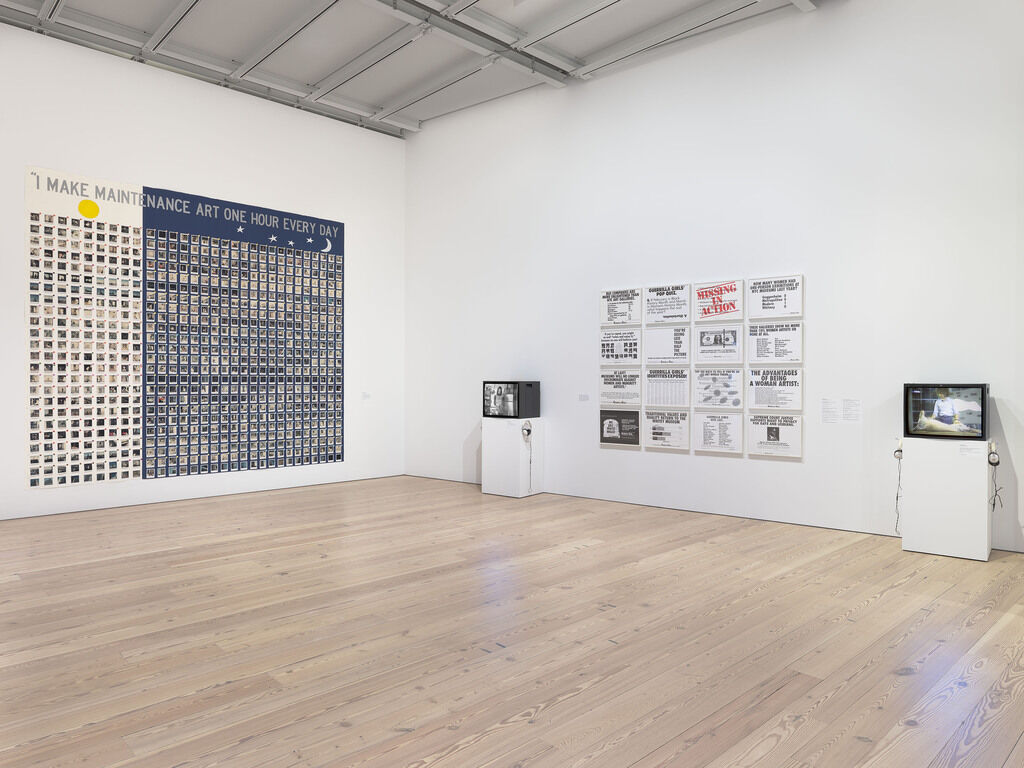
The installation photograph used here captures the work's afterlife rather than freezing the video into a screen grab: Rosler's monitor sits in a Whitney room with other feminist and protest works, so the kitchen is seen as part of a broader language of art, labor, and public argument.[6] The moving work still matters because meaning changes through sequence. Tools accumulate. Naming tightens. Gesture turns utility into pressure. By the end, the kitchen has not disappeared. It has been reread. Rosler's achievement was to make that rereading feel both analytical and bodily, as if a whole system of signs had been forced, for six minutes, to answer back.
Sources
- Martha Rosler, "Semiotics of the Kitchen 1975," YouTube video used for the embedded viewing copy.
- Martha Rosler, "Semiotics of the Kitchen" - artist page identifying the 1975 video, duration, and alphabetic lexicon of domestic meaning.
- Video Data Bank, "Semiotics of the Kitchen" - artist, date, duration, tags, and description of Rosler's mock cooking-show structure.
- Cleveland Museum of Art, "Semiotics of the Kitchen" - object record describing the parodic cooking demonstration, mismatched gestures, and gendered domestic labor.
- Whitney Museum of American Art, "Martha Rosler, Semiotics of the Kitchen" - collection record, acquisition details, medium, duration, aspect ratio, and exhibition context.
- Whitney Museum of American Art, installation view of An Incomplete History of Protest: Selections from the Whitney's Collection, 1940-2017 - gallery photograph by Ron Amstutz showing Rosler's work in feminist/protest context.
Editor’s Pick Review
This article takes today’s merged standard/add-on editor-pick slot because it has the strongest 24-hour balance of originality, source control, image-policy compliance, and bilingual finish. The English piece gives Semiotics of the Kitchen a precise archival frame: the video is treated as feminist media analysis, not as a generic classic clip, and the argument moves cleanly from domestic signs to alphabetic structure, television address, institutional afterlife, and political context. Its cover image is a real Whitney installation photograph, immersive and topic-grounded rather than analytical or decorative, which makes it especially clean under the tightened visual policy. The Chinese edition preserves the literary-critical rhythm with natural paragraph movement, stable terminology, and low translationese, so the pick works as a complete English/Chinese editorial package rather than only as a strong source article.