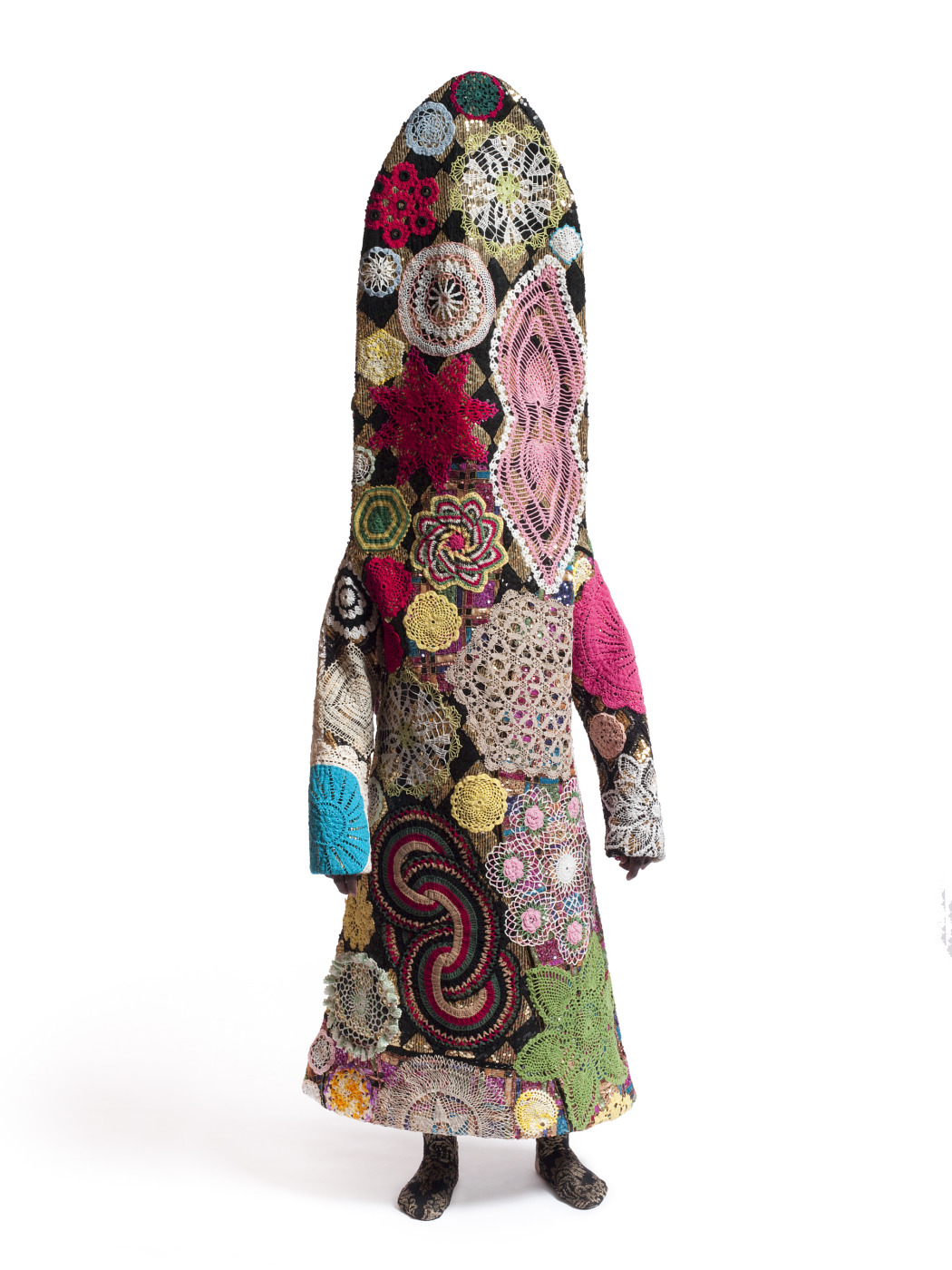
Nick Cave's 2009 Soundsuit looks festive before it explains why festivity is not the whole point. The Smithsonian American Art Museum's photograph shows a tall upright form covered in doilies, textile circles, pattern, and color: reds, pinks, greens, blues, yellows, whites, small domestic geometries layered until the body underneath becomes unreadable.[1] The surface is inviting. It has the warmth of handwork and the theatrical confidence of a costume waiting for lights. But the work's force comes from the contradiction it refuses to smooth away. This is a sculpture that can be worn, a costume that can stand still, a decoration system built from discarded material, and a shield that makes sound.
That last word is not incidental. SAAM records that Cave, trained as both fiber artist and dancer, named the series for the rustling he heard when he moved inside the suits.[1] A viewer facing the object in a museum photograph cannot hear that rustle, but the photograph still prepares the ear. The doilies do not read as flat ornament. They look like accumulated contact: stitched, looped, found, handled, and ready to brush against one another. The work asks the eye to imagine friction.
Image context: this post uses one real museum photograph of the artwork itself, not a diagram, chart, generated image, or decorative art-adjacent placeholder. The image-work match is direct: the Smithsonian object photograph shows Cave's 2009 mixed-media Soundsuit and lets the reader see the exact material density that the article is reading.[1]
The Body Is Present Because It Is Hidden
The first important thing about this Soundsuit is that it does not simply represent a body. It reorganizes one. SAAM lists the object at ninety-six inches high, twenty-six inches wide, and twenty inches deep, a scale tall enough to exceed most viewers while still preserving the sense that a person could animate it.[1] The suit's bodily implication is therefore double. It is empty in the photograph, but not vacant. It has shoulders, a column, a footed base, and a head-like upper extension. It waits as if motion has been paused rather than excluded.
Cave's series began from a more severe pressure than the object's beauty might first suggest. SAAM's object text and education page both connect the first Soundsuit to Cave's response to the 1991 beating of Rodney King by Los Angeles police officers.[1][2] Cave imagined these wearable sculptures as protective shields that could mask identity and scramble the viewer's assumptions about race, class, and gender.[1] That origin does not turn every later suit into a single-note political emblem. It does something more precise: it makes concealment a formal choice with social stakes.
In this 2009 suit, concealment is not bleak. The body is hidden by abundance. Instead of armor made from metal plates or hard edges, Cave builds a protective skin from domestic craft, thrift-store excess, and decorative labor. That is why the work should not be reduced to "costume." Costume often clarifies identity: profession, class, character, gender, ritual role. Cave's Soundsuit withholds those classifications. The wearer is not simply transformed into another legible character. The wearer becomes harder to sort.
Doilies Are Not Soft Evidence
SAAM identifies this suit as composed of doilies Cave collected from thrift stores.[1] That material fact is the key to the whole reading. A doily carries a social history of domestic display, patience, handiwork, inherited taste, table protection, and the feminized labor of making ordinary surfaces look cared for. In many homes, a doily is background: placed under a lamp, folded away, inherited, donated, dismissed as old-fashioned. Cave does not treat that background status as weakness. He makes it cumulative.
The result is a surface that looks generous but also guarded. Each doily is small enough to be familiar, yet the massing makes the suit almost impossible to inventory. The eye keeps trying to separate parts: a flower, a starburst, a lace edge, a circle, a color change. The work answers by refusing a stable hierarchy. No single patch explains the whole body. The suit is made from little acts of attention that have been rescued from low value and pushed into public intensity.
That rescue matters because Cave's art often turns devalued material into a different kind of relevance. SAAM's object page frames the work through found objects given new life, while the broader museum account of Cave's 2026 Mammoth exhibition describes him as an artist who combines sculpture, performance, and fashion while remaining interested in history and identity.[1][5] The 2009 Soundsuit sits exactly at that crossing. It is not a garment decorated after the fact. It is a social archive that has learned how to stand upright.
Sound Changes The Sculpture's Ethics
The word "sound" keeps the work from becoming purely optical. If the suit only asked to be looked at, its dense surface could become spectacle. Sound makes the object relational. It implies a body moving, an audience nearby, a room that hears the sculpture before it fully understands it.
Whitney's artist page summarizes Cave as a sculptor, dancer, performance artist, and professor, and stresses that the Soundsuits are wearable assemblage-fabric sculptures often made with found objects.[3] That description matters because it keeps the work from being trapped in one discipline. Sculpture supplies volume. Fashion supplies wearability. Dance supplies movement. Performance supplies the public encounter. Found-object assemblage supplies the material memory. The Soundsuit is strong because none of those categories gets to dominate the others.
This is why the work's silence in the still photograph feels charged rather than incomplete. The photograph gives the object a pause state. We see the suit as a figure, almost ceremonial, but the title insists that stillness is not the full condition. The true body of the work includes the possibility of shaking, rubbing, swaying, stepping, and sounding. Protection is not passive here. It is active enough to be audible.
Beauty Is A Defensive Strategy
The most tempting misreading is that the suit's color and exuberance soften its political charge. Cave's art works in the opposite direction. The beauty is part of the defense. A shield that looks like punishment would confirm the world that made shielding necessary. Cave instead builds a shield that exceeds the terms of threat. It protects by refusing the viewer a clean target, but it also protects by insisting on pleasure, complexity, excess, and theatrical life.
The Guggenheim's 2022 Forothermore press release is useful here because it frames Cave's survey around marginalization, social performance, found materials, collaboration, and survival strategies amid injustice.[4] Those terms help explain why the Soundsuit does not choose between celebration and danger. It holds them together. The work comes from vulnerability, but it does not perform vulnerability as exposure. It answers exposure with splendor.
That splendor has discipline. The Smithsonian photograph shows a narrow, vertical object rather than a loose explosion of stuff.[1] The suit's contour is tight enough to preserve bodily address. The surface is wild only within a governing silhouette. That balance is crucial. If the work were only chaotic, it would lose the sense of a protected person inside. If it were only neat, it would lose the living noise of accumulated material. Cave keeps both: a controlled figure made from uncontrolled associations.
Why This Suit Still Feels Current
The 2009 Soundsuit still feels contemporary because its central problem has not aged out. Public identity remains a site of sorting, surveillance, projection, and risk. The question "Who is under there?" is not neutral when bodies are read through race, gender, class, sexuality, and perceived threat before they are allowed complexity. Cave's suit makes that question harder to ask casually. It blocks identification and replaces it with relation: surface, movement, sound, material history, and the viewer's own desire to categorize.
SAAM's 2026 Mammoth exhibition page shows that Cave's practice has continued to broaden into new bodies of work, but it also confirms the continuity: history, identity, transformation, and imagination remain central concerns.[5] The 2009 Soundsuit is therefore not only an early signature form to be filed under biography. It is a working grammar for the later practice. It teaches Cave's art how to turn fear into movement without denying fear, and how to turn discarded material into ceremony without pretending discard was innocent.
The achievement of this particular suit lies in how lightly it carries a hard argument. The doilies invite attention before the viewer has prepared a theory. The scale makes the object bodily before the wearer appears. The title makes the photograph audible. The origin story makes the beauty accountable. Cave turns protection into noise because silence would leave the shield too close to withdrawal. In a Soundsuit, the protected body does not disappear. It becomes difficult, radiant, mobile, and impossible to hear as only one thing.
Sources
- Smithsonian American Art Museum, "Soundsuit" - official object page for Nick Cave's 2009 mixed-media sculpture, with dimensions, medium, credit line, artwork description, and the James Prinz Photography image used for this article.
- Smithsonian American Art Museum, "Nick Cave on Soundsuit" - education page connecting the series to Rodney King, identity masking, movement, and Cave's own artist commentary.
- Whitney Museum of American Art, "Nick Cave" - artist page summarizing Cave's sculpture, dance, performance background, Soundsuit series, found-object materials, Chicago base, and retrospective history.
- Solomon R. Guggenheim Museum, "Guggenheim Museum Presents Nick Cave: Forothermore" - 2022 press release PDF on Cave's survey exhibition, social performance, found materials, marginalization, and survival strategies.
- Smithsonian American Art Museum, "Nick Cave: Mammoth" - 2026 exhibition page on Cave's continuing work with history, identity, sculpture, performance, fashion, and imagination.