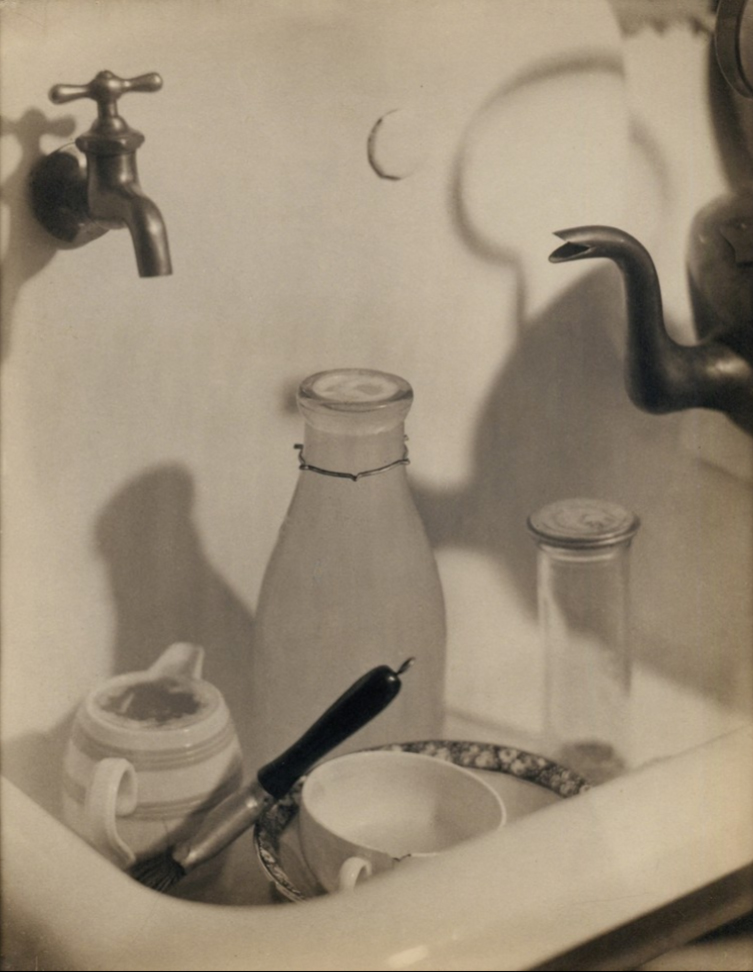
Margaret Watkins's The Kitchen Sink begins with the least heroic subject imaginable: a sink full of used things. A bottle stands near the center, dishes and a brush crowd the foreground, the faucet and kettle spout enter from above, and shadows stretch across porcelain. The photograph is not grand, polished, or obviously picturesque. That is its first act of intelligence. Watkins takes a place associated with cleanup after use and photographs it before order has been restored.[1]
Art Canada Institute places the photograph in 1919 and identifies it as a palladium print in the National Gallery of Canada collection, while LACMA and the Cleveland Museum of Art also hold 1919 palladium-print versions.[1][2][3] That cross-collection presence helps confirm that The Kitchen Sink was not a casual domestic snapshot but a print that circulated as a serious photographic work. Its importance lies in that tension: the image looks like a record of household disorder, yet every object is made to contribute to design.
Image context: this post uses one real archival photographic image of Watkins's The Kitchen Sink, downloaded from the Wikimedia Commons file page for the 1919 photograph. It is not a diagram, chart, generated visual, or generic kitchen photograph; it is the artwork itself, matching the article's close-reading subject directly.[6]
Disorder Becomes Structure
The trick of The Kitchen Sink is that it never cleans up the mess. Watkins does not hide the scum on the bottle, the mismatched crockery, the dark brush handle, or the sense of objects left after use. Art Canada Institute's account is useful because it names the picture's basic physical facts: dirty dishes in a sink, a central milk bottle, chipped and mismatched crockery, a diagonal basin edge, metal objects, and a triangular pull through faucet, kettle spout, brush, and bottle.[1] That description makes clear why the image cannot be reduced to either dirt or design. It is both at once.
The diagonal basin is the first stabilizer. It cuts the photograph away from ordinary front-facing description and gives the sink a tilted plane. The viewer is not looking straight into a household inventory. We are looking across a field of edges. The porcelain reads as a pale stage; the objects become weights distributed across it. The sink is still a sink, but it has started behaving like a composition.
The central bottle anchors the vertical movement. It rises between the lower clutter and the upper metal lines, translucent enough to catch light but plain enough to remain a used container. Around it, the kettle spout and faucet do not simply identify the room as a kitchen. They bend the eye back toward the center. Their metal curves answer the basin's smooth rim, while the brush and saucer at the bottom keep the photograph from floating into pure abstraction.
That balance is what gives the image its lasting bite. Watkins does not beautify domestic labor by removing its traces. She makes those traces carry form. The used bottle, brush, dish, spout, and shadow are not "interesting objects" in the decorative sense. They matter because their placement makes disorder legible as rhythm.
Palladium Tone Makes The Sink Think
The medium matters. Art Canada Institute, LACMA, and the Cleveland Museum of Art all identify their versions as palladium prints, and Art Canada Institute emphasizes the rich tonal range: darks, greys, and near-white passages working across the surface.[1][2][3] A more brittle print could turn the sink into harsh evidence. A softer sentimental print could dissolve the subject into atmosphere. Watkins uses tone to keep the image suspended between material fact and modernist arrangement.
The pale basin is not blank. It carries shadows, stains, and reflected forms. The bottle's shadow points downward like an implied flow of water, while the kettle handle's shadow makes a floating line across the porcelain.[1] Those shadows are the photograph's most modern elements because they do not belong neatly to the objects that cast them. They detach just enough to become graphic. The viewer sees a kitchen, then sees a set of lines, then has to hold both readings together.
That double reading places Watkins near the modernist still-life problem without making her imitate painting. The image has affinities with abstraction, but it remains stubbornly photographic. Its force depends on the camera's ability to register cheap surfaces, used objects, and specific light. The picture does not say that domestic things become art only when they are purified into shape. It says shape was already there, waiting inside ordinary use.
The Subject Was The Scandal
The controversy around The Kitchen Sink was not simply that viewers disliked its composition. It was that Watkins had chosen a domestic mess and insisted it could bear modernist seriousness. Art Canada Institute notes that one critic objected to the image's many equally interesting objects, while Watkins's handwritten response argued that the objects were meant to contribute to abstraction, pattern, and rhythm rather than to command attention as separate things.[1] The same account extends the point: the debate involved gender, representation, and the question of what counted as a suitable subject for art.[1]
That is why the photograph still feels sharper than a clever formal exercise. In 1919, a kitchen sink was not neutral subject matter. It belonged to work historically assigned to women, work expected to disappear into cleanliness. Watkins stops the process before disappearance. The dishes have not been washed into invisibility. The kitchen has not been returned to moral order. Instead, the undone task becomes the image.
This is not a simple celebration of mess. Watkins is too controlled for that. The photograph's irony is that disorder has been intensely composed. That control prevents the viewer from treating the sink as mere confession, shame, or domestic negligence. The work refuses the old trap: if the sink is dirty, the woman has failed; if the photograph is beautiful, the dirt must have been only decorative. Watkins makes both assumptions inadequate.
The image therefore turns household labor into an art-historical argument. It asks why a violent mythological scene, a nude body, or an expensive table setting could be treated as noble subject matter while the aftermath of ordinary domestic life could not.[1] The answer is not stated as a slogan. It is built into the print's geometry. The brush, bottle, and crockery do not apologize for being there.
A Modernist Still Life Without Escape
Watkins's later reputation helps explain the photograph's placement inside a larger career. Art Canada Institute's style-and-technique account describes her as a modernist still-life photographer of domestic objects whose graphic composition used repeating angles and curves, long tonal range, and platinum or palladium processes.[4] Its biography section places that practice inside a larger path from Canada and Boston to New York, the Clarence H. White circle, advertising work, Europe, Glasgow, and later rediscovery.[5]
That advertising context matters because The Kitchen Sink already understands how objects can be made active. A bottle, dish, brush, and spout are not unlike commercial objects awaiting visual persuasion. But Watkins withholds the sales promise. Nothing here is new, clean, desirable, or ready for consumption. The photograph borrows the discipline of product arrangement and points it at the residue of use.[4]
The result is a modernist still life without escape from labor. Traditional still life often turns fruit, vessels, flowers, books, or tableware into meditations on abundance, mortality, taste, or learning. Watkins keeps the still-life apparatus but changes the social temperature. Her objects belong to cleaning, eating, washing, and repetition. They do not sit in a timeless studio. They sit in a sink, the place where domestic objects go after they have done their work and before someone else must do more work to reset them.
This is why the sink basin matters as more than a container. It is a boundary between use and renewed order. Watkins photographs the boundary while it is congested. The basin holds evidence of appetite, touch, and delay. The faucet promises water but has not yet released it. The brush promises cleaning but rests among the very things it might scrub. The image is full of instruments that imply action while remaining still.
Why The Photograph Still Works
The Kitchen Sink remains alive because it does not let any one reading win. If we call it a domestic document, the geometry interrupts us. If we call it abstraction, the dirty dishes return. If we call it feminist critique, the palladium tone and exact placement insist that the photograph is also an object of formal pleasure. Watkins's achievement is to make these readings depend on one another.
The photograph also changes the viewer's sense of attention. A sink is normally passed through quickly: clean it, empty it, leave it. Watkins slows that passage until the viewer has to see how much visual pressure ordinary life contains. The central bottle, the curved spout, the brush, the pale basin, and the floating shadows become an argument about looking. Modern art does not require escape from the everyday. It may require the everyday to be seen before it is tidied away.
That is the quiet radicalism of the work. Watkins did not make the kitchen sink respectable by pretending it was something else. She made it formidable by letting it remain a kitchen sink and showing that form, gender, labor, and modern vision were already gathered there. The picture's mess is not a failure of order. It is order seen before the world has had a chance to hide the work.
Sources
- Mary O'Connor, Art Canada Institute, "The Kitchen Sink 1919" - key-work essay on composition, domestic subject matter, exhibition history, criticism, gender, and modernist abstraction.
- Los Angeles County Museum of Art, "Margaret Watkins, Kitchen Sink" - object page for a 1919 palladium print with dimensions, collection data, and public-domain image notice.
- Cleveland Museum of Art, "Margaret Watkins, The Kitchen Sink" - object page for the 1919 palladium print with measurements and visual description.
- Mary O'Connor, Art Canada Institute, "Margaret Watkins: Style & Technique" - account of Watkins's palladium process, modernist composition, kitchen still-life photography, and advertising image language.
- Mary O'Connor, Art Canada Institute, "Margaret Watkins: Biography" - career chronology from Canadian childhood and Boston training through New York, Europe, Glasgow, and posthumous rediscovery.
- Wikimedia Commons, "File:Margaret Watkins,The Kitchen Sink, 1919.jpg" - source page for the archival photographic image used as the article cover.