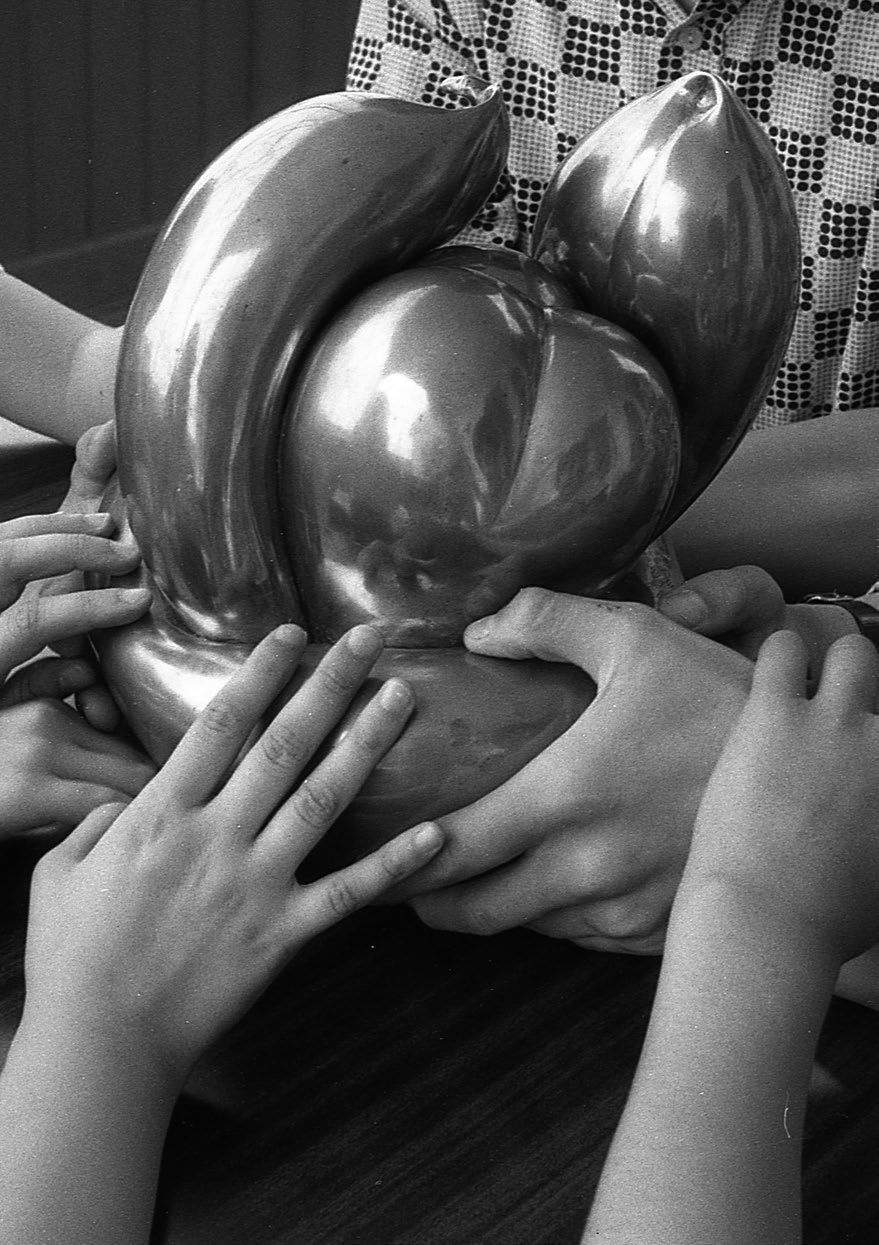
In a photograph made at a school in Levoča in June 1983, several children meet sculpture without the respectful gap that a museum usually demands. Hands travel over a polished multipart form. Weight, seam, hollow, edge, and resistance arrive before title or date. The work is not being mishandled. It is doing what Mária Bartuszová believed sculpture could do: give thought a physical route.
The photograph records the second of two workshops organized by the art historian Gabriel Kladek with blind and partially sighted children, the first having taken place in 1976. Participants explored Bartuszová's multipart and tactile forms through movement and touch. Her own description of the encounter was exact: a place where “the external world meets the internal world.”[1][2] That sentence offers the clearest entrance into her career. Bartuszová did not treat touch as a sentimental alternative to sight. She treated it as a way to test how form becomes knowledge.
This is also why her sculpture can look so contradictory. A piece may feel bodily but depict no body, resemble an egg yet remain open, or appear soft although it is cast in plaster or metal. Pressure gives the form life; pressure also threatens to crush it. Her profile is held together by these crossings—inside and outside, full and hollow, yielding and rigid, intimate handwork and public scale.[1][2]
Image context: the cover is Gabriel Kladek's archival photograph from the June 1983 Levoča workshop, reproduced from the Archive of Gabriel Kladek in the Museum der Moderne Salzburg's exhibition guide. It is used here because Bartuszová's sculpture is not fully understood as a white object on a plinth; the profile turns on the hand as an instrument of perception.[1]
Košice gave experiment a practical setting
Bartuszová was born in Prague in 1936 and trained at the Academy of Arts, Architecture and Design there. In 1963, she moved with her husband, the sculptor Juraj Bartusz, and their daughter to Košice, then a rapidly expanding industrial and cultural center in eastern Czechoslovakia. She joined the local artists' union the following year, a necessary step if she wanted to compete for state-funded public commissions.[1][2]
Those commissions complicate the familiar story of a neglected artist working alone behind the Iron Curtain. Bartuszová was certainly distant from the main centers of international contemporary art, and her abstract practice developed within the constraints of a totalitarian state. But she was not sealed inside a private studio. Playgrounds, monuments, fountains, and architectural reliefs made her solve problems of use, weather, bodies, and scale. For fountains, she joined bronze forms to rough stone from the High Tatras; for a kindergarten, she completed a climbing structure and slide. Public work paid bills, but it also kept abstraction in contact with ordinary movement.[1][2]
The distinction matters. Bartuszová's small sculptures did not become tactile because she retreated from the world. They emerged alongside projects in which a form had to be climbed, approached, or placed in running water. Her studio experiments and civic commissions belonged to different economies, yet both asked what a body could learn from matter.
A balloon was a collaborator, not a shortcut
In the early 1960s, Bartuszová began casting plaster with balloons, plastic bags, and other elastic membranes. In what she called “gravistimulated casting,” she poured plaster into a flexible container, then let gravity, shaking, water, and her hands redirect the material as it set. The mold did not impose a fixed geometric cavity. It stretched in response to the liquid's weight, registering forces while they were still active.[1]
The resulting forms can suggest drops, seeds, fruit, cells, folds, or parts of a body without settling into illustration. Their apparent softness is not carved onto a hard block after the fact. It is an index of an earlier, unstable state. The plaster remembers having been liquid; the skin remembers having been pressed.
This method gave Bartuszová an alternative to the heroic sculptor cutting away stone. She worked by supporting, turning, squeezing, and waiting. Agency was distributed among hand, membrane, gravity, water, and chemical change. To say that nature inspired the sculpture is therefore only half the point. Natural processes helped make it.[1][2]
From the 1980s, she reversed the arrangement. For her “pneumatic casting,” plaster was applied over inflated balloons. When the rubber was released or burst, a thin shell remained around an absent core. She nested some of these shells inside one another as “endless eggs”; others broke open, sagged, or were bound with string. Earlier pieces held the pressure of material pushing outward. The later ones made absence palpable.[1][2]
That reversal—from filled volume to hollow skin—explains much of the emotional range in Bartuszová's late work. A shell can be shelter, body, nest, or ruin. String can hold a form together or visibly constrict it. Plaster, ordinarily an intermediate material on the way to bronze, remains exposed and vulnerable. The work does not merely represent fragility. It accepts fragility as a condition of being seen.
The sculpture could come apart in your hands
Touch entered Bartuszová's practice before the school workshops. From the mid-1960s, she developed multipart forms in plaster, aluminum, and bronze that could be separated and intuitively reassembled. Some fold into each other; some work like puzzles; some oppose an organic curve to a geometric interruption. She imagined that sculpture might serve as a didactic tool or a tactile toy, helping someone understand a drop, gravity, or spatial orientation through the hands.[1][2]
This was not participation added after a finished artwork. Reassembly changed the identity of the form. A participant had to discover which pieces nested, where a contour continued, and how a whole could be inferred from pressure against the palm. Sight can take in an outline almost at once. Touch constructs an object through sequence. The hand knows one surface, then another; memory joins them.
Kladek's workshops in 1976 and 1983 made that temporal knowledge central. His photographs show the works in use by children who were blind or had visual impairments, sometimes before the same sculptures reached a broader exhibition audience.[1] Bartuszová's achievement here was not to make a visual artwork merely “accessible.” She allowed a nonvisual encounter to reveal what the sculpture already was: a set of relations among exterior, interior, division, weight, and fit.
The workshops also put a limit on easy claims. Not every Bartuszová sculpture was designed to be handled, and the fragile plaster shells of the 1980s cannot bear the same contact as a robust metal puzzle. “Tactile” should not become a label pasted across the whole oeuvre. It is more useful as a principle: form is something the body encounters over time, whether by holding a multipart object, circling a fountain, or feeling with the eyes how string presses into a hollow shell.
Fragility changed the terms of looking
The 1987–88 Untitled now held by the Museum of Modern Art in Warsaw makes that pressure visible. Plaster, synthetic material, and string form a wall-mounted cluster whose cavities and taut lines seem to record both binding and growth.[4] A related large relief at the Centre Pompidou, made in 1986–87 from plaster, cotton, wood, metal, and plant fiber, extends the same unstable border between sculpture and support.[5] These are not neutral white abstractions. Their openings make space feel bodily; their bindings make care and constraint difficult to separate.
Museum display inevitably changes them. The haptic works that once passed from hand to hand now often sit behind vitrines or beyond touching distance. That is not simply an institutional failure: preservation is real, especially for plaster skins whose meaning depends on their vulnerability. Yet the prohibition creates a productive frustration. Viewers must infer touch from pressure marks, seams, hollows, and the archival record of earlier handling.
The cover photograph keeps that record from becoming abstract. It shows that touch was not just studio mythology. Hands completed an encounter the objects had been built to invite. Beside today's protected sculptures, the image behaves almost like a missing sense.
Recognition arrived after the work had changed the question
Bartuszová's largest solo exhibition during her lifetime opened in Košice in 1988. She died there in 1996. A wider international reception gathered slowly: documenta 12 included her in Kassel in 2007; the Museum of Modern Art in Warsaw organized Provisional Forms in 2014; Tate Modern presented a major survey in 2022–23, developed with the Museum der Moderne Salzburg, where an expanded version followed in 2023–24.[1][3][6]
It is tempting to turn that chronology into a simple rescue narrative: an overlooked woman artist is finally installed in the canon. The exhibitions have unquestionably made hundreds of delicate works available for new study. But Bartuszová's practice resists being reduced to belated visibility. Her sharpest proposition concerns the limits of visibility itself.
In Levoča, the sculpture did not wait for sight to authorize the experience. In the studio, the cast did not hide the forces that shaped it. In the public works, abstraction did not excuse itself from use. Across those settings, Bartuszová kept returning to the moment when a form is neither wholly outside us nor safely contained within us—when pressure, memory, and imagination meet at the skin.
That is why the hand is the right place to begin her profile. It neither masters the object nor passively receives it. It presses and is pressed back. For Bartuszová, sculpture became most alive in that exchange.
Sources
- Museum der Moderne Salzburg, Maria Bartuszová: Short Guide (2023) — biography, casting methods, public commissions, archival workshop documentation, works list, and exhibition history.
- Generali Foundation, “Mária Bartuszová” — institutional collection essay on her Košice practice, public works, multipart sculpture, pneumatic casting, and the 1976 and 1983 workshops.
- Museum of Modern Art in Warsaw, “Maria Bartuszová: Provisional Forms” (2014) — exhibition overview, career context, material fragility, workshop history, and reception after documenta 12.
- Museum of Modern Art in Warsaw, Mária Bartuszová, untitled (1987–88) — collection record, materials, dimensions, and object photography.
- Centre Pompidou, Mária Bartuszová, Sans titre (1986–87) — collection record for the plaster, cotton, wood, metal, and plant-fiber relief.
- documenta, “documenta 12” retrospective — official edition archive listing Mária Bartuszová among the 2007 participating artists.