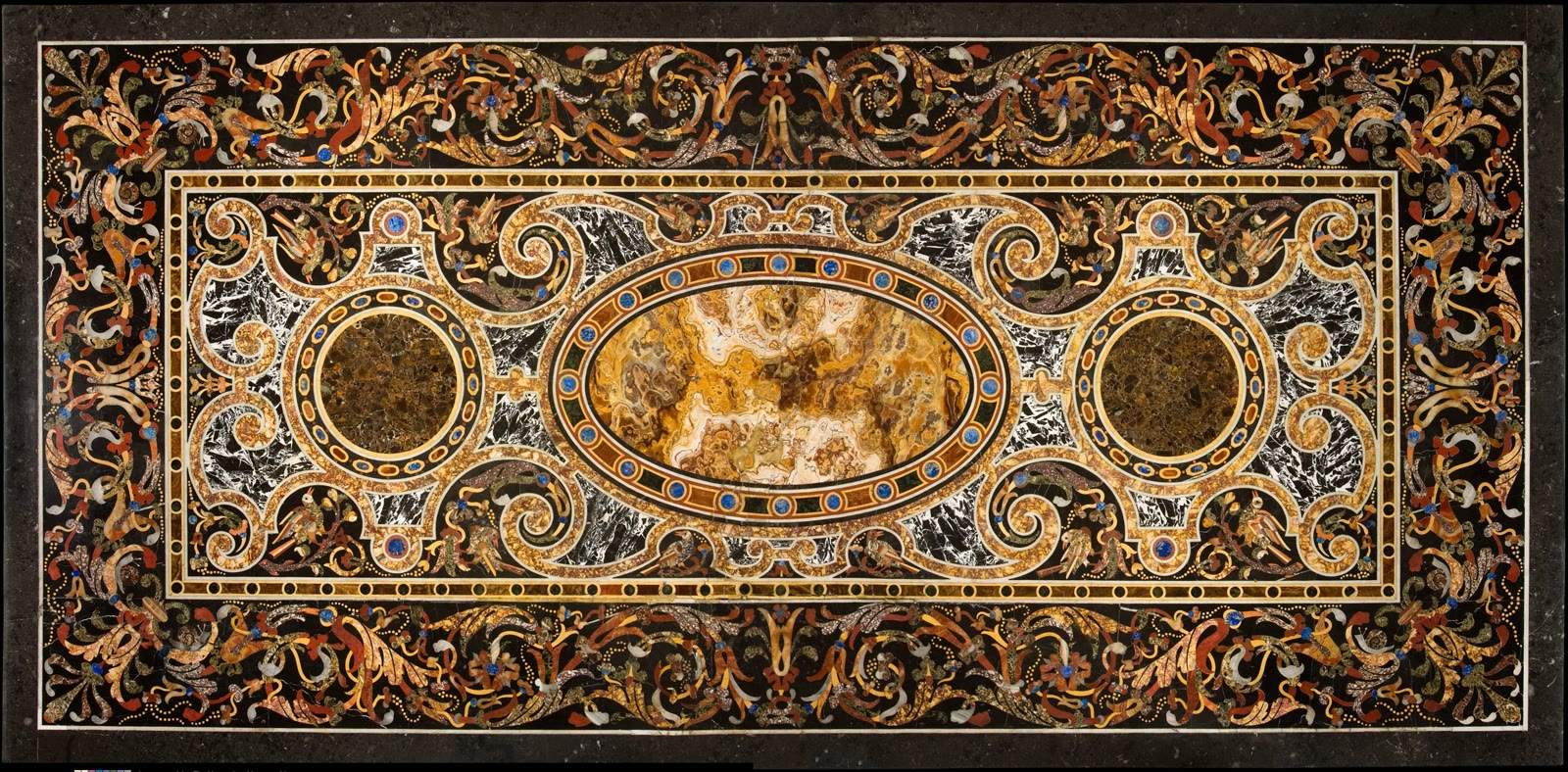
The first surprise is not that this table is made of stone. It is that stone has been persuaded to act like several other things at once.
At the center, a veined amber-gold alabaster oval sits inside an architecture of circles, bars, and dark cartouches. Four blue lapis lazuli forms appear to pin strapwork in place like ornamental bolts. Around that severe inner field, the surface loosens into animals, flowers, leafy scrolls, and seed-like strings. The Metropolitan Museum of Art describes the center as recalling forged iron and contemporary jewelry designs, while the border draws on ancient Roman mosaic motifs.[1] A material usually associated with weight has been made to imitate metalwork, drawing, botanical ornament, and movement.
The object is enormous: a little over 2.39 meters long, about 1.15 meters wide, and, as presently assembled on its replacement base, roughly 874 kilograms. The Met dates it to the late sixteenth or early seventeenth century and locates its making in Rome.[1] Yet scale alone does not explain its authority. The tabletop's real drama lies in a reversal of ordinary pictorial logic. A painter can mix a new color to complete an image. A pietra dura maker must search the world already inside the stone.
That constraint makes geology part of composition. Color is not spread over the surface; it is selected, cut, joined, and polished into the surface. The image begins as an act of looking at raw material.
Image context: the cover is the Met's photograph of the actual tabletop, not a reconstruction. It shows the full object clearly enough to compare the disciplined geometry of the center with the more animated animal-and-flower border discussed below.[1]
The palette arrives with a grain
The Victoria and Albert Museum defines pietre dure as a process in which precisely cut hardstones, chosen for their colors, are arranged into a pattern or image, usually set within marble, then polished and buffed to a high shine.[2] That concise description contains the medium's central difficulty: selection and depiction cannot be separated.
In painting, a brushstroke can be revised without changing what the pigment fundamentally is. In hardstone inlay, every visual decision also commits to a physical specimen. A clouded passage in alabaster, a dense field of dark marble, or the saturated blue of lapis lazuli is not a neutral color swatch. Veining may bend away from the intended contour. A transition may appear only in one narrow part of a slab. A flaw can become either useful texture or a future fracture line. The maker does not simply impose a design on matter; the design has to negotiate with matter's prior history.
The Met's account of the courtly technique makes that negotiation explicit. Full-scale designs were prepared, often as watercolors on paper, but their chromatic instructions could only be general because the final palette depended on available stones. Skilled lapidary workers sometimes altered details in response to patterns already present in the material.[3] The model established the destination. The stone decided which routes remained open.
That is why “painting in stone” is more than a flattering metaphor. The craft can produce pictorial effects, but its color system is closer to collage than liquid paint. Each tone arrives attached to thickness, hardness, translucency, grain, and scarcity. The maker composes with properties, not just appearances.
An abrasive wire becomes the drawing tool
The cutting method makes those constraints even sharper. The Met describes pieces being shaped with an archetto, a chestnut bow saw fitted with iron wire. Damp abrasive powder placed along the wire performed the cutting action.[3] The wire guided the path, but abrasion did the slow work.
This changes what it means to draw a contour. A line on paper occupies almost no material space. A cut in stone has width, resistance, and consequence. Every curve creates two edges that must be managed; every tight turn tests the stone; every neighboring piece must meet closely enough that the joint does not interrupt the intended form. The floral sprays and small animals in the table's border therefore register not only as motifs but as accumulated feats of fit.
The process also rewards a particular kind of planning. Large masses can tolerate a certain boldness, while a narrow tendril or pointed leaf concentrates risk. A maker has to understand how much detail the selected piece will carry before it chips, disappears into a seam, or loses its identity after polishing. The design's vocabulary is inseparable from what abrasive cutting can reliably preserve.
This is one reason the central field feels so commanding. Its broad ovals, roundels, bars, and cartouches make the stones readable as stones. The forms are clean enough for color and veining to hold their own, yet elaborate enough to make precision visible. Technique is not hidden behind illusion; technique becomes the subject.
Polish makes unlike materials share one light
Cutting separates. Fitting assembles. Polishing performs a third operation: it persuades different pieces to behave as one optical plane.
The V&A's final steps—polishing and buffing to a high shine—are easy to treat as mere finishing.[2] Visually, they are structural. Before polishing, neighboring stones may announce their differences through uneven surfaces as well as color. Once brought toward a shared plane, they catch the same room light. The joins recede, while the contrast between materials intensifies. A dark cartouche can read as a continuous silhouette; a pale oval can hold the eye like a pool of light.
Uniform sheen does not erase geological difference. It coordinates it. Some stones appear dense and opaque; others seem milky, speckled, or faintly translucent. Polishing makes those variations comparable without making them identical. The tabletop gains the coherence of an image while retaining the evidence that no single pigment produced it.
This double reading is essential to pietra dura. From a distance, the viewer follows design: center, border, symmetry, motif. Up close, representation loosens back into material: vein, inclusion, edge, fitted fragment. The object keeps switching between “what does this show?” and “what is this made from?” Its virtuosity lies in refusing to let either question win.
Rome turned antiquity into raw material
The tabletop's Roman origin matters because Rome and Florence developed distinct accents within the broader hardstone tradition. The Met identifies the central alabaster oval, marble roundels, and geometric organization as typical of Roman work around 1600, in contrast with Florentine examples.[1] Its larger exhibition history draws the distinction more broadly: Roman workshops revived ancient opus sectile and favored sophisticated nonfigurative arrangements, while Florentine makers increasingly exploited the natural variations of stone for illusionistic flowers, landscapes, and other images.[3]
The difference was not only stylistic. It was archaeological and political. According to the Met, sixteenth-century Roman makers recovered ancient colored stones from sites including the Baths of Caracalla and ruins at Ostia, then recut them for walls, pavements, and sumptuous furnishings.[3] The material could therefore make two claims at once. It displayed contemporary skill, and it carried a physical remnant of imperial Rome into a Renaissance interior.
It would be too strong to assign every piece in this particular tabletop to a named ruin without a stone-by-stone provenance study. The safer conclusion is that the work belongs to a Roman culture in which ancient material was actively harvested, reclassified, and made to certify continuity.[3] What looked like decoration could also operate as possession of the past.
That history sharpens the table's center. Its geometry does not merely restrain an exuberant border. Circles, bolts, strapwork, and symmetrical fields make the surface feel governed. Ancient stone is not left as a fragment; it is cut into a new system. The patron receives antiquity disciplined into furniture.
The border lets stone escape its own weight
Then the border pushes back. Wild animals, flowers, pearl-like seeds, leaves, and scrolls crowd the perimeter.[1] These forms do not abolish symmetry, but they make the eye travel differently. The center encourages comparison across axes. The border encourages pursuit: one curling stem leads toward another, an animal interrupts a run of ornament, a blossom opens where a hard edge might have closed the field.
That contrast reveals the maker's larger achievement. Stone is heavy, brittle, and slow to shape, yet the border makes it behave as if it could sprout. The illusion works because it never becomes total. A viewer remains aware that each lively turn was found inside resistant material and achieved through abrasion. Motion gains force from the medium's refusal to move.
The inner and outer zones therefore stage two versions of mastery. At the center, mastery means measure: stable geometry, lapidary precision, the visual language of metal fittings and jewelry. At the edge, it means metamorphosis: mineral becomes leaf, seed, fur, and curling stem. The tabletop does not choose between order and animation. It makes the difficulty of joining them visible.
A workshop survives inside a conservation institute
Florence formalized its grand-ducal hardstone workshop in 1588; the institution now known as the Opificio delle Pietre Dure continues as a center for conservation, research, and training.[3][4] Its museum preserves stone samples, benches, tools, and demonstrations of the stages used to produce inlay and carving.[4] That continuity is useful because it prevents historical technique from becoming a mystical list of lost secrets. The work was extraordinary, but it was made through teachable sequences: design, selection, cutting, fitting, and finishing.
The Roman tabletop makes those sequences legible even when the original makers' names are not. Its authorship resides in thousands of judgments: which cloudy oval deserved the center, how broad a dark band could remain unbroken, where a vein should become part of a leaf, when a curve was worth the cutting risk, how much polishing would unify the plane without flattening its character.
Look at pietra dura long enough and “permanence” stops being its most interesting quality. Stone may outlast paint, but durability is only the afterlife of the real artistic event. The event was adaptation: a fixed design meeting irregular matter, hand pressure meeting mineral resistance, fragments meeting closely enough to share light. This tabletop appears timeless because its makers were exquisitely attentive to everything stone would not let them do.
Sources
- The Metropolitan Museum of Art, Pietra dura table top (Roman, late 16th or early 17th century) — object record, materials, dimensions, imagery, chronology, and public-domain photograph.
- Victoria and Albert Museum, “How was it made? Pietre Dure” (updated April 17, 2024) — concise institutional account of selecting, cutting, arranging, setting, polishing, and buffing hardstone.
- The Metropolitan Museum of Art, “Art of the Royal Court: Treasures in Pietre Dure from the Palaces of Europe” (2008) — technique, workshop organization, Roman reuse of ancient stone, and distinctions between Roman and Florentine production.
- Opificio delle Pietre Dure, “Museo” — official account of the historic grand-ducal manufactory, museum collection, tools, workbenches, stone samples, and technique displays.