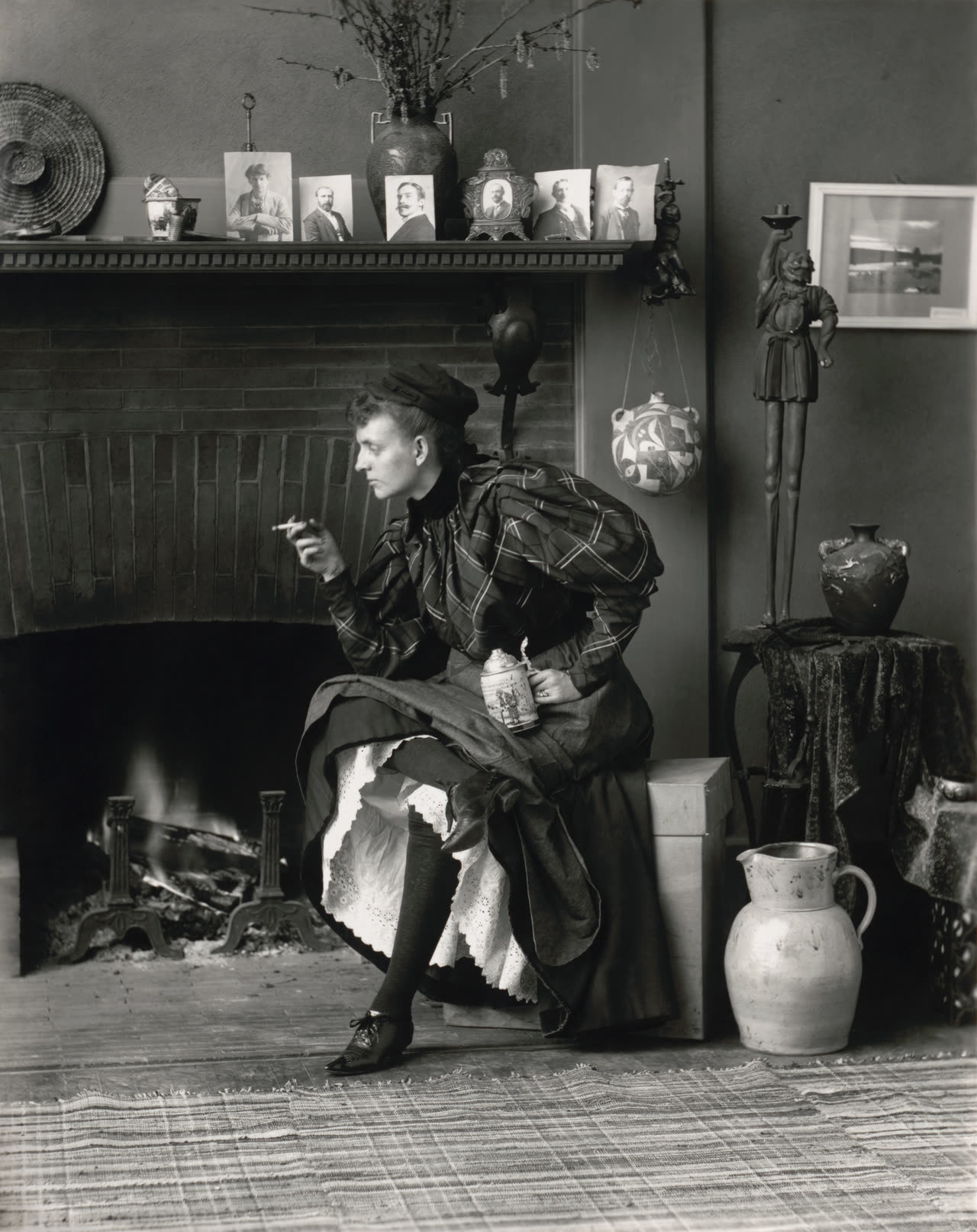
Frances Benjamin Johnston's 1896 self-portrait still has the snap of a dare. She sits in front of a fireplace, turns sideways, crosses one leg over the other, holds a cigarette in one hand and a beer stein in the other, and looks as if the room has been arranged for her argument rather than for polite company.[1][2] The picture is often read as a New Woman performance, and that is right. But it is more than a costume of rebellion. It is a professional statement made by someone who understood that the camera could build a public role as surely as it could record a face.
That is the key to Johnston. She matters not only because she was early, prominent, and unusually persistent in a field that gave women little structural room. She matters because she treated photography as a complete working identity: art practice, business, reportage, portraiture, public instruction, institutional commission, and preservation record.[3][5][6] Her career did not stay inside one genre. It moved because the camera moved: from studio skylight to cave darkness, from political portrait to schoolroom, from ship deck to garden, from self-fashioning to architectural memory.
Image context: the lead image is not a generic portrait of Johnston. It is her own photographic self-staging. The Commons file identifies it as an 1896 Library of Congress image; Smithsonian's reading emphasizes the cigarette, beer stein, crossed leg, and confrontation with Victorian gender expectations.[1][2] This is the right cover because the article turns on Johnston's ability to make a photograph carry authorship, persona, and labor at once.
The Portrait Is A Workplace
The self-portrait works because it does not pretend to be spontaneous. Johnston knew exactly how much a pose could do. The scene is theatrical, but not frivolous. The fireplace, dress, exposed petticoat, profile angle, cigarette, and drink form a controlled vocabulary of social risk.[1][2] She is not simply saying that she can violate decorum. She is showing that she can compose decorum, disassemble it, and turn it into an image.
Smithsonian Magazine places the portrait beside another self-image in which Johnston appears more conventionally refined, with fur, hat, gloves, and a hand carefully near the chin.[2] That pairing matters. Johnston was not replacing one fixed feminine role with another fixed bohemian one. She was demonstrating range. A photographer who could move between these roles could also move between clients, assignments, publics, and markets.
That professional range was not incidental. The National Park Service account traces her early path through journalism, illustration, art study in Paris, and photography lessons with Thomas Smillie at the Smithsonian.[3] Johnston did not arrive at the camera as a naive amateur touched by technology. She arrived as someone already trained to think about images in relation to publication, audience, and use.
The Studio Was A Business Argument
In 1897, Johnston published "What a Woman Can Do with a Camera" in Ladies' Home Journal.[4] Read today, the piece is bluntly practical. It asks what kind of photographic work can pay, what training is needed, what equipment costs, how a studio should be arranged, and why artistic ambition cannot be separated from business discipline.[4] That combination is the strongest clue to her seriousness.
Johnston's advice is not romantic. She insists on patience, tact, taste, attention, experience, capital, and a field of work to exploit.[4] She also refuses the idea that photography is only a mechanical operation. For portraiture, she points toward composition, light, pose, drapery, and the study of artistic precedent.[4] In other words, she is arguing on two fronts at once: women should be able to enter photography as paid workers, and photography should be understood as an expressive medium rather than a machine trade.
The Library of Congress exhibition page for Johnston's camera makes the same practical imagination tangible. It describes a five-by-seven-inch Rochester Optical Company Universal Camera with a compact folding design and long bellows, suitable for work beyond the studio.[6] The object matters because Johnston's career depended on exactly that flexibility. A camera was not a symbol in her hands. It was a working tool that had to be carried, adapted, aimed, and made profitable.
Reportage Without Losing Form
Johnston's early reputation grew through assignments that demanded more than studio charm. The National Park Service account follows her into Mammoth Cave in 1891, where she worked with flash powder in punishing darkness, and then into coal mines, factories, shipboard scenes, schools, Hampton, Tuskegee, and portraits of public figures.[3] This is where her self-portrait's bravado becomes less decorative. The image performs independence because the life required it.
Her best documentary work does not abandon formal intelligence. MoMA's artist page is especially useful on the Hampton photographs because it refuses to flatten them into either celebration or indictment.[5] Johnston was commissioned in 1899 to photograph the Hampton Normal and Agricultural Institute for the 1900 Paris Exposition, where the photographs appeared in the American Negro Exhibit context.[5] MoMA notes both the institutional ambition behind the series and the later critical difficulty of its assimilationist framework.[5]
That difficulty is central to reading Johnston now. The Hampton images are not neutral educational records, and they are not easily detachable from the politics of their commission. They show classrooms, labor, discipline, buildings, students, and staged improvement, all under a system that claimed racial uplift while measuring it against dominant white Victorian ideals.[5] Johnston's art-history importance here lies partly in the photographs' unresolved pressure. They are beautifully organized and historically compromised. They record a school and a value system at the same time.
This is why treating Johnston only as an inspiring pioneer is too simple. Her photographs belong to institutions, markets, racial politics, gender performance, and preservation systems. The work is strongest when those frames remain visible. She made images that traveled because they were useful, and usefulness can clarify or distort depending on who commissions, captions, and circulates the picture.[5]
A Career Built On Mobility
Johnston's career kept changing shape. Smithsonian summarizes the arc clearly: Washington political and society portraits in the 1890s, friendships with artists and outsiders, school documentation, Paris Exposition work, later gardens, and Southern architecture.[2] NPS extends that later story into preservation, noting her role in documenting colonial architecture and connecting her work with Historic American Buildings Survey activity and local preservation outcomes.[3]
That late architectural work can look distant from the 1896 self-portrait, but the continuity is real. In both cases, Johnston uses the camera to make a claim about presence. The self-portrait says: this professional woman can author her own image. The architectural photographs say: these buildings, gardens, streets, and interiors deserve to remain visible before demolition and neglect erase them.[2][3] One is personal staging; the other is cultural inventory. Both are acts of photographic control.
The result is a career that resists a single label. MoMA lists Johnston with documentary photography, photojournalism, photography, and portraiture, and its online collection includes 158 works.[5] LOC's camera exhibition frames her as working across portraiture, photojournalism, artistic, and architectural photography.[6] Those categories can seem scattered only if we expect a photographer's authority to come from narrowing. Johnston's authority came from moving across categories while keeping a steady belief that the camera was a serious instrument of work.
Why She Still Looks Modern
Johnston's self-portrait still feels contemporary because it understands something that later image cultures would make unavoidable: identity is made through circulation. A professional image is never just inward expression. It is a negotiation with viewers, clients, editors, institutions, and future archives. Johnston knew this before modern celebrity photography, before feminist performance photography, before social-media self-branding made self-presentation feel ordinary.[1][2][4]
But the photograph's lasting force is not that it predicts the present. It is that it keeps the labor visible. The pose is sharp because it is made. The career is impressive because it was built assignment by assignment. The advocacy matters because Johnston did not merely ask that women be admired as exceptions; she described equipment, apprenticeship, studio conditions, markets, and the daily discipline required to survive.[4]
That is why Frances Benjamin Johnston should be read as more than a colorful figure at the edge of photographic history. She made the camera into a profession she could inhabit, and then she kept enlarging the house. In her hands, photography could be portrait, article, lecture, school record, architectural archive, social performance, and proof of women's technical authority. The 1896 self-portrait is the flash point, not the whole story. It shows a woman sitting as if she owns the room. The career shows how much work it took to make that ownership real.[1][2][3][4][5][6]
Sources
- Wikimedia Commons, "File:Frances Benjamin Johnston, Self-Portrait (as 'New Woman'), 1896.png" - source page for the Library of Congress archival photograph used as the article image.
- Victoria Olsen, "Victorian Womanhood, in All Its Guises," Smithsonian Magazine, May 2010 - essay on Johnston's self-portraits, Washington career, Paris Exposition work, and later garden and architecture photography.
- National Park Service, "Frances Benjamin Johnston" - biographical profile covering Johnston's journalism, training, Mammoth Cave work, photojournalism, portraiture, Hampton and Tuskegee commissions, and preservation photography.
- Frances Benjamin Johnston, "What a Woman Can Do with a Camera," Ladies' Home Journal, 1897, reproduced by Clio Visualizing History - primary text on women, professional photography, studio practice, equipment, and artistic expression.
- The Museum of Modern Art, "Frances Benjamin Johnston" - artist page on Johnston's studio, early press photography, Hampton Institute commission, later architectural work, and MoMA collection context.
- Library of Congress, "A Groundbreaking Photographer's Camera" - exhibition object page on Johnston's Universal Camera and her work across portraiture, photojournalism, artistic, and architectural photography.