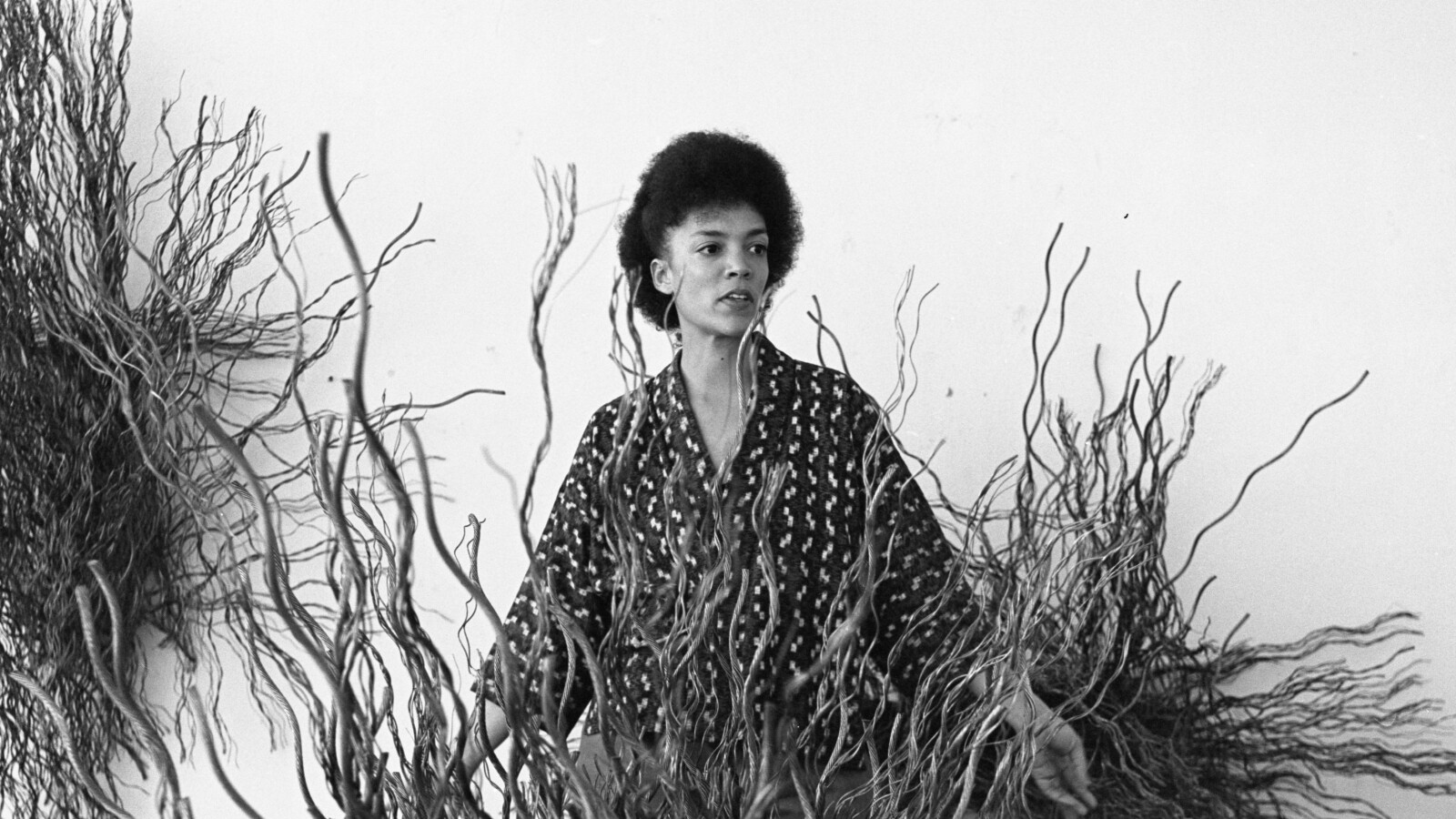
Image context: the cover is a 1981 documentary studio photograph of Maren Hassinger with the actual installation discussed here. It records a crucial fact that an isolated object view would lose: her metal “bushes” accumulate at the height and density of bodies, turning the space between them into part of the work.[1]
Steel cable is not supposed to look undecided.
It is manufactured to pull, brace, suspend, and bear loads. Its strands are twisted into a larger rope so that many narrow wires can act as one reliable line. In Maren Hassinger's sculpture, that line comes apart. She cuts cable into lengths, binds one end, and unplies the other until dozens of wiry filaments spring outward. A material engineered for tension begins to resemble grass in wind, a branch in leaf, hair rising, or a body inclining toward another body.
The transformation sounds like a clever material trick. It is more demanding than that. Across five decades, Hassinger has made sculpture, installation, performance, video, and public work in which movement is never merely illustrated. It is assigned: to a wire bundle that leans, to a viewer who must edge around it, to collaborators improvising among objects, or to many hands twisting newspaper into a shared form. Her art does not hide steel's industrial history beneath a convincing imitation of nature. It keeps manufacture and growth visible at once, then asks what kinds of relation can exist between them.[2][3][4]
That is why the best unit for understanding Hassinger is neither the object nor the symbol. It is the gesture. A stalk bends. A crowd gathers. A person changes course.
Fiber without the loom
Born in Los Angeles in 1947, Hassinger studied sculpture at Bennington College and completed an MFA in fiber structure at UCLA in 1973. The degree name matters. She entered a field associated with weaving, yet the artists who opened the medium for her—figures such as Magdalena Abakanowicz and Sheila Hicks—showed that fiber could leave the loom and occupy a room. Hassinger did not need to become a conventional weaver to think structurally about ply, knot, bundle, tension, repetition, and slack.[2][4]
Wire rope offered all of those operations in an obstinate form. Hassinger encountered it in a Los Angeles salvage yard while in graduate school. At first glance, it belonged to infrastructure rather than textiles: steel threads helically wound into cable. But its construction made it legible as fiber. Once cut and untwisted, it retained both the memory of industrial torque and the unruly spread of a plant.
This double identity distinguishes her work from a simple nature imitation. A wire bush never completes its disguise. The clipped ends remain sharp; the grey filaments catch light like metal; concrete bases hold them to the floor. Yet the cable's splay is uncannily botanical. Hassinger understood early that a manufactured material could register the loss of nature precisely because it approximated living form without becoming alive.[2][3][4]
The making is therefore a controlled release. Factory organization has already compressed many wires into one cable. Hassinger reverses part of that work, separating the plies without returning them to shapeless raw material. Each bundle stays collective: many lines still bound at one end, newly independent at the other. The sculpture's social charge begins in that material condition.
The verbs came before the monument
Hassinger's early titles read like stage directions: Walking, Whirling, Leaning. They refuse the static noun that sculpture traditionally expects.
In Leaning (1980), thirty-two wire-rope bundles, each roughly forty-one centimetres high, tilt in groups across the floor. Hassinger has explained that “leaning” describes both a physical angle and an inclination—a tendency or preference. Some elements appear to bend in common weather; others suggest people running or pressing toward an event. No figure is represented, yet the installation is full of posture.[3]
The number matters less as a statistic than as a threshold. One leaning bundle could read as a specimen. Thirty-two become a population. Their differences are slight, but their directions create affiliation, divergence, and temporary consensus. The viewer looks for a cause—wind, attraction, alarm—then realizes that the work supplies no single answer. Direction is visible; motive remains open.
Hassinger's training in dance made that ambiguity productive. She had studied movement since childhood and continued taking classes after college. In sculpture, she found a way to choreograph without representing a dancer. The metal holds a gesture after a human body would have passed through it. The gallery floor becomes a performance space because viewers must negotiate the same directions, intervals, and obstructions that organize the objects.[2][4]
This is also why photographs of the work need bodies or architecture for scale. The 1981 studio image of On Dangerous Ground does not show Hassinger posing beside a discrete achievement. She appears behind a packed zone of cable growth. The installation occupies the route between camera and artist. Looking becomes a small exercise in blocked access: before we reach the person, we encounter the field.[1]
Sculpture became a partner
Performance did not arrive as a later supplement to an established sculptural career. In 1976, Hassinger staged High Noon at the ARCO Center for Visual Art in Los Angeles, moving improvisationally among her wire-rope works with collaborators, fabric, and natural branches. The sculptures served as conditions for action—something like partners, obstacles, scenery, and scores at the same time.[2][4]
Her long collaboration with Senga Nengudi made that reciprocity even clearer. In 1977, Hassinger activated one of Nengudi's stretched-nylon R.S.V.P. works with her body, pulling and yielding to a sculpture whose tension changed in response. The two artists shared dance backgrounds and worked within a loose Los Angeles community that included David Hammons, Ulysses Jenkins, Houston Conwill, and other artists associated with Studio Z. They improvised in galleries but also in parks, gardens, and abandoned buildings—spaces where an artwork could be an encounter rather than a protected commodity.[1][2]
This context is essential because formal resemblance alone can make Hassinger's cable pieces appear to be elegant descendants of Minimalism: repeated units, restricted materials, a grid on the floor. The comparison is useful up to a point. She was attentive to serial form and post-Minimal process. But the social life of her work exceeds an account of material and geometry. Dance, collaboration, racial and gender exclusion, and the practical search for spaces outside established institutions all shaped how those units came to move together.[1][4]
The distinction is visible in the verb lean. A formal description can measure the angle. A choreography asks who leans, toward what, under whose pressure, and whether the others follow.
A field you cannot enter
Hassinger made Field in 1983, one year before moving from Los Angeles to New York. Its 182 components are constructed from wire-rope bundles set into round concrete bases. Each rises like a metallic plant; together they occupy a tight square grid. Dia Beacon exhibited the complete installation in 2023, the first presentation of all 182 units in almost forty years.[2]
From a distance, the grid promises order. At its edge, order becomes thicket. Frayed strands cross the gaps between bases, visually tangling one unit with the next. The repeated spacing suggests a path, but the metal growth denies passage. Hassinger has produced a field that can be surveyed but not entered, a landscape whose boundary is enforced by the very stalks that make it inviting.
That contradiction changes the viewer's body. Instead of walking through the grid, one circles it. The eyes enter where the feet cannot. Natural and artificial light catch different filaments, so the mass alternately resolves into 182 separate constructions and dissolves into one shimmering surface. Seriality does not eliminate difference; it gives minute changes in lean, spread, overlap, and shadow a structure against which to appear.
The work's environmental meaning is similarly double. Hassinger has called it an “industrial field,” a place where human-made products imitate nature in nature's absence.[2] The phrase does not turn the sculpture into a prediction that steel will literally replace vegetation. It identifies a habit of perception: industrial culture borrows the forms of growth even while helping to damage the systems that make growth possible.
The cable cannot resolve that conflict. It can only hold it at body scale. Its beauty is therefore uncomfortable. The more convincingly the wire behaves like grass, the more insistently its steel remains.
Nature was never scenery
Hassinger decided early that the loss of nature would be one of the defining problems of her lifetime. In interviews, she has resisted being reduced to a specialist ecological label. Her subject is broader: how damaged relationships to the natural world connect with unequal relationships among people.[4] The Art Institute of Chicago accordingly describes nature in her work as psychological and political space, not as untouched scenery.[5]
That boundary helps explain why her materials expanded beyond cable. Branches, leaves, pink plastic bags, trash, cardboard, cloth, and newspapers enter the work with their existing social lives intact. In Pink Trash (1982), discarded pink objects collected in New York parks were laid back into the landscape until litter resembled fallen leaves. Later works twist newspaper—the supposed record of public life—into cords, bundles, and communal structures. The technique changes, but the gesture returns: separate things are gathered without losing all evidence of what they were.[4]
Over time, Hassinger has described her emphasis shifting from vanishing nature toward equality. This is not a change of subject so much as a widening of the same question. A cable consists of distinct strands whose strength depends on relation. A field consists of repeated units whose individuality appears through the group. In participatory newspaper works, people build a form through shared manual action. None of these is a tidy allegory in which material automatically proves a political claim. They are working situations in which interdependence becomes physical.[3][4][5]
That physicality prevents “community” from becoming a soft abstraction. Cooperation has weight and resistance. Wire fights the hand that untwists it. A crowded installation blocks movement as well as suggesting solidarity. Many elements leaning together can evoke mutual support, but also pressure, flight, or conformity. Hassinger leaves those possibilities in tension because collectivity is not automatically benign.
The archive restores the event
In 2023, the Getty Research Institute acquired Hassinger's archive, spanning the early 1970s through the late 2000s. Its sketches, project drawings, photographs, correspondence, notes, exhibition records, and audiovisual material preserve a practice that conventional object histories are poorly equipped to hold.[1]
The need is obvious. A museum can accession a set of wire bundles, but not the entire network around them: an improvised performance in a non-art space, a dancer's negotiation with nylon, a temporary arrangement of trash, a collaborator's gesture, or the exclusions that made artist-run communities necessary. Documentation does not replace those events. It lets their conditions re-enter the history of the surviving objects.
It also corrects a distortion created by belated visibility. When an installation such as Field reappears complete after decades, it can look newly relevant because present-day institutions have learned to speak more fluently about ecology, embodiment, and collective practice. The archive reverses that timeline. Hassinger was already joining those questions through material, movement, and collaboration in the 1970s and early 1980s. The recent exhibition does not make the work contemporary. It makes the continuity harder to overlook.[1][2]
What the cable remembers
Hassinger does not make industrial material innocent. She does something more useful: she discovers that manufacture has not exhausted its capacity for other behavior.
Wire rope arrives already social. Separate strands have been twisted into a unit, disciplined toward a common load. Hassinger cuts, unplies, bends, spaces, and multiplies it. The cable keeps its factory torque while acquiring gesture. It leans like grass and gathers like people, but the resemblance never closes over the difference.
That gap is where the work lives. Nature is present as memory, model, and threatened relation. Dance is present without requiring a depicted dancer. Equality is present not as a slogan but as the difficult organization of distinct parts. The viewer is present because the installation redirects the body before interpretation begins.
Maren Hassinger makes steel cable behave like a crowd. She does not tell us whether the crowd is bending in weather, moving toward one purpose, or recoiling from danger. She gives every strand an inclination—and makes relation visible without pretending it is simple.
Sources
- Getty Research Institute, “Getty Acquires Maren Hassinger Archive” (August 31, 2023) — source page for the cover photograph, archive contents, Los Angeles networks, non-art spaces, and Hassinger's collaborations with Senga Nengudi.
- Dia Art Foundation, “Maren Hassinger” at Dia Beacon (2023–24) — curatorial history of Field, its 182 components, wire-rope process, dance background, early performances, and movement-oriented sculpture.
- Museum of Modern Art, “Maren Hassinger, Leaning, 1980” — exact work record and artist audio on wire rope, inclination, grouped movement, industrial nature, and interdependence.
- BOMB Magazine, Lowery Stokes Sims, “An Oral History with Maren Hassinger” (September 25, 2018) — primary interview on fiber training, dance, wire-rope installations, Studio Z, material choices, nature, equality, and the economics of non-object work.
- Art Institute of Chicago, “Maren Hassinger: This Is How We Grow” (2023–24) — institutional account of nature as political and psychological space, the movement of sculpture, and later site-responsive cable installations.