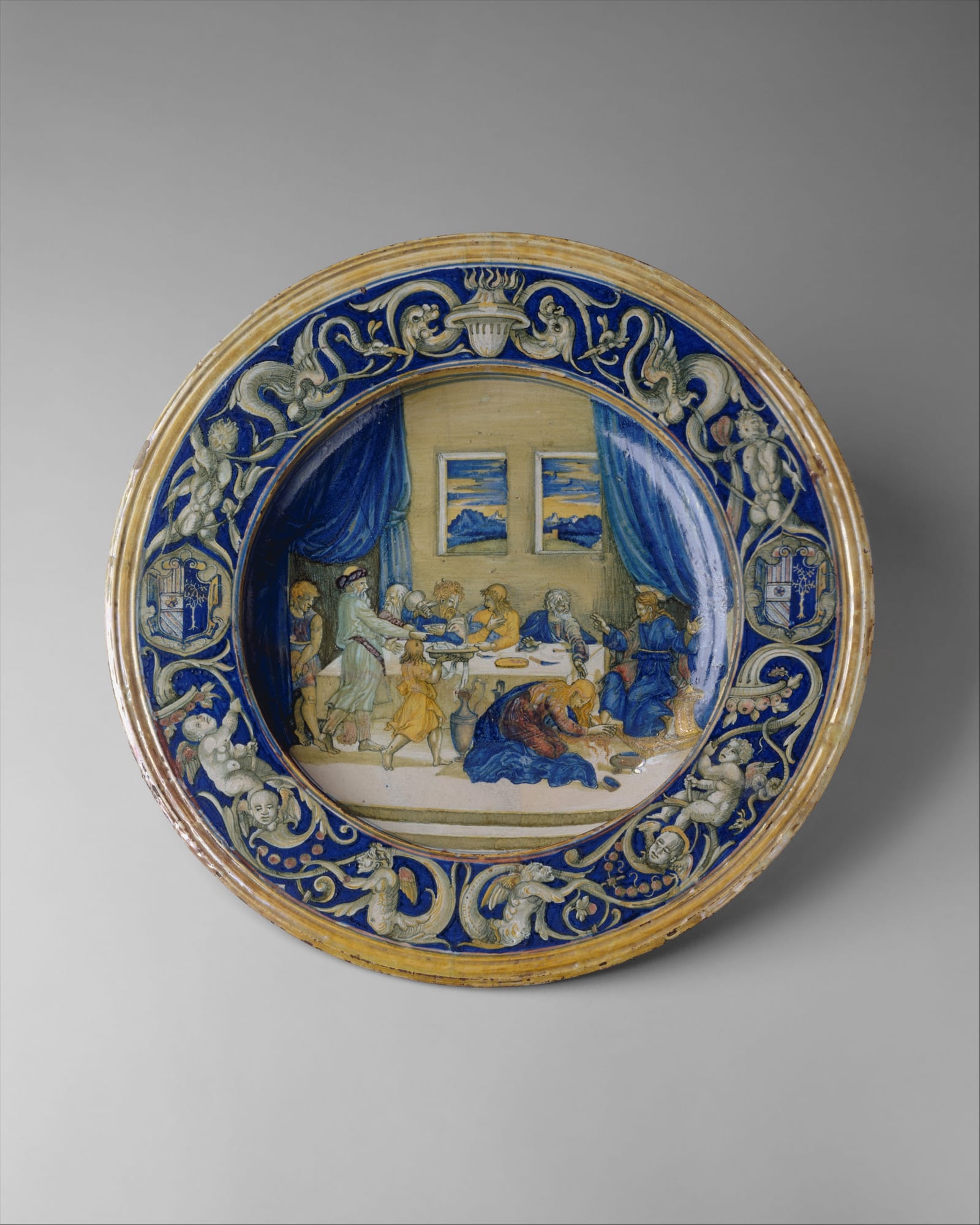
Image context: this is a photograph of the actual 1528 dish, not a flattened reconstruction of its painted scene. The chips along the rim, the shallow well, and the streak of reflected light across the right curtain all belong to our encounter with a glazed earthenware object. At 46.5 centimeters across, it is large enough for a biblical supper, two family arms, and a population of pale grotesques to share one circular field.[6]
The crowded supper floats on a white ground that the clay did not supply. Beneath the scene lies earthenware that might be buff, pinkish, or red. What makes it look ready for a painter is a glaze opacified with tin: a costly artificial whiteness spread over a comparatively ordinary ceramic body.[1][2]
That engineered blank invited painting and punished hesitation. A painter worked on dry, unfired glaze, a powdery and absorbent surface that took in the liquid carrying each mineral color. A misplaced stroke could not simply be lifted from a nonabsorbent surface or scraped back like dried oil paint. Once the object returned to the kiln, pigment and glaze fused. The picture became inseparable from the dish's skin.[1][2]
That sequence changes how the 1528 armorial dish above should be seen. Its crowded room is not a small easel painting transferred intact onto pottery. It is the visible end of a chain involving refined clay, two major firings, imported tin, metal oxides, specialized hands, borrowed imagery, temperature judgment, and the risk that heat would revise everybody's work. Maiolica put painting through the kiln, but the kiln was never merely the final delivery system. It was a collaborator with veto power.
White was a technology before it was a background
Opacity was the decisive intervention. Adding tin oxide to a lead glaze hid the color and irregularities of low-fired earthenware under a pale surface. Tin was expensive and imported, so the white was both material and economic: it made local clay look optically refined, and it made the finished ware more costly than ordinary pottery.[1][2]
Its history also reaches well beyond Renaissance Italy. The tin-glaze technique was developed in the Islamic world; the Met's collection catalogue places early experiments in or near Basra around 800, in a setting where potters were responding to imported white-bodied wares from Tang China. The technology moved through the Mediterranean and was established in parts of Italy after 1200. By the late fourteenth century, lustreware from Paterna and Manises near Valencia was entering Italian markets in quantity.[2]
Even the word maiolica carries that traffic imperfectly. It has long been connected to Majorca, an important point on the shipping route between Spain and Italy, while documentary evidence also suggests that Italians may have reshaped a phrase meaning Málaga ware into a more familiar place-name. The uncertainty is useful. The medium was not born from a sealed national tradition; its name preserves trade, imitation, translation, and perhaps a durable misunderstanding.[2][4]
Italian workshops eventually used the inherited white-glaze technology for an extraordinary range of forms: pharmacy jars, bowls, ewers, floor tiles, devotional reliefs, sculpture, and table services. By the early sixteenth century, ambitious potters had also made the circular dish a stage for istoriato—story painting drawn from scripture, ancient history, mythology, poetry, and contemporary prints.[1][2] The white ground did more than imitate a prestigious material. It opened a pictorial field on almost any clay form.
The brush landed before the colors fully existed
The production order was exacting. Clay was purified, shaped on a wheel or pressed in a mold, dried, and given an initial firing. A vessel was then dipped in a liquid glaze composed chiefly of potash, sand, lead, and tin oxides. As it dried, that coating became the thirsty white ground on which the decorator worked.[2]
The available colors were not tubes of familiar paint. They were compounds chosen for what they would become in heat: cobalt for blue, copper for green, iron for orange or ocher, antimony for yellow, manganese for purple or brown, and tin for white. A satisfactory bright red was especially difficult at the required firing temperatures. The painter therefore had to imagine a future surface while handling a chalkier, less resolved present one.[2]
Absorbency made control paradoxical. The glaze accepted pigment readily and, under successful firing conditions, held the colors in place instead of letting them spread. That property enabled fine contours and densely staged narratives. Yet it also made correction difficult because the stroke sank into the unfired coating. Maiolica rewarded the confident hand precisely because its best image-making surface offered so little room for rehearsal.[1][2]
After painting, the ware entered a second firing, somewhat cooler than the first. Pieces were often stacked on small pointed supports, whose contact could leave scars. Some workshops added a transparent top glaze, or coperta, before this firing to increase brilliance.[2] The finished smoothness can make this labor disappear, but a surviving plate is also a record of kiln furniture, fuel, timing, airflow, and practiced judgment.
Lustre introduced another, distinct gamble. On already glazed and refired pottery, compounds containing copper or silver could be painted and subjected to a third, lower-temperature firing with restricted oxygen. Reduction left a microscopically thin metallic layer in or on the glaze, producing gold, ruby, or iridescent effects. Deruta and Gubbio became especially associated with the technique.[2][5] The dish above comes from the Gubbio workshop of the celebrated lustre specialist Maestro Giorgio Andreoli. The Met's current online record abbreviates its medium to “maiolica,” while an earlier Met catalogue identifies the same object as tin-glazed earthenware with lustre; the photograph alone cannot resolve that cataloguing difference.[6][7]
A manuscript lets us enter the workshop—with caution
Much of what is known about sixteenth-century practice comes from Cipriano Piccolpasso's Li tre libri dell'arte del vasaio (The Three Books of the Potter's Art), compiled around 1557. Its pages describe clays, pigments, kilns, firing, forms, and workshop tools, accompanied by drawings of people at work. The V&A, which holds the manuscript, calls it the only contemporary document of its kind to explain and illustrate the stages of making maiolica.[3]
Piccolpasso was an architect, engineer, writer, and administrator from the pottery town of Castel Durante, not a career potter writing a shop diary. That makes the treatise invaluable without making it transparent. It records close observation shaped for an educated patron who wanted to understand—and perhaps reproduce—an admired industry.[2][3]
What emerges is coordinated labor rather than the fantasy of one inspired hand. McNab describes a representative workshop of about eight specialists who gathered fuel, prepared clay, threw or molded vessels, managed kilns, mixed glaze, and decorated under a master potter.[1] Piccolpasso's illustrations show a kiln master judging heat by eye and painters seated at benches with rotating tables, colors close at hand, and prints or drawings pinned up as models.[2][3] The image on a plate depended on people who might never touch a brush.
That division matters when a museum label names a famous workshop. “Workshop of Maestro Giorgio Andreoli” is not a diluted substitute for individual authorship. It is a more accurate description of a production system in which authorship was distributed across bodies, recipes, tools, and heat.
The print became a plate without becoming the same picture
Renaissance pottery painters often borrowed figures and compositions from circulating prints. Some designs could be transferred by pouncing: pricked outlines were dusted through to establish a guide on the prepared surface.[4] Others were recomposed more freely. Reuse was not a failure of invention. It moved an image across scale and medium, then bound it to a new function and patron through the vessel and its arms.
The armorial dish makes that movement unusually legible. Its central scene—the Magdalen at Christ's feet during supper in the house of Simon the Pharisee—was adapted from an engraving by Marcantonio Raimondi. Yet the potter did not merely copy a rectangle into a circle. Blue curtains push inward from the sides, converting the well into a room. The long table runs across the scene while kneeling, standing, and seated figures fill the lower half. Architecture is compressed behind them into two narrow windows and a wall of warm glaze.[6]
Around that crowded center, the rim changes register. Pale hybrid bodies, masks, birds, foliage, shields, and an urn unspool across deep blue. The two coats of arms belong to Giangiordano Orsini and Felice della Rovere, daughter of Pope Julius II. The Met notes that these energetic grotteschi were not necessarily painted by the person responsible for the central narrative.[6] The dish does not conceal workshop plurality; it organizes it into concentric bands.
Its shape also edits the source. A broad plate offers a center, a rim, a directional top, and an edge that can be handled, stacked, displayed, or chipped. Composition must answer those facts. The story occupies the well; family identity sits at opposite sides; ornamental invention mediates between scene and circumference. What began as printed information becomes ceramic choreography.
The painted dish never stopped being tableware
Calling an elaborate maiolica dish “painting” can obscure the domestic work it continued to do. Elite patrons collected and commissioned ambitious services, but even highly refined istoriato could be used at table, particularly in the less formal setting of a country villa. Archaeological evidence also records vast quantities of more simply decorated pottery made for kitchens and tables across society.[2]
The distinction between picture and useful thing was therefore porous. A plate could carry biblical interpretation, a printmaker's composition, a painter's skill, a family's alliances, and food. Its status changed with the room and occasion. Its fragility was part of that life: unlike silver it could not be melted and remade, but unlike wood, leather, or textiles it resisted organic decay, leaving an unusually vivid record of Renaissance domestic color.[2]
The photograph above preserves this double identity. The frontal view encourages us to read the center as a painting, but the small shadow underneath and the worn circumference return it to thickness and weight. A bright reflection interrupts the curtain on the right; the glaze answers the studio light differently from pigment reproduced on a matte page. Along the edge, losses expose the distance between white surface and earthen body.
That distance is the medium's central drama. Maiolica offered painters a white field, then denied them the leisurely revisions associated with a blank sheet. It offered durable color, then required pigment, glaze, and every worker's contribution to face the kiln together. Its most assured surfaces are not effortless. Museum masterpieces foreground the successful negotiations among absorption, chemical change, collaborative labor, and heat, not their routine uncertainty.
Look once more at the supper scene. Its blues remain forceful; its figures still hold their places; the two armorial shields still balance the rim. The picture has survived almost five centuries not beside the ceramic process but inside it. On maiolica, painting does not rest on a support. It becomes the fired surface of a thing.
Sources
- Jessie McNab, “Maiolica in the Renaissance.” The Metropolitan Museum of Art, 2002 — overview of tin glaze, workshop roles, pigments, forms, and Italian production centers.
- Timothy Wilson with Luke Syson, Maiolica: Italian Renaissance Ceramics in The Metropolitan Museum of Art. The Metropolitan Museum of Art, 2016 — scholarly catalogue on the medium's cross-Mediterranean history, manufacture, firing, lustre, labor, and social use.
- Victoria and Albert Museum, “Piccolpasso's treatise on maiolica” (updated April 17, 2024) — provenance, purpose, and contents of the circa 1557 illustrated manufacturing manuscript.
- Victoria and Albert Museum, “Italian Renaissance pottery — ‘beautiful women’ plates” — account of tin-glaze transmission, colored pigments, pouncing, and the social meanings of decorated dishes.
- Victoria and Albert Museum, “An A–Z of Ceramics” — definitions of maiolica and the copper- or silver-bearing reduction process used to produce lustre.
- The Metropolitan Museum of Art, “Armorial dish: Supper at the House of Simon the Pharisee” — official record and public-domain image for the 1528 dish, including workshop attribution, dimensions, print source, heraldry, and the possible division of painting labor.
- Andrea Bayer, ed., Art and Love in Renaissance Italy. The Metropolitan Museum of Art, 2008 — catalogue entry for the same dish, identifying its tin-glazed earthenware surface as lustred.