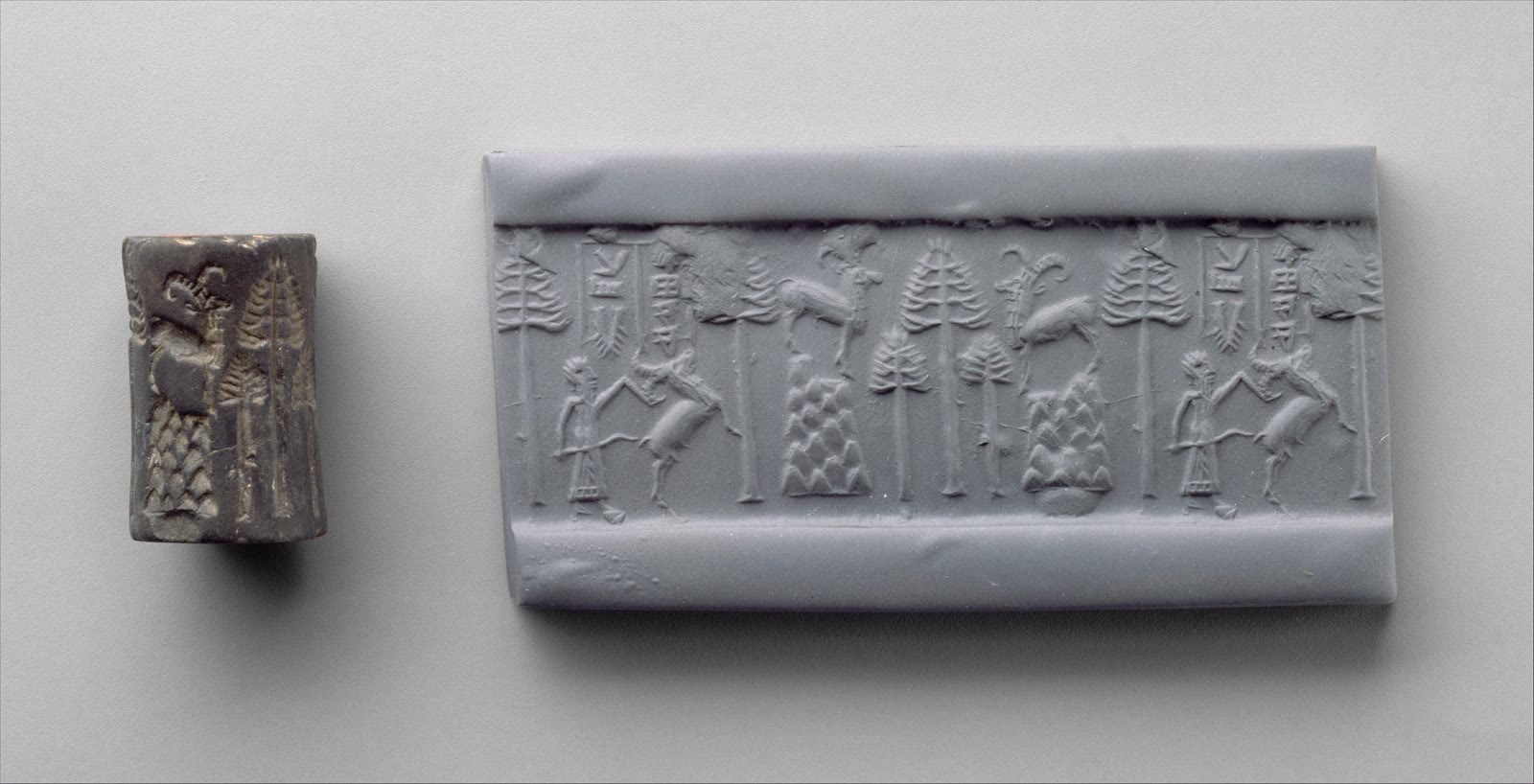
Image context: The Met's photograph puts two different objects side by side. The dark cylinder is ancient; the pale strip is a modern impression made to reveal the scene cut around its curved surface. Neither view is sufficient alone. One preserves the carved stone that moved through an Akkadian hand, while the other makes its moving image legible.[1][3]
At rest, a cylinder seal keeps its picture to itself. A few trees, an animal's leg, or the strokes of an inscription may be visible on the near side, but the rest bends away. The carving is recessed, reversed, and wrapped around a stone scarcely taller than the top joint of a finger. To see what it was designed to do, the object has to move.
Press it into wet clay and roll. Grooves become raised lines. A curved surface opens into a band. Figures hidden on opposite sides meet in one field, and the design can continue beyond a single turn. The hand does not merely copy a finished image from one support to another; its pressure, direction, and distance bring that image into its useful state.[1][4]
That transformation made the cylinder seal one of the ancient Near East's most compact unions of art and action. It could identify a person or office, acknowledge a document, secure a jar or door, carry a prayer, display an imported stone, and stage a miniature encounter among humans, animals, rulers, and gods.[1][2][5][6] Its picture was never only something to contemplate. It was made to travel across matter.
The object withholds its own image
The seal in the photograph is chert, 2.8 centimeters high, and was made in Mesopotamia during the Akkadian period, around 2250–2150 BCE. On the modern impression, two groups join through a stylized landscape. A hunter grasps an ibex between tall trees; above him, cuneiform names the owner as Balu-ili and identifies his court office as cupbearer. Elsewhere, two ibexes face one another across three more trees and mountain forms.[1]
Almost none of that composition can be taken in from one view of the cylinder. Its physical shape denies the frontal encounter expected of a painting or relief panel. Rotate it and one fragment replaces another. Even the inscription must be mentally reversed before rolling makes it read in raised clay. The complete image exists as a capacity distributed around the object.
This is why the museum's modern impression is more than a convenient duplicate. It performs a translation from curved intaglio to flat relief, from negative to positive, and from sequence to overview. Yet the pale strip is not an ancient tablet or sealing. It is a present-day aid made by putting the ancient tool back into controlled motion. The Met explains that its staff now roll seals into a polymer modeling material, while British Museum curators describe preparing polymer clay, dusting the seal to prevent sticking, applying firm pressure, checking legibility, trimming the result, and baking it hard for study.[3][6]
The clean impression therefore solves one problem while introducing another. It shows a design no photograph of the cylinder's exterior can reveal at once, but it can make the image look as though it had always been a neat rectangle. The actual work lived between formats: stone in the hand, clay under pressure, partial roll on a small closure, longer band on a larger surface.
Rolling changes the unit of the picture
A stamp seal can place one bounded emblem with one downward press. A cylinder changes the geometry. Because the design circles the stone, a full rotation produces a band; further rolling begins the band again. The Met's scholarly catalogue describes this as a continuous, potentially unending design, an effect valued not simply because a cylinder offered more space but because repetition was built into its operation.[4]
Look at the pale strip in the hero image. At both edges, the scene starts again. Those cropped repetitions are not mistakes in the photograph. They expose the cylinder's central proposition: the physical object has a circumference, but its impression does not have an obligatory length. A narrow lump of clay may receive only part of the scene. A tablet case may receive a turn or two. The same carved program must remain intelligible under different durations of contact.
The Akkadian engraver of Balu-ili's seal planned for exactly that variation. The Met notes that the composition had to retain balance and clarity whether rolled for half the cylinder's length on a small surface or for twice its length on a larger one.[1] The trees do structural work as well as representational work. They separate and link the hunter group, the facing ibexes, the inscription, and the mountains, giving the moving band internal beats without sealing it inside a single frame.
That makes rolling part of composition. A painter can assume that the canvas will be presented all at once, even if a viewer's attention moves through it. The seal carver had to imagine a picture revealed by contact, with no guarantee that every use would expose a complete turn. The unit of design was not the stone alone or the final strip alone. It was a repeatable relation between circumference and distance.
Pressure mattered too. Too little, and recessed details would not transfer. Uneven force could blur or drop part of the image. Clay had to be soft enough to receive relief yet capable of holding the mark. None of those variables turns every ancient impression into an expressive hand gesture, but they prevent the seal from behaving like a disembodied symbol. Authority became visible through a small physical performance.
A picture that does administrative work
Cylinder seals emerged in Mesopotamia in the fourth millennium BCE, where expanding systems of storage, exchange, accounting, and writing relied heavily on clay.[2][4] They did not invent sealing; stamp seals were far older. Nor should they be credited with inventing writing. What the cylinder offered was a particularly effective way to join a repeatable image to the clay surfaces through which institutions organized goods and obligations.
On a tablet or its clay envelope, an impression could identify the authority responsible for a text. On a lump of clay fastened over the closure of a door, jar, or basket, it could identify the sealer and make unauthorized opening materially evident.[1][2] The image did not merely decorate an administrative act after the important work was finished. Rolling was one of the acts that made the document, container, or threshold accountable.
“Signature” is a useful comparison, but only if it remains a comparison. The Institute for the Study of Ancient Cultures notes that seals could convey an individual's identity or that of an office, combining administrative, social, and religious roles.[5] A modern handwritten signature usually points toward one named person. A seal impression might assert ownership, participation, authorization, obligation, or institutional standing, depending on where and how it was used.
Balu-ili's seal demonstrates both the power and the limit of interpretation. Its inscription gives a personal name and office. The hunting imagery adds a carefully made public face: a human figure commanding an ibex within an ordered landscape. But the Met cautions that any precise relationship between that scene and the inscribed text is no longer understood.[1] It would be tempting to call the hunter Balu-ili or treat the hunt as a literal portrait of his duties. The surviving evidence does not earn that certainty.
The image could authenticate without functioning as a modern ID photograph. Recognition came through the repeatable combination of carving, inscription, object, and context. A seal could make someone present at a transaction through a mark while keeping the meaning of its imagery larger, stranger, and more durable than a likeness.
Worn before it was rolled
Many cylinder seals were pierced lengthwise like beads. They could be suspended, worn as jewelry, or pinned to clothing, and hard or semiprecious stones helped them endure repeated handling.[1][2] The British Museum's curators describe seals as prominent displays of status as well as instruments that acknowledged obligations or transfers of rights; inscriptions and particular stones could also carry protective or amuletic force.[6]
The hole through the center changes the object's scale from merely “small” to bodily. A cylinder seal belonged near skin, cloth, cord, wrist, or hand before it reached a tablet or closure. Its portability kept the means of making an authoritative image with the person entitled to use it—or with whoever had legitimate custody of an office's seal.
That double life resists the modern division between ornament and tool. The stone could be visually valued while worn, even though its most consequential picture was hard to see until impressed. Its material announced color, polish, rarity, and status; its carved surface stored a scene; its perforation made it mobile; its roll made it operative. No one layer exhausts the object.
The same doubleness appears across the long and geographically varied history of the form. ISAC traces cylinder seals from the fourth millennium BCE through the end of the first millennium and beyond Mesopotamia into Persia, Anatolia, the Levant, Arabia, and Egypt.[5] Materials, inscriptions, figures, and uses changed across those places and centuries. “Cylinder seal” names a mechanism, not one fixed iconography or one uniform social system.
The band has no neutral beginning
A museum catalogue has to begin describing Balu-ili's impression somewhere: hunter, ibex, trees, inscription, second animal group. The rolled design itself has no natural left edge. Wherever the cylinder first touches clay becomes a temporary beginning, and after one complete turn the sequence loops.
This does not mean the composition is shapeless. The seal's engraver organized intervals, axes, encounters, and a terminal area where parts meet. But a circular design makes “front” contingent. The image can be entered at different points while retaining its identity, closer to a recurring procession than to a scene behind a window.
Other seals exploit the band differently. An Old Babylonian hematite example at The Met presents the goddess Ishtar, a male figure, a suppliant goddess, and a three-line inscription in a presentation scene common to its period.[2] Such works help scholars trace changes in style and iconography because large numbers survive across chronological phases. The cylinder is therefore both individual and serial: one owner's portable object participates in visual conventions shared by workshops, cities, courts, and cults.
The continuous band also complicates narrative. Repetition can make the hunter seem to return, trees become punctuation, and facing animals establish a rhythm without requiring a unique first moment. The seal does not tell a story exactly as a frieze with a prescribed entrance might. It creates a field in which action, emblem, and recurrence remain available every time the object rolls.
The copy museums need
Most museum objects are protected from reenactment. Their use is reconstructed through labels, diagrams, or adjacent media because operating the original would be too risky. Cylinder seals pose a special curatorial problem: the carved image is difficult to study fully unless someone uses the object according to its basic design.
The British Museum calls rolling essential to revealing and researching a seal's image. Its published workflow also makes clear how much judgment enters a modern impression: select a clay-like material, prevent adhesion, choose pressure, decide whether the result is clear, and cut a clean rectangle for handling.[6] The resulting strip is evidence of what the ancient cylinder can produce, not direct evidence of one ancient sealing event.
That distinction is easy to lose in a polished object photograph. Ancient clay impressions bear their own histories of support, overlap, damage, incomplete contact, and archaeological context. A modern impression minimizes those contingencies so the carving can be compared and read. It exchanges historical mess for formal access.
The modern copy does not diminish the original. It identifies what kind of original this is: an object whose essential visual information was designed to leave it. The more faithfully the impression reveals the carving, the more clearly it demonstrates that the carved cylinder was never meant to be the only place where its image lived.
Not an ancient printing press
It is tempting to call the cylinder seal an early printing press. The analogy catches something real—reversed carving, contact, repeatability—but it drags in too much. A press suggests standardized sheets, mechanical multiplication, and an audience for many equivalent copies. A cylinder seal usually acted within particular documents, closures, relationships, and claims of authority. Its repeated image did not make every impression socially interchangeable.
The safer description is also the more interesting one: a rotational image technology made for wet clay. That phrase keeps the movement, medium, and purpose together. It explains why the form flourished in ancient Near Eastern settings where clay tablets and sealings were ordinary administrative surfaces, and why stamp seals could later replace cylinders rather than represent a simple technological retreat.[2][4][5]
The cylinder's ingenuity lies in the contradictions it keeps operational. The carving is miniature; the band can extend. The stone is durable; the receiving clay begins soft. The design is hidden; the mark can be publicly legible. The object may be personal; the impression can serve an institution. The seal is singular; its image is repeatable. Each pair is resolved not by choosing one side but by rolling from one to the other.
Return to the photograph and the small gap between the dark stone and pale strip. That gap contains the missing hand, the yielding clay, and the turn that connected them. It is where possession became a mark, curved carving became a scene, and a body could leave authority behind after moving on. A cylinder seal's greatest formal achievement was not fitting a world onto a tiny stone. It was teaching that world how to travel.
Sources
- The Metropolitan Museum of Art, “Cylinder seal and modern impression: hunting scene,” c. 2250–2150 BCE — official object record and image, with material, dimensions, Balu-ili inscription, composition, uses, and repeat logic.
- The Metropolitan Museum of Art, “Babylonian cylinder seal,” c. 18th–17th century BCE — official overview of the form's fourth-millennium development, administrative uses, materials, chronology, and Old Babylonian presentation scene.
- Yelena Rakic, “Cylinder Seals: Tiny Treasures That Leave a Big Impression,” The Metropolitan Museum of Art (2018) — curator's explanation of reverse carving, rolling, clay documents, signatures, and modern Sculpey impressions.
- Holly Pittman with Joan Aruz, Ancient Art in Miniature: Ancient Near Eastern Seals from the Collection of Martin and Sarah Cherkasky. The Metropolitan Museum of Art, 1987 — scholarly catalogue on the continuous band, administrative identity, early state systems, writing, style, and iconography.
- Institute for the Study of Ancient Cultures, University of Chicago, “Cylinder Seals” — institutional overview of chronology, geographic spread, individual and office identities, religious roles, and jewelry use.
- Jon Taylor, “First impressions,” British Museum Middle East Newsletter 7 (2023), pp. 16–17 — curator's account of signature, status, amuletic function, materials, and the museum process for rolling modern polymer-clay impressions.