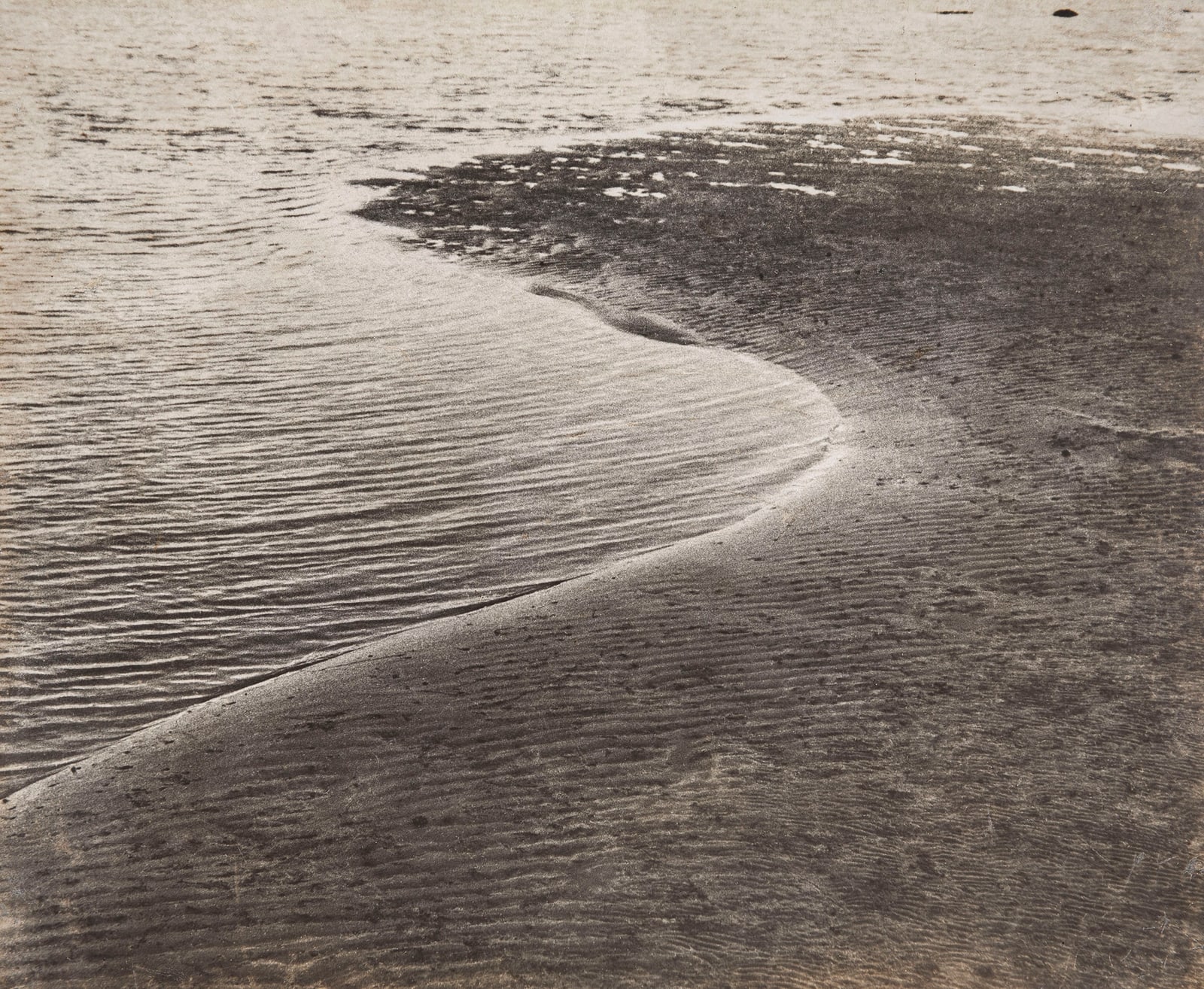
Image context: Ripples run almost horizontally until a pale sandbank bends through them like an enormous unruled line. Dark water gathers beyond the curve; raked sand carries a second set of parallel marks below it. The photograph is not a neutral record of one of Nasreen Mohamedi's drawings but an artwork made with a camera. Mohamedi worked across photography and drawing without making either medium a servant of the other.[1][3][4]
Nasreen Mohamedi did not make the world disappear. She made it pass through narrower apertures.
In her photographs, a road marking, a stretch of sand, an architectural edge, or a channel of water could lose the contextual clues that ordinarily tell us what to call it. In her mature drawings, ruled lines cross otherwise open paper, gather into bands, tilt away from a grid, and produce shallow depths that seem to arrive and vanish as the eye adjusts. Both bodies of work are famously spare. Neither is empty.
That difference is the key to Mohamedi's precision. The ruler, the camera, and the crop did not protect art from experience; they concentrated experience until a shift in angle or a breath of white paper could carry it. Her abstraction belongs within post-Independence Indian art, but it also unsettles any history that treats modernism as a style exported from one center to the rest of the world. What looks universal in her work was made from a particular life of travel, teaching, illness, reading, listening, and sustained attention.[1][2]
A life of crossings, not a list of borrowed styles
Mohamedi was born in Karachi in 1937, when the city was still part of British India. Her family moved to Bombay, now Mumbai, in 1944. She studied at Saint Martin's School of Art in London from 1954 to 1957, returned to Bombay in 1958, and worked in a Paris atelier from 1961 to 1963. During the 1960s she also traveled through India, Iran, Turkey, Bahrain, and Kuwait. In 1972 she moved to Baroda, now Vadodara, to teach at the Faculty of Fine Arts of M.S. University.[2]
It would be easy to turn that itinerary into a tidy influence chart: Europe supplied modern abstraction, West and South Asia supplied architecture and landscape, India supplied a national context. Her work resists the arrangement. The earliest pieces retained contours, washes, and natural reference; through the 1960s, discernible landscape gave way gradually rather than disappearing in one conversion. Talwar Gallery's account of these early works notes the continuity between a spindly desert plant and its shadow in a photograph, sharp and soft passages in nearby drawings, and the later grid. Nature remained an anchor even as imitation fell away.[5]
The dominant currents around Mohamedi were not simple, either. The Museo Reina Sofía retrospective placed her beside Bombay abstractionists V.S. Gaitonde, her early mentor, and Jeram Patel, her friend and colleague, while also acknowledging her engagement with artists such as Klee, Kandinsky, Malevich, and Mondrian. At a moment when figurative and narrative art often carried questions of nation and identity in India, her radically reduced vocabulary took another route.[1]
That route was cosmopolitan without being placeless. Mohamedi did not assemble motifs from her travels. She carried problems between places: how a horizon establishes distance, how a shadow turns masonry into a diagonal, how repetition can remain alive, how a line can divide space without closing it.
The camera did not sketch the drawing
Photography was available to Mohamedi unusually early. Her father, Ashraf Mohamedi, founded a photographic-equipment business in Bahrain around 1913; the company later expanded through the Persian Gulf. She owned several cameras and used them while studying and traveling, as well as in everyday life. From the late 1960s she also participated in photographic initiatives among artists in Bombay and, later, Baroda.[4]
Her surviving subjects sound ordinary: pavements, zebra crossings, feet, the sea, desert ground, a loom, and fragments of buildings. Her treatment made them difficult to settle. Close cropping removed explanatory surroundings. A camera tipped up or down disturbed the body's expected relation to the horizon. Near and far could collapse into adjacent shapes. At Fatehpur Sikri, she focused not on a monumental gateway or dome but on the shadow of an empty water channel crossing sandstone.[2][4]
The temptation is to place each photograph beside a drawing and announce a source. The evidence argues for more care. Mohamedi did not exhibit the photographs during her lifetime and apparently discouraged an overt, one-to-one relationship between them and her other work. The Drawing Center later described an exchange between the media: each reduces structures and spaces to diagonals and planes. Emilia Terracciano goes further while preserving the uncertainty, proposing that the camera helped Mohamedi test how the white page might be approached, tilted, cropped, and divided.[3][4]
That is an operational kinship, not a chain of copies. A photograph closes the shutter on one arrangement of the visible. A drawing can continue deciding where a line begins, how pressure changes, and how long an interval remains open. The camera trained attention by excluding; the hand rebuilt attention in time.
The hero photograph is therefore more than biographical evidence for the drawings. Its severe crop is a complete act in its own medium. It asks how little recognizable information a photograph needs before light and structure become its real event.
The ruler did not remove the hand
By the 1970s, Mohamedi had settled on the square as a recurring format and worked with graphite, ink, a Rotring Rapidograph pen, rulers, set squares, and T-squares. In one circa-1970 drawing now at The Met, parallel and angled lines traverse a square sheet measuring 47.6 centimeters on each side. Some lines were incised into the paper rather than merely laid on its surface.[6]
Those instruments can suggest impersonal execution, as though the drawing resulted from a system once its rules were selected. Look closely and the opposite happens. Every tool increases the consequence of a choice. Spacing accelerates or relaxes. A band ends before becoming a solid block. One diagonal pulls against a set of horizontals; another opens the suggestion of a plane. White paper is not background but an interval with a measured duration.
The Reina Sofía survey traced how, after 1975, Mohamedi disturbed the grid by changing the widths of vertical registers and the distances between horizontal lines, introducing divergent angles, shifting horizons, and shallow axonometric effects. Her order generated movement rather than defeating it. Late drawings became more economical still, with open paper increasingly outweighing drawn marks.[1]
This is why “minimalism” is useful only as a beginning. It identifies reduction, repetition, and a refusal of narrative image-making. It does not explain the pressure inside Mohamedi's line. Her drawing tools constrained the hand, but they did not automate duration, judgment, or touch. Precision was not the absence of the body. It was one of the body's most exacting performances.
Architecture, music, and the space between marks
Mohamedi's diaries place Rilke and Camus near Rumi, Ghalib, and Muhammad Iqbal; museum accounts also emphasize her devotion to Indian classical music. Her camera moved between the Mughal geometry of Fatehpur Sikri and the modernist spaces of Le Corbusier's Chandigarh. Islamic calligraphy and architecture, Russian Constructivism, Zen aesthetics, desert horizons, sea light, and the work of other abstractionists all enter the scholarship around her.[1][2][4]
None should be used as a decoder ring. A diagonal does not become “Islamic” because Mohamedi photographed a Mughal site, and a sequence of ruled lines is not automatically a transcription of musical rhythm. These references matter because they show how widely she studied relations: pause and recurrence, surface and depth, material structure and immaterial light.
Her diaries were not conventional commentaries on particular works. The Reina Sofía exhibition presented them as vital but oblique evidence: notes, observations, copied passages, and concentrated phrases rather than a theory that fixes each drawing's meaning. The lack of titles and dates on much of the work makes that archive indispensable and incomplete at once.[1][4]
The same boundary should govern any reading of the photographs. They demonstrate what held her eye, not exactly how an image became a line. Their greatest value may lie in preserving attention before explanation—light caught at an edge, a horizon stripped of anecdote, a structure briefly seen as force.
Illness changed the conditions, not the meaning
Huntington's disease began affecting Mohamedi's motor abilities around 1969–70. The Reina Sofía chronology connects that bodily change with assisted working methods and her adoption of precision instruments. She continued drawing as the degenerative illness progressed and died in 1990, aged 53.[1]
This fact belongs in an artist profile, but it is a dangerous master key. Read carelessly, the ruled drawing becomes either a symptom or an inspirational victory over one. Both versions shrink the work to a medical plot. Mohamedi's investment in line, landscape, restraint, and photographic framing had already developed across years; the disease altered the conditions under which those questions were pursued.[1][5]
Tools enabled control, but control was never the sole subject. Her mature works repeatedly risk imbalance, interruption, and optical uncertainty. Their discipline is moving because it does not pretend that the body has vanished. It gives the body's decisions a structure in which the slightest deviation matters.
Teaching was another form of that discipline. From 1972, Mohamedi worked at M.S. University in Baroda, where photography, design, and debates over modernism circulated among colleagues and students. Later accounts remember her as a generous teacher whose practice became consequential for younger artists, even while her wider international reputation developed slowly.[2][4][5]
Recognition without a rescue story
The Drawing Center called Mohamedi “under-recognized” when it mounted Lines among Lines in 2005, bringing thirty drawings into dialogue with fifteen photographs. Yet the Reina Sofía catalogue material stresses that she was admired during her lifetime. Both statements can be true. Recognition has a geography: an artist may matter intensely within a community while remaining peripheral to museum narratives written elsewhere.[1][3]
Her posthumous exhibition history changed that scale. The Drawing Center show was followed by inclusion in Documenta 12 in 2007, a Kiran Nadar Museum of Art retrospective in 2013, a major Tate Liverpool exhibition in 2014, the Reina Sofía survey in 2015, and The Met Breuer's first U.S. museum retrospective in 2016. The Met presented her work not as an appendix to an established minimalist canon but as evidence that international modernism itself required expansion.[1][2]
That reframing is more useful than a discovery story. Mohamedi did not need a Western museum to make her lines modern. The museum needed her work to make its account of modernism less provincial.
Return to the photograph at the top. It withholds the reassuring breadth of a view and keeps only an encounter sharpened by selection. The drawings do something comparable without reproducing it: observed structure passes through memory, instrument, and hand until no landmark remains, but relations of light, weight, distance, and motion do. Mohamedi's precision did not forget the world. It remembered what looking felt like after the names had fallen away.
Sources
- Museo Nacional Centro de Arte Reina Sofía, “Nasreen Mohamedi: Waiting Is a Part of Intense Living” (2015) — official retrospective page, chronology, curatorial account, and source page for the high-resolution Untitled photograph used here.
- The Metropolitan Museum of Art, “Nasreen Mohamedi” (November 16, 2015) — official retrospective release covering her biography, travels, teaching, diaries, artistic references, photographic practice, and exhibition history.
- The Drawing Center, “Nasreen Mohamedi: Lines among Lines” (2005) — institutional exhibition record on the exchange between her fine-line drawings and black-and-white photographs.
- Emilia Terracciano, “Tilt, Swing, Crop, Fold! Nasreen Mohamedi's Photographic Practice.” Alkazi Foundation for the Arts, 2022 — scholarly essay on her cameras, travels, photographic subjects, cropping, vantage points, diaries, and the evidentiary limits of relating photographs to drawings.
- Talwar Gallery, “Nasreen Mohamedi: Pull with a Direction” — exhibition text tracing continuities among her early landscapes, photographs, paintings, prints, ink washes, desert experience, and later grid drawings.
- The Metropolitan Museum of Art, “Nasreen Mohamedi: Untitled, ca. 1970” — official object record documenting the drawing's materials, dimensions, square format, drafting instruments, incised lines, and spatial effects.