Mierle Laderman Ukeles made one of contemporary art's sharpest arguments by refusing to treat maintenance as the dull work that happens before art can begin. In her hands, washing, cleaning, repairing, carrying, routing, thanking, and returning became artistic materials. The point was not to decorate labor with a nicer name. The point was to expose a cultural mistake: modern life depends on maintenance while aesthetic prestige usually flows toward novelty, rupture, and heroic making.[1][2]
That mistake is why Ukeles still feels necessary in 2026. Her 1969 Manifesto for Maintenance Art grew from the collision between artistic freedom and maternal, domestic, and social necessity.[1][2] She did not solve that collision by choosing one identity over the other. She named the hidden work itself as art, then kept expanding the frame: from personal care to institutional labor, from museum cleaning to sanitation routes, from feminism to ecology, from a household to the whole city.[1][4][6]
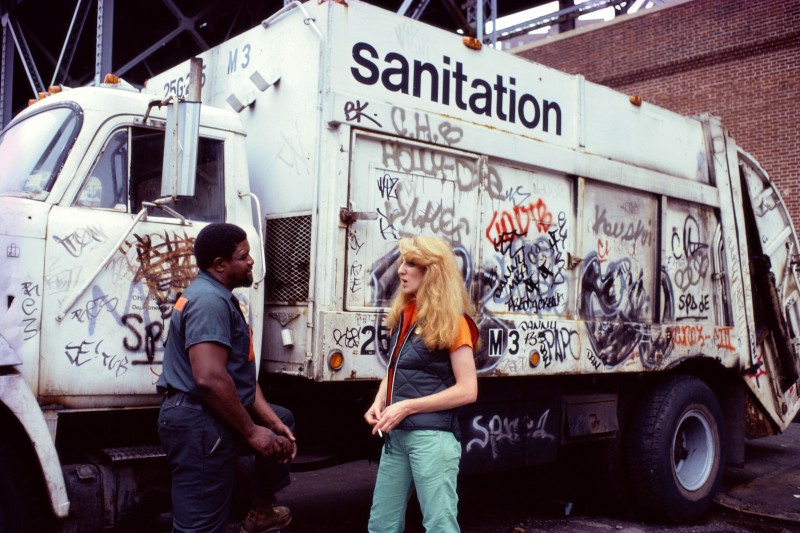
Image context: the cover photograph comes from the Queens Museum's documentation of Touch Sanitation Performance, 1979-1980. It is not a generic portrait. Ukeles stands beside a sanitation worker and a marked truck, making visible the exact triangle this essay follows: artist, worker, and city system.[1]
Maintenance was the missing medium
The 1969 manifesto matters because it does not simply demand respect for unseen work. It reorganizes the category of art around duration.[1][2] A painting may be finished; a performance may end; a sculpture may settle into an object. Maintenance does not close so neatly. It repeats because bodies, buildings, streets, households, museums, parks, and waste systems keep needing support. Ukeles took that repetition seriously as form.
This is the key to her difference from a sentimental celebration of care. She does not make maintenance soft. She makes it structural. The Queens Museum's 2016-2017 survey framed her practice across five decades, from feminist performance to public art, with the New York City Department of Sanitation residency as the long civic spine of the work.[1] That range matters. Ukeles was not adding a service-work theme to an otherwise conventional practice. She was building an art practice out of systems that have to keep running.
The manifesto's scale also keeps widening. The Queens Museum brochure describes the early work as moving through personal maintenance, social or city maintenance, and planetary maintenance.[2] Those categories are not metaphors arranged for elegance. They are operational levels. Someone cleans a floor; a building stays usable. Workers collect refuse; a city remains inhabitable. People repair damaged land and water; civic life gains a future instead of only a disposal plan.[2][4]
Touch Sanitation made recognition into a route
Ukeles's best-known work, Touch Sanitation Performance, took place from July 1979 to June 1980, after she became the official, unsalaried artist-in-residence at New York's Department of Sanitation.[2][3][4] The work sounds almost impossibly simple when reduced to its action: she traveled through all 59 sanitation districts, shook hands with 8,500 sanitation workers, and thanked each one for keeping New York City alive.[1][2][3]
The simplicity is deceptive. Touch Sanitation was not a courtesy tour. It was a citywide drawing made by bodies, routes, schedules, trucks, depots, and hands. The Queens Museum's later account describes Ukeles's "Ten Sweeps" itinerary across the sanitation system, a repeated face-to-face ritual that took nearly a year rather than the few months she first imagined.[3] The work's duration was part of its truth. A quick symbolic action would have turned sanitation into an image. Ukeles instead entered the time scale of the system.
That time scale changed the meaning of the handshake. In a museum, a handshake might read as performance gesture. On a route, beside a truck, with a worker in the middle of a shift, it becomes a test of attention. The worker is not a figure in the background of urban life. The worker is the person whose repeated labor keeps the city's living conditions from collapsing.[3][4] Ukeles did not ask viewers to admire maintenance from a distance. She built an artwork that had to meet maintenance where it was already happening.
This is also why the sentence "Thank you for keeping NYC alive" has more force than a general civic slogan.[3] It refuses the smaller claim that sanitation only keeps a city clean. Cleanliness is part of the work, but Ukeles's formulation reaches deeper. Waste collection, transfer stations, routes, repairs, hazards, weather, speed, and bodily risk are conditions of urban survival. The city is alive because maintenance work returns again and again before crisis becomes visible.
The museum was not outside the system
Ukeles's art is strongest when it prevents the museum from pretending innocence. Her early Maintenance Art performances included cleaning, washing, and other tasks in art spaces; the point was to make the institution's dependence on care legible.[2][6] A museum often asks visitors to see finished objects under controlled light, but its apparent calm rests on guards, preparators, cleaners, registrars, installers, conservators, educators, and maintenance crews. Ukeles made that supporting labor part of the aesthetic field.
The 1984 Touch Sanitation Show: Part One sharpened that institutional argument by entering a sanitation facility itself. Creative Time notes that the exhibition took place at the 59th Street Marine Transfer Station and was the first art exhibit in a real sanitation facility in the United States.[5] That site choice matters as much as the work inside it. If sanitation labor had been treated as invisible because it was dirty, noisy, low-status, or infrastructural, then the transfer station forced the art public to meet the system at one of its own working thresholds.
The move also reverses a familiar art-world habit. Usually an institution brings an outside subject into the museum, where it can be framed, interpreted, and made safe. Ukeles brought art into the sanitation system and let the system's own scale alter the artwork. The result was not social documentary alone. It was a pressure change in what counted as an art site.
Feminism becomes infrastructure
Ukeles's feminism is often easiest to understand through domestic labor, but the strength of her work lies in how far she carries that insight. The National Women's History Museum places her practice within a broader challenge to undervalued domestic and civic labor, especially work performed by women, working-class people, and public-service workers.[6] That framing is useful because it avoids separating home from city. The kitchen, the museum floor, the sanitation route, the transfer station, and the landfill all belong to one maintenance continuum.
This continuum does not flatten differences. Domestic care and municipal sanitation are not identical jobs. They differ by pay, gender history, exposure, union structure, public visibility, danger, and institutional power. Ukeles's achievement is to show that the culture that dismisses one often knows how to dismiss the other. It treats sustaining work as natural background. It notices the failure of maintenance more quickly than the presence of maintenance.
That is why her residency with the Department of Sanitation remains such a radical model.[1][3][4] It was official and unsalaried, an odd and revealing arrangement. The official status placed art inside a city agency; the absence of salary kept visible the problem of valuing care and civic imagination. Ukeles worked with the system while continuing to ask how systems recognize, or refuse to recognize, the people who keep them alive.
The later work proves the sentence did not expire
In 2020, during the COVID-19 pandemic, Ukeles returned to the sentence from Touch Sanitation through For -> forever..., a public message presented by the Queens Museum, Times Square Arts, and MTA Arts & Design.[3] The Queens Museum account describes the work across the museum facade, Times Square, and more than 2,000 transit displays, addressing public-service workers moving through the city during crisis.[3] That return could have become nostalgia. Instead, it clarified the old work's durability.
The pandemic made maintenance newly visible because breakdown became thinkable at every scale: transit, sanitation, hospitals, food distribution, cleaning, elder care, school buildings, domestic routines, ventilation, delivery, and public space. Ukeles did not need to invent a new language for that moment. Her older language had been waiting inside the city's infrastructure.[3][4]
This is why Maintenance Art should not be read as a narrow chapter in feminist performance history. It is also a theory of urban form. Buildings, roads, parks, transit systems, waste systems, museums, and households are not stable objects. They are agreements renewed by labor. Ukeles's art asks what changes when that renewal becomes visible before it fails.
What the work asks now
The lesson of Ukeles's work is not that every act of care automatically becomes art. That would make the argument too easy. Her harder claim is that maintenance can become art when its structure, duration, social relation, and ethical stakes are made perceptible.[1][2][5] Touch Sanitation works because it does not merely praise workers. It maps a city by meeting the people whose routes make the city possible.[2][3]
Seen this way, the cover photograph carries more than historical documentation. The sanitation truck is marked, used, and materially present. The worker and artist stand in conversation rather than in a staged heroic tableau. The image has no need to glamorize the job. Its force comes from proximity. Art is not floating above the city. It is standing beside the truck, trying to understand what the city owes to the hands that return each morning.
Ukeles made maintenance visible without turning it into spectacle. That remains the hardest part of the work. Spectacle burns fast. Maintenance returns. Her art stays with the return.
Sources
- Queens Museum, "Mierle Laderman Ukeles: Maintenance Art" - exhibition page, cover image source, survey overview, and Touch Sanitation Performance caption.
- Queens Museum, Mierle Laderman Ukeles: Maintenance Art exhibition brochure PDF - manifesto context, performance chronology, and exhibition structure.
- Queens Museum, "Mierle Laderman Ukeles: For -> forever..." - 2020 public artwork page linking the pandemic message back to Touch Sanitation.
- Maintenance Artist, "Mierle Laderman Ukeles" - artist biography, Department of Sanitation residency, key works, exhibitions, collections, and awards.
- Creative Time, "Touch Sanitation Show: Part One" - project page on the 1984 exhibition at the 59th Street Marine Transfer Station.
- National Women's History Museum, "Mierle Laderman Ukeles" - biography framing Maintenance Art through feminism, civic labor, environmental care, and visibility.