The daguerreotype is easy to misremember as an early photograph that simply waited for later photography to improve it. That misses the medium's strangeness. A daguerreotype is a photograph, but it is also a polished object: silver over copper, worked to a mirror surface, sensitized, exposed, developed, fixed, protected, and handled as something closer to a small technological relic than a paper print.[1][2] Its image does not sit comfortably in front of the viewer. It appears and recedes with angle, light, and reflection. You look at it, and it looks back through the same shining surface.
That physical difficulty is why a technique deep dive suits the daguerreotype better than a simple origin story. The process was announced to the public in 1839 and quickly became the first widely successful photographic medium, but its success did not come from convenience alone.[3][4] It offered unprecedented detail, directness, and presence. It also demanded elaborate preparation, hazardous chemistry, exact timing, and protective housing. The daguerreotype made modern photographic vision possible while refusing to become weightless.
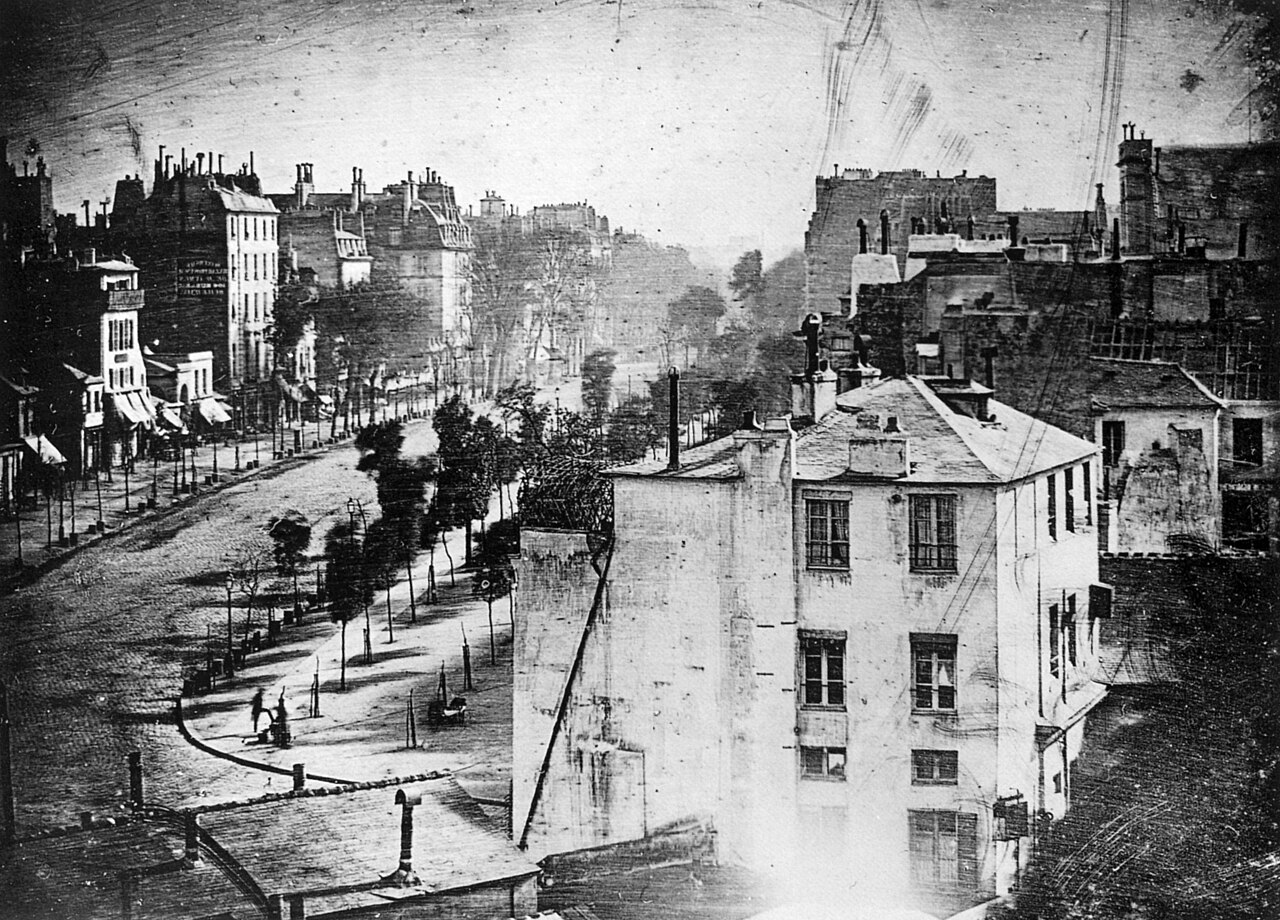
Louis Daguerre's Boulevard du Temple, used here as the cover image, gives the problem a city-size stage. Wikimedia Commons identifies the file as Daguerre's 1838 daguerreotype of the Paris boulevard; its captions describe the famous stationary figure near the lower left and note that moving traffic disappeared during the long exposure.[5] The picture often gets remembered as one of the earliest surviving photographs to show a person. More interesting is the reason that person can be seen at all. The street had to be converted into time. Motion fell away. Stillness became evidence.
A mirror had to become sensitive
The Library of Congress gives the essential procedure in compressed form: the daguerreotype is a direct-positive process on silver-plated copper, made without a negative, and the plate first had to be cleaned and polished until it looked like a mirror.[1] That first step is not cosmetic. The mirror surface is the ground of the image. Before the plate can receive the world, it must become almost too reflective to see as a material support.
Cornell's photographic-process guide describes the same beginning with useful bluntness: a silver-plated copper plate was polished on the silver side to a mirror-like sheen, then exposed to iodine vapor to form light-sensitive silver iodide.[2] The language sounds procedural, yet each step changes how the eventual image behaves. Because the image is made on polished metal, viewing remains unstable. A daguerreotype can appear positive or negative depending on the angle and lighting conditions.[2] It is therefore not a transparent window in the later photographic sense. It is an image that keeps reminding the viewer of its surface.
That matters aesthetically. Paper photographs invite scanning; daguerreotypes invite adjustment. The viewer tilts the plate, finds a dark reflection, loses it, then finds it again. The object trains the body. It asks for a slower, more intimate form of looking, one in which the image is not fully separate from room light, hand position, and the viewer's own shadow. The medium's "mirror with a memory" reputation is more than a metaphor.[3] The memory arrives inside a mirror.
Chemistry made detail, but detail cost time
After sensitization, the plate entered the camera and received a latent image. The Library of Congress notes that after exposure the plate was developed over hot mercury until the image appeared, then fixed in sodium thiosulfate or salt and often toned with gold chloride.[1] Cornell's account matches that sequence: camera exposure, heated mercury-vapor development, hypo fixation, rinsing, and later improvements including bromine fumes and gilding.[2] The daguerreotype's beauty is therefore inseparable from a chain of chemical negotiations.
The detail could be astonishing. Getty's exhibition text describes the daguerreotype as a direct positive image fixed on a sensitized silver-coated plate, and its book page for The Silver Canvas stresses the highly polished silver surface that captured camera images through exposure to light.[3][4] Fine hair, fabric, masonry, and small inscriptions could register with a clarity that seemed uncanny to nineteenth-century viewers. That sharpness helped the medium travel quickly through portraiture, urban views, scientific records, antiquarian documentation, and collecting culture.
Yet early exposure times placed severe conditions on what could appear. The Library of Congress gives a range of three to fifteen minutes for the earliest daguerreotypes, before lens and sensitization improvements shortened exposure times to less than a minute.[1] That explains the peculiar quiet of many early plates. The world did not lack people, carts, weather, or noise. The process selected against movement. It rewarded architecture, posed bodies, still lifes, and any human figure able or forced to hold position long enough to impress itself on silver.
Boulevard du Temple turns absence into evidence
Seen with that process in mind, Boulevard du Temple stops being only a milestone image and becomes a technical argument. The boulevard was busy, but the plate preserves a city disciplined by exposure time.[5] Moving pedestrians and vehicles did not vanish because the street was empty; they vanished because the chemistry could not hold them as finished forms. The famous figure near the lower left, usually described as a man having his boots polished, survives because his stillness matched the medium's demand.[5]
The photograph's apparent emptiness is therefore not a failure of early technology. It is the image's subject. Daguerreotype time turns urban life into a filter: buildings, rooflines, pavement, and stationary bodies remain; passing life thins out. The result looks almost theatrical, which is fitting for Daguerre, whose career was tied to the Diorama before photography became his historical name.[4] The city becomes a stage after most of the action has moved too quickly to be recorded.
The mirror reversal adds another pressure. Commons captions for the image note that the view is laterally reversed.[5] That reversal belongs to the medium's optics and to the larger feeling of estrangement. We recognize the street as a document, but it is not simply the street as a walker would have met it. It is Paris translated through a polished plate, long exposure, and chemical development. The daguerreotype's truth is precise, but it is never neutral.
One plate, one encounter
The daguerreotype also resists later photographic assumptions because it is one-of-a-kind. The Library of Congress calls it a direct-positive process without a negative; Cornell states that it produces only a single image.[1][2] Copies could be made by re-photographing or translating the image into other media, but the original plate did not generate a run of identical prints in the way later negative-positive systems would.[1]
That uniqueness changes the social life of the picture. A daguerreotype portrait is not merely an image of an absent person. It is a handled object with a scale, case, mat, glass, preserver, tarnish risk, and viewing ritual.[2] It belongs to pockets, drawers, parlors, studios, and archives. Its intimacy comes partly from that portability and partly from the knowledge that the image is materially singular. The plate has not been pulled from an edition; it is the encounter's own surface.
For art history, this objecthood keeps the daguerreotype from being reduced to a primitive camera result. Getty's In Focus: Daguerreotypes exhibition framed the medium through unique reflections of people, places, and events during the first two decades of photography.[3] That phrase matters because reflection is both literal and historical. The daguerreotype reflected light, reflected faces, reflected a public suddenly learning that the world could deposit itself on metal, and reflected the viewer back into the act of looking.
Why the silver mirror still matters
Later photography solved many of the daguerreotype's limitations. Paper processes made images easier to reproduce. Shorter exposures changed the relation between movement and record. Safer and more flexible chemistry opened photography to broader use. Those changes were real advances. They also made it easier to forget what the daguerreotype understood at the start: a photograph is never only a view. It is a material agreement among surface, light, time, chemistry, and viewer.
That is why daguerreotypes still feel contemporary when encountered in museums or archives. They slow down the habit of consuming images as frictionless information. Their polish makes the viewer aware of lighting. Their reversal complicates documentary confidence. Their singularity pushes against infinite reproduction. Their long exposures make time visible as selection rather than as background.
Boulevard du Temple endures because all of those forces gather in one plate. The city is present, but incomplete. The person is present, but only because he was still. The image is documentary, but mirrored. The surface is photographic, but metallic. Daguerreotype did not merely begin photography. It left behind a demanding lesson about the medium: the captured view becomes powerful when the object that holds it remains visible.
Sources
- Library of Congress Prints & Photographs Online Catalog, "Daguerreotypes: The Daguerreotype Medium" - process note on direct-positive silver-plated copper plates, polishing, iodine sensitization, mercury development, fixing, exposure times, and uniqueness.
- Cornell University Library, "Photographic Processes: Daguerreotype, 1839-1860" - exhibition guide on the mirror-like silver/copper plate, iodine, mercury vapor, hypo fixing, one-of-a-kind images, viewing angle, tarnish, and protective casing.
- The J. Paul Getty Museum, "In Focus: Daguerreotypes" - exhibition page describing daguerreotypes as direct-positive images on sensitized silver-coated plates and as "mirror with a memory" objects from photography's first two decades.
- Bates Lowry and Isabel Barrett Lowry, The Silver Canvas: Daguerreotype Masterpieces from the J. Paul Getty Museum, Getty Publications, 1998 - book page on Daguerre's polished silver-surface invention and Getty's daguerreotype collection.
- Wikimedia Commons, "File:Boulevard du Temple by Daguerre.jpg" - public-domain scan of Louis Daguerre's 1838 daguerreotype used as the article image, with file notes on the stationary figure, long exposure, and mirror reversal.