Eugene Atget built one of modern photography's strangest reputations out of practical work. He photographed doorways, shop windows, staircases, courtyards, parks, street vendors, interiors, bridges, signs, and empty streets as if Paris might vanish if each surface were not patiently recorded. Getty's recent Atget exhibition describes him walking the city around the turn of the twentieth century with a heavy camera, focusing on old alleys, shop fronts, architectural details, staircases, and vendors.[1] That list sounds ordinary until the pictures begin to accumulate. Then the ordinary becomes unstable. Atget's Paris is both a document and a stage after the actors have stepped away.
That double life is why an artist profile suits him better than a simple history of documentary photography. Atget sold useful images to architects, artisans, libraries, archives, illustrators, and painters; Britannica's account stresses that his business was built around a visual catalog of Old Paris before later audiences treated the work as modern art.[2] Yet usefulness did not keep the photographs from becoming poetic. The same negative could serve as architectural reference, urban evidence, or an uncanny scene. Atget did not need to choose between those roles. His art grew from holding them in tension.
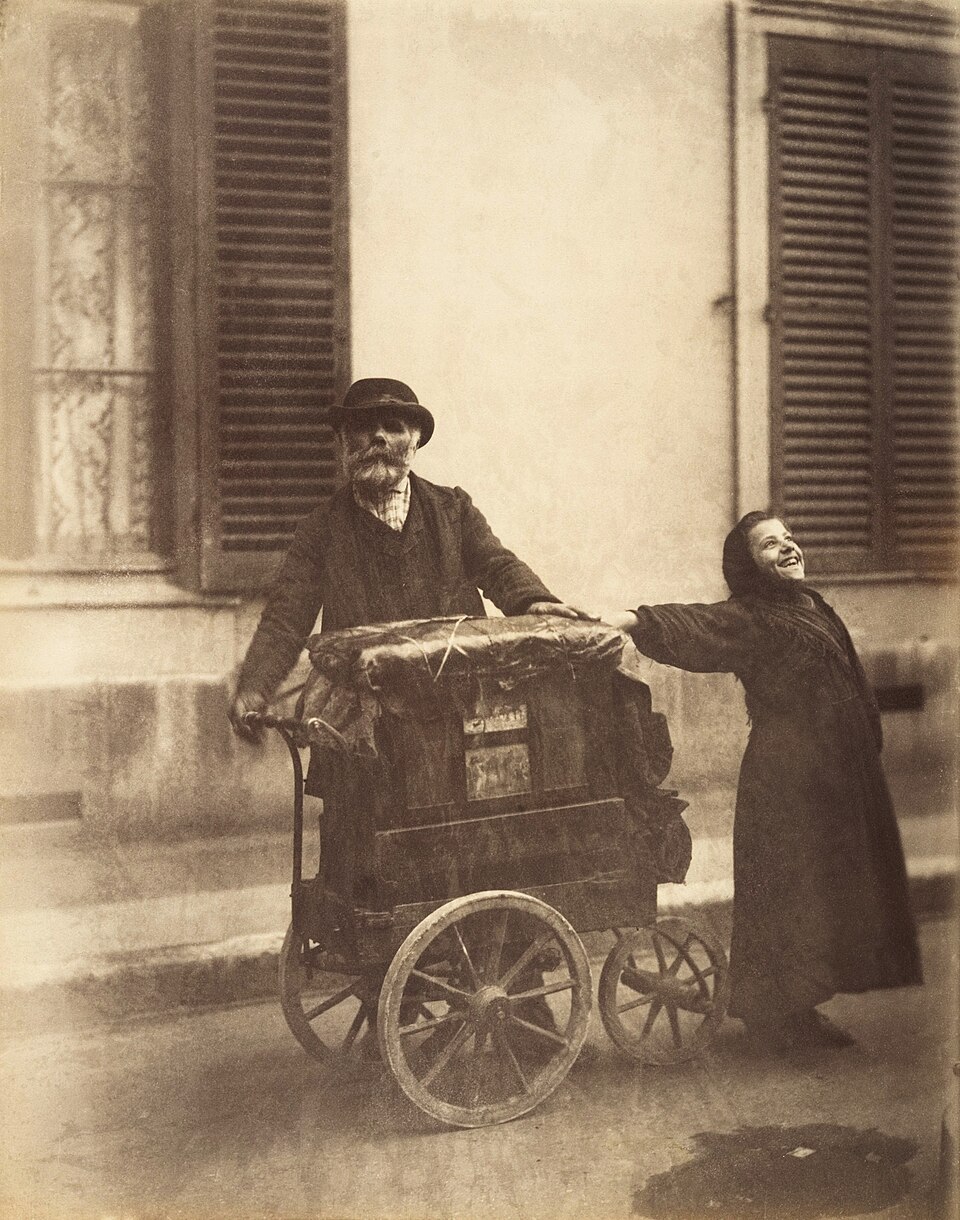
The photograph used here, Organ-grinder, made in 1898-1899, gives the tension a human scale. The Philadelphia Museum of Art identifies its version as an Atget photograph of an organ grinder, with the negative dated 1898-1899 and the print around 1930.[4] Wikimedia Commons hosts a related public-domain file from the same image family.[5] A street musician stands with his instrument, not dramatized into heroic poverty and not dissolved into street texture. He is recorded plainly, but the plainness has pressure. The camera gives enough detail to make him occupational evidence and enough stillness to make him feel like an apparition from a city already receding.
A working archive, not a grand pose
Britannica gives the essential biographical boundary: Atget worked across the aftermath of Haussmann's nineteenth-century rebuilding and described his business in terms of photographic views of Old Paris.[2] Those dates and ambitions place him across several Parisian eras. He lived after the great rebuilding had already altered the city, and he worked as modern streets, shops, signage, transport, and photographic reproduction were changing how urban life appeared. His subject was therefore not "old Paris" as nostalgia alone. It was old Paris under pressure from modern Paris.
Atget's method matched that pressure. Getty notes that he made thousands of photographs from the late 1880s until his death, giving a view of the French capital during rapid urban transition.[1] Its exhibition page frames the same achievement as an obsessive chronicle of Paris and its environs, with selected works ranging from boulevards and Gobelins shop windows to Saint-Cloud and old architectural sites.[3] The scale matters. A single Atget picture can look modest; thousands of them become a system. He returned to types, facades, districts, parks, trades, interiors, and architectural fragments until the city began to read like an index. That index was not neutral. Every chosen doorway and shop window marked a belief that overlooked urban facts carried cultural memory.
This is where Atget differs from the photographer as instant hunter. His work often feels deliberate, frontal, and patient. The camera is not trying to catch a spectacular event. It waits until the structure of a place can show itself. The pictures have time inside them: early morning light, vacant pavement, a vendor holding position, a facade standing with its old ornament exposed. They are slow photographs of a city moving faster than it appears.
Documents for artists became documents about modernity
Atget's practical market matters because it kept the photographs close to use. Getty's 2023 essay says he made photographs for clients including illustrators, set designers, cartoonists, and painters, isolating architectural elements so artists could study them.[1] Britannica similarly describes principal customers among architects, artisans, libraries, archives, and lovers of the older city.[2] This was not a romantic studio mythology. It was an image business built around reference, memory, and demand.
The twist is that those utilitarian pictures later became some of the most charged images in modern photography. Britannica traces the afterlife clearly: in the 1920s Atget's photographs came to Man Ray's attention; after Atget's death, Berenice Abbott bought a large residual collection of glass plates and prints, and later writers and photographers helped recast his plain facts as a model for creative photography.[2] The canon was built after the labor. The artist who had provided images for other people became, in retrospect, a maker whose practical restraint looked like vision.
That reversal can be overstated if Atget is turned into a secret Surrealist against his will. The better reading is narrower and stronger. His photographs were open enough to survive new readings because they were exact. Surrealist viewers could feel their eerie vacancies, mannequins, reflections, and deserted streets; historians could value their record of buildings and trades; photographers could study their composition. The images did not become modern by abandoning the document. They became modern because the document, made with enough patience, began to disclose the unease of modern life.
The city looks empty because it is full of evidence
Many Atget street views are famous for their emptiness. Getty's discussion of his early morning facade and shopfront work notes that people are often absent or blurred, while the heavy view camera and glass negatives preserve signage and architecture with remarkable clarity.[1] That technical fact shaped the feeling of the work. Long exposure, tripod discipline, and architectural attention gave the city a suspended look. The person who moves too quickly vanishes into blur; the threshold, sign, railing, window, or stone remains.
Yet the photographs are not empty in any simple sense. The absence of crowds makes other social facts visible. A shop window presents desire through mannequins and reflections. A courtyard shows labor by the carts and tools left behind. A staircase records class through material wear. A street vendor, as in Organ-grinder, becomes a figure held between occupation and performance. Atget's Paris is full of evidence, but the evidence rarely announces itself. It sits in surfaces and waits for attention.
That is why the pictures can feel haunted without needing theatrical darkness. A haunted image is not only an image with ghosts. It is an image where time refuses to stay in one layer. Atget photographed old city fabric while the twentieth century was arriving; later viewers saw those photographs after much of the world they recorded had already changed again. The result is a double exposure of history: the subject was already old when Atget photographed it, and the photograph itself has since become old.
Abbott helped the archive become an argument
Atget's posthumous reputation depends heavily on Berenice Abbott. Britannica says Abbott visited Atget before his death, bought a large remaining collection after he died, and helped open the way for later photographers to read his work as creative photography built from plainly seen facts.[2] That sequence matters because Atget's archive did not simply drift into fame. It needed an advocate who understood that a working photographer's stock could become an argument about modern vision.
Abbott's role also clarifies the difference between making an archive and making a public legacy. Atget had built a vast visual inventory. Abbott and later institutions helped make that inventory legible to audiences who could see it as art. The Getty acquisition and exhibition, the Philadelphia object record, and the Wikimedia file all belong to this second life: cataloging, digitizing, describing, and circulating an archive that began as physical prints and glass negatives.[1][3][4][5]
The institutional afterlife does not soften the work. It sharpens the paradox. Atget photographed things that looked too ordinary to survive attention: a bridge, a shop window, a street musician, a staircase, a doorway. Museums now preserve those images because the ordinary was exactly where historical change was accumulating. His career asks the viewer to treat the city not as scenery but as a layered document, where commerce, class, memory, architecture, and chance all leave marks.
Why Atget still feels modern
Atget remains modern because he does not flatter speed. Much twentieth-century photography would become associated with the decisive instant, the mobile camera, the passing gesture, the street caught mid-breath. Atget's modernity is quieter. He shows that a city can be read through persistence: repeat visits, plain framing, patient inventory, and trust that a facade or vendor can hold as much historical pressure as a dramatic event.
The result is not cold typology. It has weather. It has morning. It has the odd dignity of businesses before opening and streets before traffic thickens. It has the theatrical calm of mannequins and the dry comedy of architectural ornaments. It has people who meet the camera as workers rather than symbols. In the best Atget photographs, fact and atmosphere become inseparable. The image is useful, but its usefulness opens into feeling.
That is why Atget's Old Paris still feels factual and haunted. He photographed the city as if documenting it were a modest service. The pictures outgrew that service because they understood something modern viewers still recognize: a place becomes most fragile when it looks most available, and memory often hides in the details everyone thinks they already know.
Sources
- Antares Wells, "Walking the Streets of Turn-of-the-Century Paris," Getty, September 28, 2023 - exhibition story on Atget's Paris subjects, working method, clients, and urban-transition context.
- John Szarkowski, "Eugene Atget," Encyclopaedia Britannica - biographical account of Atget's Old Paris business, buyers, Haussmann context, and Berenice Abbott's role in the archive's afterlife.
- J. Paul Getty Museum, "Eugene Atget: Highlights from the Mary & Dan Solomon Collection" - exhibition page summarizing Atget's Paris subjects and selected works.
- Philadelphia Museum of Art, "Untitled (Organ Grinder)" - object record for Atget's organ-grinder photograph, dated 1898-1899 negative and circa 1930 print.
- Wikimedia Commons, "File:Eugene Atget, Organ-grinder, 1898-99.jpg" - public-domain image file used for the article cover.