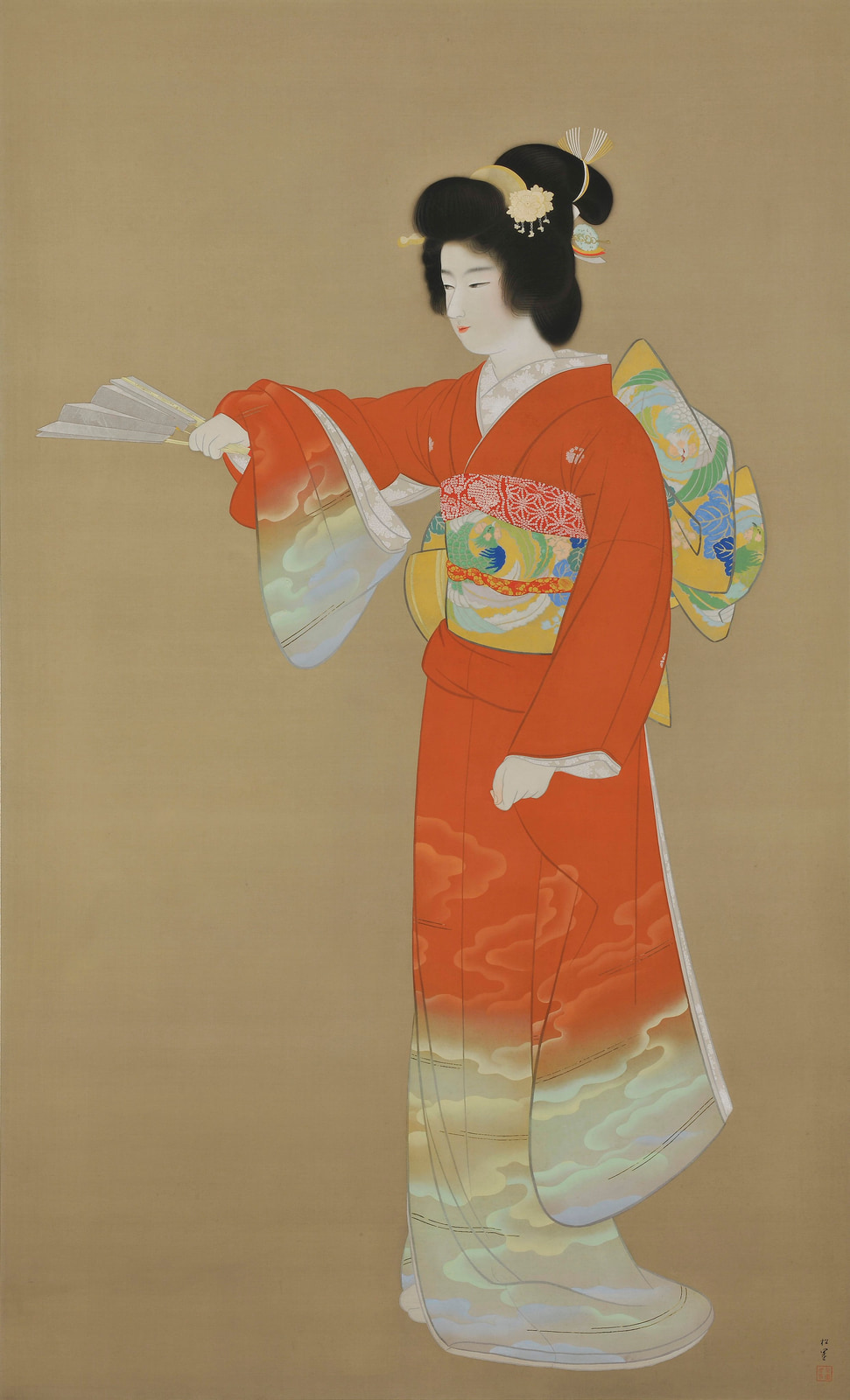
The woman in Uemura Shōen’s Jo-no-Mai has no scenery to support her. A pale field removes the theater, the audience, and almost every clue to place. What remains is a red kimono, a fan, an elaborately dressed head, and a stance so measured that the smallest angle begins to feel consequential. Her body is still, but it is not idle. The sleeve preserves a sweep; the fan sets an interval; the turn of the torso holds a dance in suspension.[1][2]
That concentration is the key to Shōen’s art. She is usually introduced as a master of bijinga, “paintings of beautiful women,” and her figures are undeniably elegant. Yet beauty is a poor endpoint for looking at them. Shōen used historical costume, close study of manners, Noh performance, and disciplined drawing to compress character into posture. The composure does not remove inner life. It gives inner life a structure.
Across a career of six decades, she tested how much a figure could reveal without surrendering self-possession. In Flame, jealousy bends a woman almost past recognition. In Mother and Child, attention travels through touch and nearness. In Jo-no-Mai, drama is held at the edge of motion. These are not variations on one decorative type. They are different answers to a professional question: how can a painted body think?
A professional life began inside a changing art world
Shōen was born Tsune Uemura in Kyoto in 1875. She entered the Kyoto Prefectural School of Painting in 1887, but her impatience to study figures led her simultaneously to the private school of Suzuki Shōnen. When he left the prefectural school, she followed him and became his disciple; he gave her the art name Shōen. Her training later moved through Kōno Bairei and Takeuchi Seihō, placing her inside the evolving institutions of modern Kyoto painting while exposing her to sharply different kinds of brushwork and observation.[3]
Recognition arrived early. In 1890, when she was fifteen, Beautiful Women in Four Seasons received a certificate of merit at the Third National Industrial Exposition and was bought by Prince Arthur, Duke of Connaught. A related work was sent to the Woman’s Building at Chicago’s World’s Columbian Exposition in 1893. Those milestones mattered because Japan’s modern schools, juried exhibitions, and public art hierarchies were still being built—and, as Art Platform Japan notes, they did not open equally to women.[3]
It would be easy to turn this into a simple triumph-over-exclusion story. Shōen’s career was harder and more interesting than that. She did not merely gain access to a fixed profession; she learned how to operate its new machinery. She submitted repeatedly to national exhibitions, absorbed hostile reviews, altered her approach, accepted commissions, and eventually served within the juries and committees that conferred artistic authority. Her work became refined inside public competition, not protected from it.
“Beautiful women” was a market and a problem
By the 1910s, bijinga had become popular enough to receive dedicated space at the government-sponsored Bunten exhibition—and familiar enough to attract critical suspicion. Shōen herself was praised for technical sophistication but faulted for relying too much on technique or for lacking originality. Works such as Daughter Miyuki and Flower Basket show her pressing beyond inherited genre scenes toward the model’s psychology.[3]
Her solution was not to make the paintings look conspicuously modern. She went deeper into historical material. Shōen researched Edo- and Meiji-period manners, classical Chinese and Japanese painting, literature, hairstyles, clothing, and traditional performance. The Yamatane Museum describes this research as the basis for images that sought spiritual character as well as outward beauty.[5] Costume, in this practice, was not a layer of luxury applied after a figure had been conceived. It located the figure in a social world: age, rank, role, season, occasion, and range of possible gesture.
Shōen explained that she looked to the past not because she simply preferred it, but because the atmosphere of another era could give an image greater depth.[3] This is a revealing distinction. Historical distance became a working medium. It let her remove the noise of contemporary anecdote while retaining the pressure of conduct: how a hand should hold an object, how a body should occupy formal dress, how feeling might pass through a pose without becoming a facial declaration.
That is why her clean contours can feel strict rather than merely delicate. A line around a sleeve is also a boundary around behavior. The clear field around a body makes every deviation legible. Her women do not float free of convention; they become articulate inside it.
Flame lets the pressure rupture the surface
The most violent test of that discipline came in 1918. Flame takes Lady Rokujō from The Tale of Genji, a woman whose jealousy turns her into a vengeful spirit. She stoops, bites or gnaws at her loosened hair, and seems to fold around an emotion she cannot master. On her kimono, spiderwebs and flowering wisteria convert ornament into a map of entanglement.[6]
Tokyo National Museum calls the picture a startling exception to Shōen’s usual elegance; Art Platform Japan describes it as an extreme representation of emotion and notes that the artist later associated the period with a creative slump.[3][6] But Flame is more than the dark opposite of the graceful pictures. It exposes what those pictures normally control.
The work’s intensity still depends on the tools of bijinga: hair, textile, profile, pale skin, flowing contour. Shōen does not abandon refinement to represent torment. She makes refinement carry torment until it nearly breaks. The wisteria remains exquisitely drawn, but its abundance feels feverish. The curve of the garment remains controlled, but it tracks a body buckling inward. Costume ceases to describe status and starts to behave like a nervous system.
Seen beside Flame, the quiet of Shōen’s other figures becomes active. Calm is not the absence of feeling; it is one possible organization of feeling. The difference between anguish and dignity may be a small change in what the line permits the body to do.
Noh taught her to make stillness eventful
Shōen practiced and studied Noh songs for years, and she repeatedly drew subjects from the theater. Lady Komachi Washing Away a Poem and Scene from the Noh Play “Kinuta” translate named dramas into painting. Jo-no-Mai, completed in 1936, is more radical in its restraint. Rather than illustrating a plot’s climax, it isolates a measured dance gesture. Shōen later described the figure as her supreme ideal of a woman.[3]
The painting is physically commanding: more than 2.3 meters high, color applied to silk, exhibited by invitation at the Bunten and purchased by the government.[1] Its scale prevents delicacy from becoming smallness. The woman meets the viewer as a near life-size presence, yet the empty ground refuses to turn her into a portrait caught in ordinary time. She is a performer, a character, and a formal construction at once.
Noh offered Shōen a vocabulary in which a minor adjustment could contain an entire sequence. The fan extends the hand’s reach without becoming a prop to be decoded. The long sleeve amplifies an arm while concealing it. The broad red field of the garment gives the body mass, then the patterned passages and obi interrupt that mass with counter-rhythms. The dancer appears balanced because multiple directions have reached a temporary agreement.
The National Museum of Modern Art, Kyoto captures the productive tension in Shōen’s portraits: affection for the people she painted, paired with a stern distance that could make grace feel rigorous.[4] Jo-no-Mai needs both. Too much distance and the dancer would become a costume specimen. Too much intimacy and the pose would collapse into private expression. Shōen keeps the figure close enough to register as a person and far enough away to preserve her authority.
Her ideal was not passivity
The phrase “ideal woman” can sound like a trap, especially when attached to a genre historically marketed through female beauty. Shōen’s own record makes the phrase less docile. Her ideal is a woman whose inner state has not been made available all at once.
That reserve had personal and professional stakes. Shōen’s mother, Nakako, raised her alone and supported her artistic ambition despite family opposition. After Nakako’s death in 1934, works including Mother and Child carried Shōen’s grief and gratitude into intimate scenes; Shōen wrote that her mother had given birth not only to her, but to her art.[3] The maternal figure is therefore not just a timeless emblem. She belongs to a lineage of work, permission, and memory.
Shōen also occupied the public art world with increasing authority. She became exempt from Bunten screening in 1916, joined the Teiten committee in 1924, became a counselor in 1935, entered the Imperial Art Academy in 1941, and in 1948 became the first woman awarded Japan’s Order of Culture.[3][7] These honors should not be confused with uncomplicated freedom—the same institutions that elevated her had narrowed many other women’s paths. But they make it impossible to read her ideal as withdrawal. The figures’ self-command belonged to an artist who had spent her career acquiring the right to define standards, not merely meet them.
The climax stays just outside the frame
Shōen’s great subject was not serenity. It was the threshold at which feeling becomes visible. Flame crosses that threshold in a convulsion of hair, textile, and bent posture. Jo-no-Mai approaches it through the opposite route: a fan, an angled sleeve, and a body that has mastered the next movement without performing it for us.
This is the theater inside her poised figures. Historical research gives each gesture a credible world. Noh gives stillness duration. Line gives emotion a boundary. Costume records the forces acting on the body, whether those forces are ritual, memory, jealousy, care, or professional self-possession.
Calling these women beautiful is not wrong. It is simply unfinished. Shōen’s achievement begins when beauty stops being the answer and becomes the disciplined surface of a harder question: what does a person choose to reveal, and how much can a painter make us feel in what remains withheld?
Sources
- The University Art Museum, Tokyo University of the Arts, “Jo-no-mai (Dance Performed in Noh Play)” — collection record for the 1936 color-on-silk painting, including dimensions, exhibition status, and government purchase.
- Wikimedia Commons, “Jo-no-mai by Uemura Shoen.jpg” — source page for the full archival reproduction used as this article’s cover image.
- Art Platform Japan, “UEMURA Shōen” — research biography covering Shōen’s training, exhibition career, critical reception, writings, Noh subjects, major works, and institutional appointments.
- The National Museum of Modern Art, Kyoto, “UEMURA Shoen” — retrospective overview describing the affection, distance, grace, and rigor of Shōen’s portraits.
- Yamatane Museum of Art, “Uemura Shōen and Splendid Women” — exhibition overview on Shōen’s research into manners, classical painting, and traditional performance, and her pursuit of spiritual as well as external character.
- Tokyo National Museum, “Flames” — museum account of the 1918 painting’s Tale of Genji subject, bent pose, hair-biting gesture, spiderwebs, wisteria, and unusual emotional intensity.
- National Diet Library, Japan, “UEMURA Shoen” — biographical record covering Shōen’s Nihonga career, major exhibitions, signature works, and 1948 Order of Culture.