The Ashcan School is often remembered through one blunt adjective: gritty.[1] The label is not wrong, but it is smaller than the achievement. What Henri, Sloan, Bellows, Glackens, Luks, and Shinn changed was not simply subject matter. They changed the speed and altitude of American painting. Instead of asking the city to pose, they painted it as something already in motion: crowds crossing, wagons blocking, theater lights flashing, snow turning gray at curbside, and strangers learning to look at one another in public.[1][2][3]
That is why the movement still feels alive. The Ashcan painters did not offer a neutral inventory of New York. They brought the reflexes of illustration, print culture, and street observation into oil paint, then used those reflexes to make urban life feel immediate without making it orderly.[1][2][5] Their real subject was not dirt for its own sake. It was crowd pressure: the sensation that a modern city keeps compressing work, leisure, commerce, spectacle, and anonymity into the same frame.
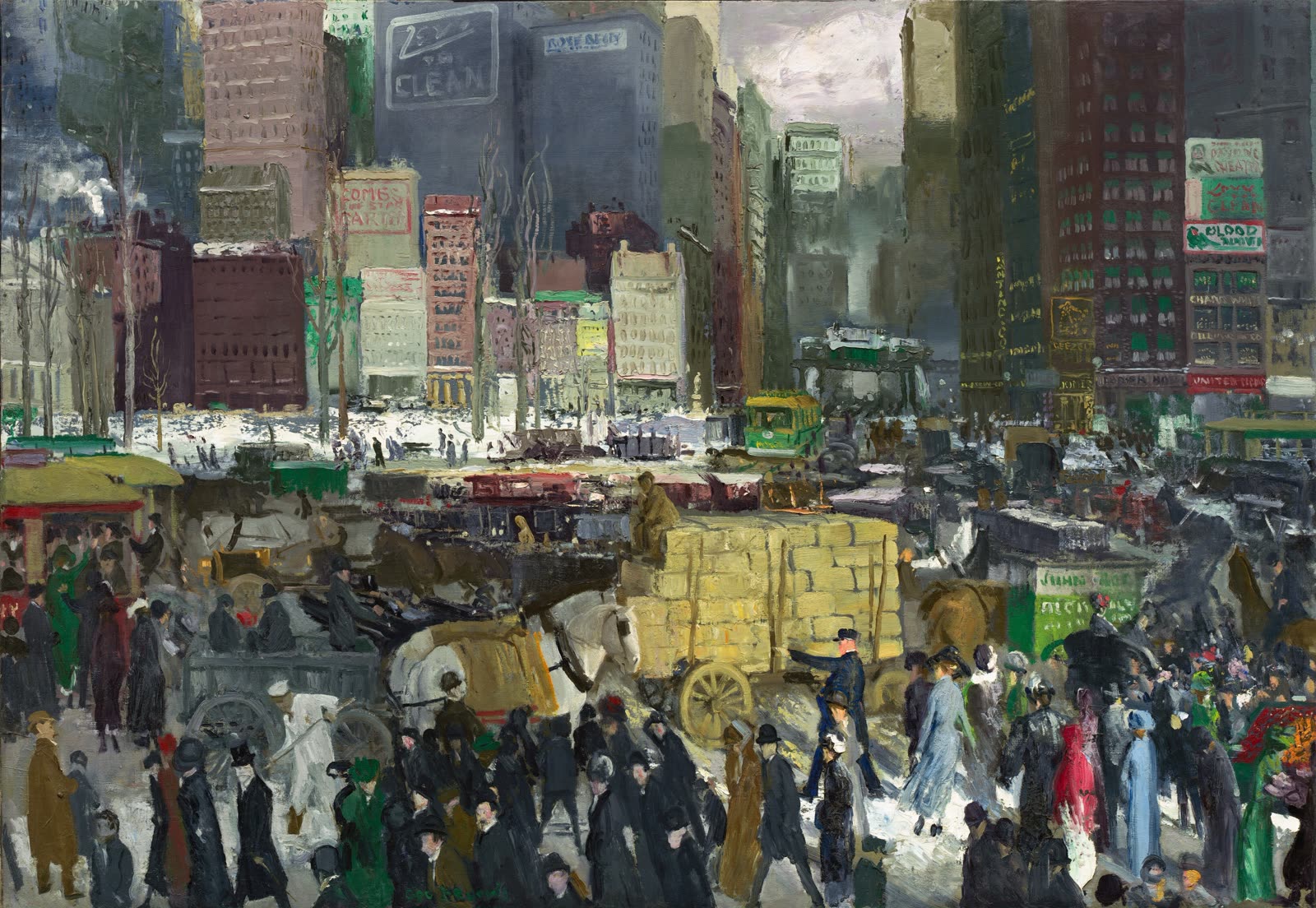
Image context: this article uses Bellows's New York because the painting gathers several Ashcan priorities at once. The street is packed but not diagrammed, the brushwork stays loose enough to feel caught on the move, and the city arrives as a field of collisions rather than as a clean skyline view.[4][5]
The city stopped being backdrop
The Metropolitan Museum's Ashcan essay is useful because it starts with training and migration rather than legend.[1] Robert Henri came out of the Pennsylvania Academy, spent formative time in Paris, then became the mentor to a set of Philadelphia newspaper illustrators, including John Sloan, William Glackens, George Luks, and Everett Shinn.[1][2][3] Between the late 1890s and 1904, that circle moved into New York, where the old hierarchy of American painting still leaned toward academic finish and Impressionist polish.[1]
Henri's intervention was larger than a preference for rougher pictures. His "art for life's sake" position gave permission to treat everyday urban existence as fully paintable material.[1][5] That meant city streets, saloons, music halls, ferries, cheap entertainments, and working-class neighborhoods could enter high art without being cleaned up first. The change sounds obvious now because the Ashcan School helped make it obvious. At the time, it was a real shift of cultural altitude. Painting came down from the elevated overlook and moved into the weather of ordinary public life.
John Sloan's biography at the National Gallery makes the mechanism especially clear. He worked in the art departments of Philadelphia newspapers before moving to New York, continued freelancing as an illustrator, and painted Greenwich Village and Tenderloin scenes with the same directness he had learned in commercial work.[3] Henri's own NGA biography shows the same chain from Philadelphia teaching to New York leadership, with the newspaper illustrators passing through his orbit before the 1908 exhibition of The Eight made the break with institutional taste unmistakable.[2] The Ashcan School was therefore never just a mood or a palette. It was a transfer of working habits from illustrated journalism into painting.
Newsprint habits became painterly method
The Met essay says Ashcan artists preferred broad, calligraphic forms they could render "on the run" or from memory, drawing on skills cultivated as newspaper illustrators.[1] That phrase gets close to the core of the style. These artists did not want the city to settle down long enough for polished finish. They wanted a brush language that could survive haste. The resulting surfaces stay loose, dark, and responsive; they carry enough information to orient the viewer, but they rarely freeze the street into still life.[1][4]
That is one reason Ashcan painting often feels closer to editing than to description. The artist crops, condenses, and chooses a point of pressure. The frame catches movement where traffic jams, where bodies bunch up under bad weather, where signage and windows compete for the eye, where leisure shades into labor or spectacle.[1][4][5] The city is not simply seen; it is processed under deadline.
This is where the movement differs from a simpler story about "realism." The Ashcan School did not merely replace pretty subjects with rough ones. It altered the relation between perception and finish. If American Impressionism often treated urban or suburban life through light effects and pleasurable surface, Ashcan painting pushed toward a denser kind of looking, one that kept track of social friction and public theater without losing painterly freedom.[1][5] The movement's darkness is therefore functional. It helps mass together bodies, vehicles, facades, smoke, and winter air into a single urban medium.
The street became a public stage
Ashcan artists cared deeply about who occupied the city and how people behaved once they shared public space.[1][3][5] The Met notes their attention to New York's vitality and seamy side, but also stresses that they were not programmatic reformers in the mode of Jacob Riis.[1] They recorded social surfaces, coded tensions, and pleasure economies more than they staged direct protest. That distinction matters. Their canvases are not policy arguments. They are records of contact.
Sloan's New York scenes, whether on Fifth Avenue or in Greenwich Village, keep returning to the fact that modern urban life is always half performance.[3][5] People go out to move through streets, but also to be seen in them. Bellows intensifies that principle. In the NGA's collection essay, New York is described as one of his most ambitious attempts to capture the multiplicity of the modern city.[5] That wording matters because multiplicity, not anecdote, is the point. One does not read Bellows by isolating one protagonist. One reads him by watching different systems occupy the same block at once.
The theater, the boxing ring, the saloon, the ferry, and the market all appealed to the Ashcan painters for the same structural reason: each turned modern life into a crowd situation.[1][3][5] People were packed into relation before they were sorted into clear narratives. That crowd logic is what gives the movement its continuing edge. Even when individual faces blur, the paintings stay socially specific because their real unit is not the portrait subject. It is the shared public field.
Bellows's New York is the movement in one frame
Bellows's 1911 painting is an ideal hero image for an Ashcan essay because it refuses the postcard view.[4][5] The NGA object page describes a crush of pedestrians, horses, wagons, trolleys, billboards, snow patches, and building fronts compressed into one horizontal city band.[4] The visual description reads almost like a traffic report. That is exactly why the work matters. Bellows paints Manhattan as a coordination problem.
Nothing in the picture is fully isolated. The hay wagon blocks one line of sight, a green streetcar cuts across another, dark-coated pedestrians push through the lower edge, and the skyline above refuses heroic clarity.[4] Buildings rise, but they do not produce transcendence. They behave like retaining walls for urban energy. Even the bright dresses and yellow wagon load operate less as decorative accents than as points where the eye catches and then gets thrown back into circulation.
This is where Ashcan modernity separates itself from later machine-age modernism. Bellows does not simplify the city into geometry. He leaves it messy, overfull, and bodily.[4][5] Yet the painting is still modern because it understands that the city is no longer best grasped through monuments alone. It must be read through flows, bottlenecks, temporary visibility, and the unstable cohabitation of classes and occupations on the same pavement.
Why the movement stayed important after it stopped being radical
The Armory Show of 1913 quickly made the Ashcan painters look less advanced beside European modernism.[1][3] The Met is clear on that point, and Sloan's biography shows that he himself absorbed parts of postimpressionism and fauvism after the exhibition.[1][3] Even so, the movement's importance did not disappear. It had already changed the permissible subject matter and working tempo of American art.
What remained durable was the permission structure. Ashcan painting showed that modern life in the United States could be treated through crowds, entertainment, labor, transit, and informal public ritual without waiting for mythic uplift.[1][5] It also established a bridge between illustration, realism, and later urban modernisms. The movement ceased to be the newest thing, but it left behind a sharper way of seeing the city: not as background for stories, but as the story-generating apparatus itself.
That is the scale on which the Ashcan School still matters. It taught American painting to work closer to the curb. Once that happened, urban art could no longer fully return to the old polite distance.
60-second viewing drill
Try this sequence with Bellows's New York or another Ashcan city scene:
- Start at the bottom edge and count how many different flows of movement are crossing at once.
- Look for the point where traffic, pedestrians, and signage bunch into one knot of attention.
- Move upward and ask whether the buildings clarify the scene or merely hold in its pressure.
- End by checking how many figures are individually legible versus absorbed into the crowd field.[1][4][5]
Sources
- H. Barbara Weinberg, "The Ashcan School." The Metropolitan Museum of Art, Heilbrunn Timeline of Art History (April 2010).
- National Gallery of Art, "Robert Henri" (artist biography).
- National Gallery of Art, "John Sloan" (artist biography).
- National Gallery of Art, "New York," George Bellows, 1911 (object page and open-access image source).
- Charles Brock, "Building the Collection: Robert Henri and His Circle." National Gallery of Art, American Paintings, 1900-1945.