Lyubov Popova is often introduced as one of the great Russian avant-garde painters who eventually gave up easel painting for the harder social task of design.[1][5] That timeline is true, but it can make her career sound split in two, as if abstraction belonged to one phase and practical making to another. The stronger way to read her is through continuity. Across painting, stage design, and textiles, Popova kept asking the same question: how can form stop sitting still and start behaving like construction?
That question gives her work its unusual urgency. Popova did not treat abstraction as private escape or pure geometry for its own sake.[1][2] Even in the Painterly Architectonic works of 1916 to 1918, the canvas feels loaded with weight, torque, collision, and assembly. The shapes do not drift. They brace, tilt, lock, and shove. When she later moved into theater sets and printed fabric, she was not abandoning the earlier paintings. She was pushing their internal mechanics outward into lived space.[1][5]
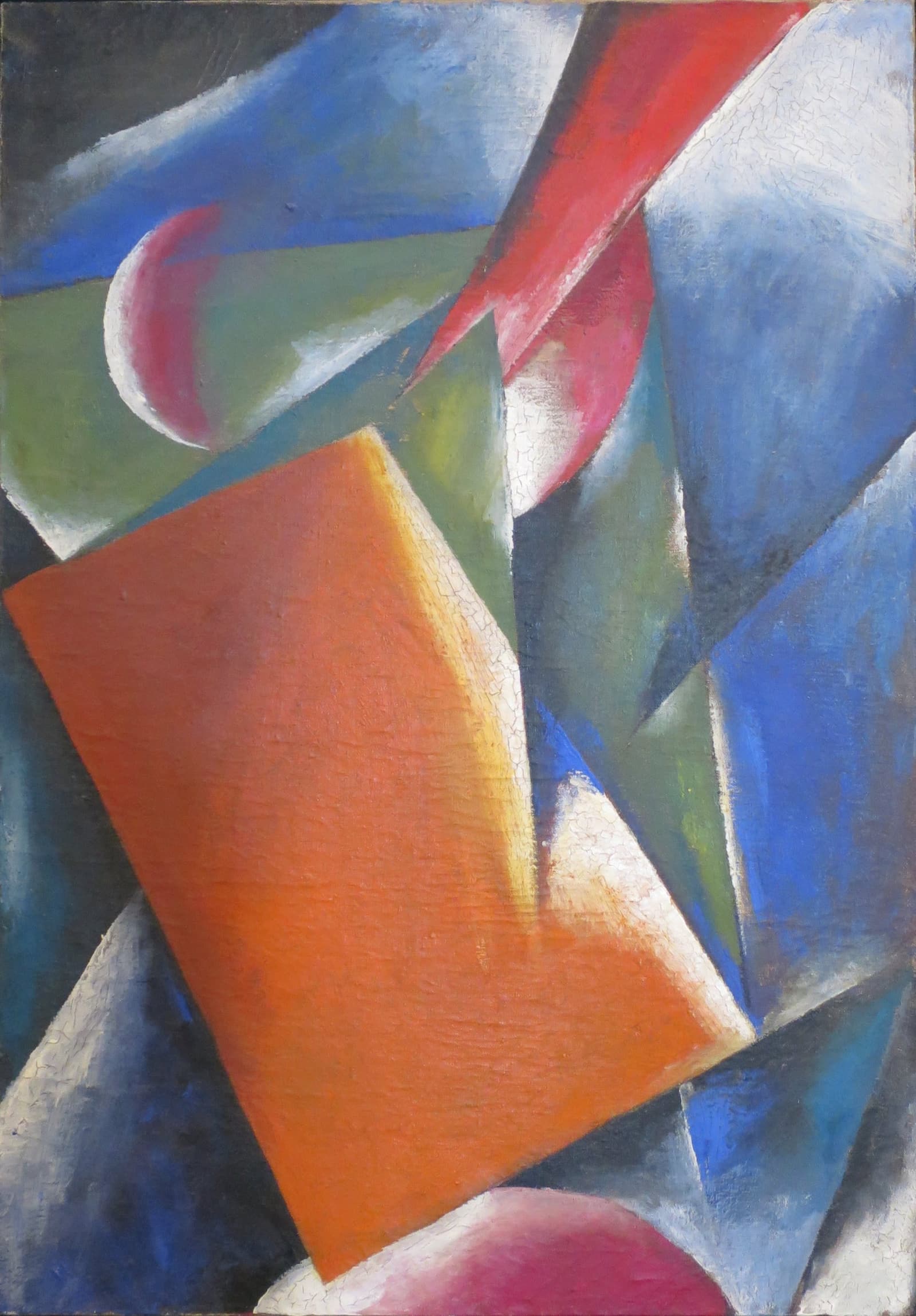
Image context: the lead image uses a faithful photographic reproduction of Popova's 1917 Architectonic Painting in LACMA rather than a diagram, poster, or installation snapshot. That choice matters because the article's argument begins in the painting's actual surface: the black ground, the overlapping colored planes, and the feeling that the composition is being built under pressure rather than merely arranged for balance.[3][6]
She turned the picture plane into a force field
MoMA's 1991 retrospective remains useful because it sketches Popova's development with real sharpness. Born in 1889, she moved from early figuration to Cubism after her extended stay in Paris in 1912, then entered the Cubo-Futurist orbit in 1913-14, and by 1916-18 arrived at the fully abstract Painterly Architectonics cycle.[1] MoMA's audio note on Painterly Architectonic adds the crucial point: Popova knew Cubism in Paris and Futurism in Italy firsthand, yet she used both as springboards for a more decisive break from the visual world.[2] The jump matters. Her abstraction does not look like a soft refinement of French modernism. It looks like a system under load.
The Met's short note on a ca. 1920 watercolor catches the same trajectory in compressed form. It describes Popova as one of the first female pioneers of the specifically Russian development of Cubo-Futurism and says that, through this synthesis, she approached what she called painterly architectonics before later joining the Suprematist group.[4] That phrasing is important because it frames architectonics less as a decorative label than as a working metaphor. Popova wanted a painting to hold itself together the way a built structure does: through tensions among parts, not through the old illusion of depth or anecdote.
LACMA's Architectonic Painting shows the method clearly.[3] The composition is packed with overlapping angular planes in orange, pink, green, and blue-gray set against a dark ground. A tilted orange form drives the whole picture off-center, while smaller planes wedge in around it.[3] The result is dynamic, but not in the loose, atmospheric sense. The motion feels engineered. MoMA's retrospective says that in the Painterly Architectonics, bold forms push against the picture surface.[1] That is the exact sensation the best Popova paintings create. They do not open a window. They compress the surface until looking begins to feel like reading stress, impact, and direction.
Architectonic painting was already thinking about the world beyond the canvas
This is why Popova's abstraction never feels detached from material life even before she enters industrial production. MoMA's audio for the 1917 Painterly Architectonic says the Russian Revolution helped make painting feel like a laboratory for the visual forms of a new world, and that architecture became a central metaphor for her.[2] The metaphor was not casual. Architecture implies load-bearing relations, construction logic, and an encounter with collective space. Popova's paintings do not depict buildings, but they behave as if they have learned from building.
That point helps explain the importance of her later shift around 1920-21. MoMA describes an increasing preoccupation with line rather than plane and color, along with works on bare plywood and cardboard often titled Space-Force Constructions.[1] Sand, metallic powder, and marble dust thicken these surfaces; beams, rays, and oblique axes begin to dominate.[1] The old category of painting is already being tested from within. The picture plane is turning into something closer to a construction site, where material, direction, and support matter as much as image.
When Popova joined the 5 x 5 = 25 exhibition in 1921, easel painting was being presented almost as a final statement rather than a permanent home.[1] Later that year, MoMA notes, Popova and other Constructivists signed the declaration renouncing easel painting in the name of "Art into Life," calling for a fusion of art and technology.[1] That decision can sound, from a distance, like the end of the interesting part. In Popova's case it reads more clearly as a continuation. She had already been trying to make painting act less like a precious object and more like an active system. Theater and textile gave her more room to do it.
Stage machinery and printed cloth carried the same visual grammar forward
MoMA's retrospective makes a strong case that Popova's theatrical work was the most recognized part of her utilitarian practice for good reason.[1] Her stage design for The Magnanimous Cuckold used verticals, horizontals, planes, and rotating platforms, and the museum notes that it helped destroy the idea of scenery as passive backdrop or illusion.[1] That sentence is easy to overlook. It means Popova was not decorating theater. She was rebuilding its spatial logic. The set became an engine for gesture, movement, and time, the same way her paintings had already turned the surface into a field of directed forces.[1]
The textile work carries the argument further because it makes repetition social. Smarthistory notes that Popova and Varvara Stepanova were the only prominent Constructivists working as designers in industrial production during the 1920s, creating aggressively abstract textile patterns for the First State Textile Printing Works.[5] Those designs used repeating geometric forms, limited colors, and an economical visual language intended for mass manufacture.[5] In other words, the same diagonals, blocks, and directional rhythms that once strained against the canvas were now meant to circulate through clothing and everyday interiors.
Smarthistory is also useful because it keeps the historical outcome honest. Popova's textile work was mass-produced, yet it still fell short of the full Constructivist dream of the artist-producer completely embedded in all stages of industrial life.[5] That limitation matters, but it does not weaken her achievement. It clarifies it. Popova's importance lies in how far she managed to carry abstract form toward use without draining it of intensity. The textiles still snap with movement. They do not read like watered-down paintings. They read like abstraction learning a new speed.
Why Popova still matters
Popova died in 1924 at only thirty-five, which makes the density of her career feel almost unreasonable.[1] In little more than a decade, she moved from post-impressionist and Cubist study to Cubo-Futurist fracture, from Painterly Architectonics to Space-Force Constructions, then into stage design, graphics, and factory textiles.[1][2][4][5] The through-line is what gives the work its authority. She did not drift from one modernist fashion to the next. She kept refining one belief: form could be organized to change how modern life felt.
That is why Popova still looks contemporary. Many artists are described as moving between media; Popova makes that phrase feel too weak. She made each medium answer the same constructive pressure. In painting, the surface became an argument about force. In theater, force entered public space as machinery and movement. In textile design, it entered repetition, clothing, and ordinary use.[1][5] Her art does not celebrate utility in a dutiful way. It keeps asking how abstraction can remain vivid while entering the world of work, bodies, and shared environment. Very few artists asked that question with such speed, and fewer still made it look so alive.
Sources
- The Museum of Modern Art, "Liubov Popova" - 1991 retrospective page outlining Popova's development from figuration to abstraction to utilitarian design, including Painterly Architectonics, 5 x 5 = 25, stage work, and textiles.
- The Museum of Modern Art, "Liubov Popova. Painterly Architectonic. 1917" - audio commentary on Popova's exposure to Cubism and Futurism, the revolutionary context of 1917, and the architectonic metaphor in her abstract painting.
- Los Angeles County Museum of Art, "Liubov Popova, Architectonic Painting, 1917" - collection page for the specific painting used as this article's cover image, with medium, date, and on-view status.
- The Metropolitan Museum of Art, "Lyubov Popova - Untitled" - collection note describing Popova's Cubo-Futurist synthesis, painterly architectonics, and later relation to Suprematism.
- Smarthistory, "Constructivism, Part II" - essay on Constructivist productivism, Popova's textile work with the First State Textile Printing Works, and the limits of the industrial-design project.
- Wikimedia Commons, "'Architectonic Painting' by Lyubov Popova, 1917, LACMA.JPG" - file page for the faithful reproduction used as the article image.