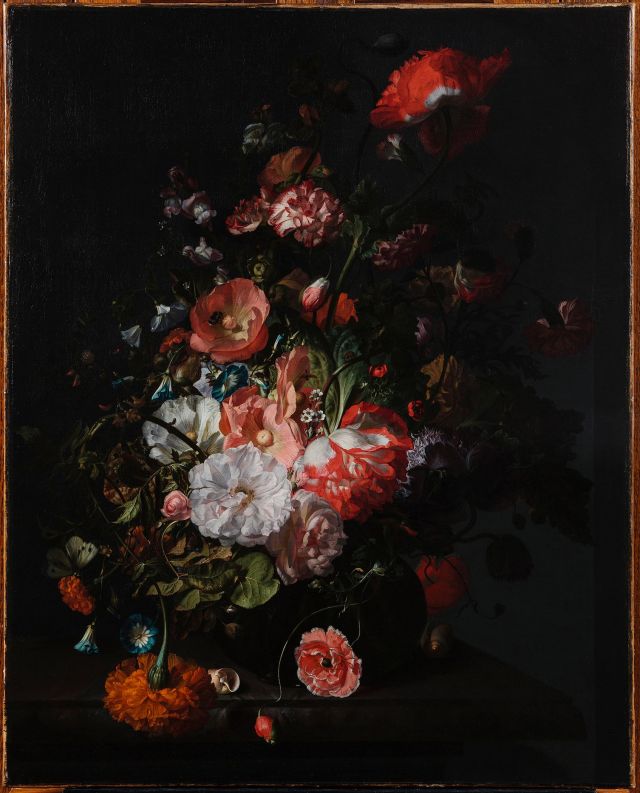
Rachel Ruysch's Flower Still Life looks, at first glance, like one of those Dutch bouquets built to overwhelm the viewer with cultivated richness.[1][3] The flowers surge upward, the colors flare out of darkness, and every petal seems sharpened for delight. Yet the painting becomes stronger when it is read less as a floral inventory than as a pressure chamber. Beauty is here, densely and expertly arranged, yet beauty is never allowed to settle into pure ease. The bouquet keeps producing tiny warnings: a drooping stem, a torn leaf, an insect crossing the arrangement, a blossom already falling toward the ledge.[1][2]
That pressure is why the black background matters so much. Ruysch does not give the flowers a generous garden atmosphere or a descriptive room. She gives them a dark field that behaves almost like a stage curtain.[1][3] The result is theatrical, though not in a loud way. The bouquet seems to emerge into visibility under concentrated light, while the surrounding space refuses to explain itself. That darkness makes every flower feel chosen rather than casually gathered. It also keeps the arrangement suspended, as if abundance had to prove itself moment by moment against a void waiting behind it.
Image context: the lead image uses a real photographic reproduction of the Toledo Museum of Art painting rather than a crop, diagram, or exhibition graphic. The argument turns on relationships that only the whole picture clarifies: the bouquet's vertical climb, the ledge at the bottom, and the way bright petals pulse forward while the ground behind them stays almost entirely closed.[1][5]
The bouquet is built from time, not from one instant
The Toledo Museum's object text is especially useful because it names the painting's first quiet impossibility. Ruysch gathers together flowers that would not actually bloom at the same time.[1] Once that is noticed, the picture stops reading as a single observed moment from nature. It becomes a composed argument about nature. The bouquet is assembled out of different seasonal states, then held together on the canvas as though art could briefly outmaneuver the calendar.[1][4]
That does not make the image less naturalistic. It makes it more ambitious. Ruysch wants the viewer to feel the pleasures of exact description while also sensing that exact description alone cannot explain the picture. A flower still life like this one is part observation, part orchestration.[2][4] Stems arc past each other in improbable ways; blossoms open at different rates; some faces turn toward us while others curl away into shadow. The composition breathes, but it breathes through arrangement. The bouquet feels alive precisely because it has been so carefully made.
Damage enters the painting early, before beauty can harden into luxury
The same Toledo label points to the painting's second decisive move: among the blossoms are caterpillars, browning leaves, and holes eaten through the foliage.[1] These are not incidental bits of realism sprinkled on top of an otherwise ideal bouquet. They are structural interruptions. They keep the arrangement from becoming a fantasy of untouched perfection. Ruysch makes room for nibbling, curling, and decay inside splendor itself.[1][2]
This is where the work's emotional temperature becomes more interesting. The usual shorthand for Dutch flower pieces is vanitas, fragility, mortality, beauty fading. Those ideas are present here, and the museum explicitly notes them.[1] Yet the picture does something subtler than moral illustration. It does not simply announce that all life dies. It asks the viewer to linger in the interval where ripeness and decline occupy the same surface. The bouquet glows most intensely at the very moment it shows signs of being eaten, bruised, and out of season.[1][3]
The fallen blossom near the ledge is crucial for the same reason.[1][5] It lowers the painting's center of gravity. Instead of letting the arrangement remain a victorious upward display, Ruysch gives gravity a visible share in the composition. Something has already dropped. The bouquet is still magnificent; the painting has already admitted loss.
Scientific seeing changes the kind of beauty on offer
Smarthistory's account gives the biographical key that sharpens all of this. Ruysch grew up in Amsterdam in a family shaped by art and science; her father was a professor of anatomy and botany, and she helped catalogue and record rare natural-history specimens.[4] That background matters because it helps explain why the insects and plant particulars do not feel like decorative extras. They belong to a way of looking trained by classification, collection, and close attention.[1][4]
The recent Toledo and Boston exhibitions push that point further by presenting Ruysch at the intersection of painting, nature, and science.[2][3] The MFA page describes bouquets alive with movement, lizards and stems set against dark grounds, and an artistic career that earned fame across Europe at a time when few women received such prominence.[3] It also places her work inside a world of expanding global trade, new imported species, and women participating in the production of scientific knowledge.[3] Read back into Flower Still Life, that context enlarges the picture. The bouquet is not only a domestic ornament. It is also a knowledge display, a trade map, and a study in how observation could become prestige.
Why this painting still feels alert
Ruysch's achievement is that she never asks the viewer to choose between delight and intelligence.[1][2][3][4] The painting offers lushness, but lushness under discipline. It offers botanical exactness, but exactness staged for drama. It offers a luxury object, yet one already infiltrated by bite marks, time shifts, and small mortal corrections. The flowers are glorious. The glory is unstable. That instability is the painting's real subject.
That is why the picture still feels modern. It understands that beauty acquires force when it includes pressure from what could undo it.[1][2] Against black space, the bouquet does not float free as decorative surplus. It holds together provisionally, through craft, balance, and attention. Ruysch lets us see abundance as something both radiant and vulnerable. The arrangement dazzles because it has never been innocent of damage.
Sources
- Toledo Museum of Art, "Flower Still Life" - collection page and label text on the impossible bouquet, the caterpillars and damaged leaves, Ruysch's botany background, and the painting's meditation on fragility.
- Toledo Museum of Art, "Rachel Ruysch: Nature into Art" - exhibition page on Ruysch's masterful brushwork, illusionistic natural detail, and the intersections between painting, nature, and science.
- Museum of Fine Arts, Boston, "Rachel Ruysch: Artist, Naturalist, and Pioneer" - exhibition page on the animated bouquets, Ruysch's European fame, women and scientific knowledge, and the role of global trade in expanding the floral world of the paintings.
- Smarthistory, "Rachel Ruysch, Flower Still-Life" - essay on Ruysch's family background in anatomy and botany, her cataloguing work, and the wider status and meaning of Dutch flower painting.
- Wikimedia Commons, "Rachel Ruysch - Flower Still Life, Toledo.jpg" - redirect URL for the faithful photographic reproduction used as this article's image, preserving the work title and Commons provenance.