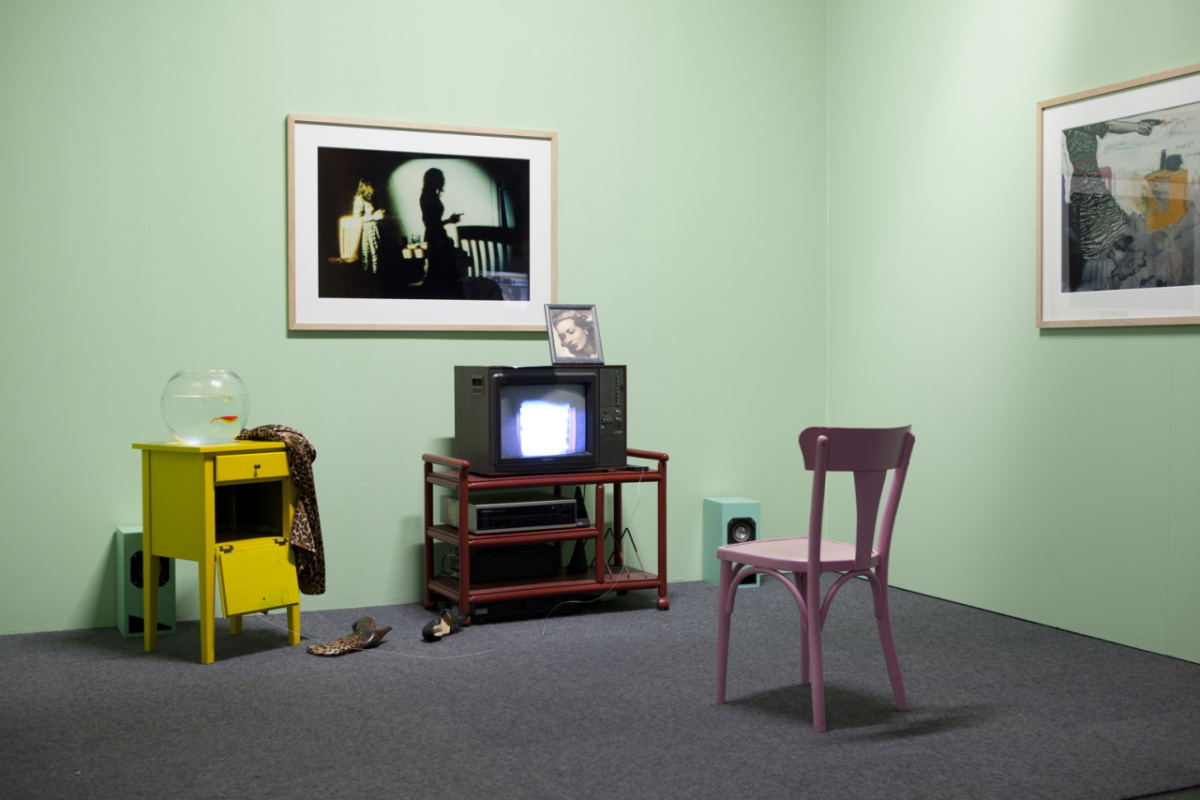
Image context: ZKM's official installation photograph shows the artwork as a furnished room, not a video playing in isolation. The television sits among a chair, side table, fishbowl, shoes, clothing, and framed images that make Lorna's interior navigable—and difficult to leave.[1]
The first thing LORNA gives its viewer is control. The second is a reason to distrust it.
Lynn Hershman Leeson's interactive installation places a modified remote in the visitor's hand and a fictional woman, played by Joanna Mross, on the television. Lorna lives with agoraphobia in a one-room apartment. Her telephone and TV connect her to the world outside, but they also deliver the messages that intensify her fear. By selecting numbered objects and moving among recorded scenes, the visitor can inspect her possessions, enter fragments of her history, and push her story toward different conclusions.[1][4][5]
That sounds like an early promise of interactive media: the spectator is no longer passive. Yet LORNA makes activity ethically uncomfortable. The visitor cannot speak with Lorna, ask what she wants, or invent an unprogrammed route. The remote offers access to her life by turning her into the object of someone else's decisions. Its buttons may open narrative branches, but they do not open the apartment door. Control is the work's subject before it is its novelty.
The dates record a work in motion
Even LORNA's date resists a single clean label. ZKM identifies the work as 1979 while captioning installation views 1979–1982; the Walker dates its edition 1979–1983; the Whitney uses 1979–1984; and Hershman Leeson recalls making it in 1983–1984.[1][2][3][6] These ranges are not a reason to choose whichever year makes the strongest “first” claim. They show that the work developed through writing, filming, programming, fabrication, and revision rather than arriving as one finished consumer product.
Museums and the artist commonly identify LORNA as the first interactive artwork made for LaserDisc, or the first to use videodisc in this way.[1][4][6] The priority matters, but the more revealing fact is what Hershman Leeson asked a newly available format to do. Instead of demonstrating rapid access as a neutral technical feature, she attached it to a story about isolation, observation, and the desire to act through a screen.
The work also distributes authorship more widely than a lone-inventor story suggests. ZKM credits Ann Marie Gartie with programming, Terry Allen with music, and Joanna Mross as the performer.[1] The interface joins their labor to furniture, props, recorded images, optical media, and the visitor's hand. LORNA is not simply a film with optional scenes. It is a room whose parts become legible only through a chain of people and devices.
The room is the first interface
The reconstructed apartment looks modest because it has to feel usable. A television cabinet, night table, end table, wood chair, upholstered chair, mirror, fishbowl, clothing, wallet, belt, shoes, watch, telephone, magazines, framed storyboards, and framed art belong to the Whitney edition.[2] ZKM's installation inventory is similarly specific, down to a check, a cookie package, a blouse, and mismatched footwear.[1]
These are not background decorations around the “real” electronic artwork. They give the branching structure a domestic grammar. A wallet promises identity and evidence. A telephone suggests contact. A fishbowl repeats the room's enclosure in miniature. Shoes imply the absent act of going out. The television is both furniture and portal: an appliance in Lorna's space through which the museum visitor gains power over that space.
The interface therefore begins before anyone presses a button. A visitor stands in a public gallery looking into a simulated private room, then uses a household controller to search a woman's life. The familiar gesture of channel changing becomes more invasive when the channel is a person. Hershman Leeson turns domestic convenience into a position from which spectatorship, caretaking, curiosity, and coercion are hard to separate.
LaserDisc made the branch physical
Videotape trained viewers to experience recorded time as a line: play forward, rewind, wait. LaserDisc made direct access to separated scenes practical. The Walker's account emphasizes the format's ability to pause, scan, and select stored options with much greater visual clarity than common home videotape. LORNA exploited that access for a hybrid of video, photography, menu, and point-and-click narrative before those forms became ordinary domestic habits.[4]
The scale was compact but structurally ambitious. A UCR ARTS catalogue records seventeen minutes of moving footage divided into thirty-six chapters, accessed by pressing numbers associated with objects in the apartment.[5] ZKM likewise describes thirty-six “labyrinthine” sequences.[1] Seventeen minutes need not produce a seventeen-minute experience: repetition, return, skipped scenes, and different orders make duration belong partly to the visitor.
Hershman Leeson has said that the idea of multiple narratives led her to the interactive LaserDisc because it was the available cutting edge. For her, a period's technology is part of an artwork's language, not a transparent container that can be swapped without consequence.[6] In LORNA, the clack of a button, the delay before a segment, and the possibility of losing one's place all give branching a bodily rhythm. Choice is not an abstract tree. It is a hand waiting for a machine.
The proxy can choose, but Lorna bears the result
Institutional accounts agree that the work offers three terminal outcomes, though they describe one route differently. Both ZKM and the Walker include Lorna's suicide and the destruction of her television. ZKM says the remaining outcome leaves her imprisoned in the apartment; the Walker describes her leaving for Los Angeles.[1][4] The discrepancy should not be smoothed into false certainty. It may reflect different versions, routes, or interpretations of a work whose sequences and hardware have migrated.
The two shared endings already reveal the interface's trap. If Lorna dies, the visitor's activity has not become care. If she shoots the television, she attacks the medium that connects and confines her—even as the museum visitor can witness that refusal only through another television. The image of liberation is delivered by the apparatus being rejected.
This is why “interactive” cannot be treated as a synonym for emancipatory. The visitor receives options, but Hershman Leeson authored their field and Lorna absorbs their consequences. Agency is unevenly distributed: the spectator explores; the character is explored. The remote makes that imbalance visible because it resembles a tiny instrument of command. Its ordinary design lets the viewer feel how easily participation can reproduce control.
The false exit in LORNA is not the claim that no branch changes anything. One account does let her leave. It is the belief that choosing an exit for someone else amounts to sharing her freedom. The visitor can reach an ending without ever escaping the role of proxy.
Obsolescence exposes the interface
Four decades later, the hardware no longer disappears behind the story. The Walker preserves the original disc but directs primary researchers to a transferred DVD. Its institutional essay reports that the migrated version can stick on passages, mishandle returns, or allow fast-forwarding around the intended choice structure.[4] ZKM's current materials list a DVD player where the installation originally used a LaserDisc player.[1] The apparatus has become historical evidence.
Those failures are not automatically virtues. A broken menu can prevent a viewer from encountering the work's argument at all. But a frictionless remake would create another problem: it could turn a strange 1980s encounter with optical media into the smooth responsiveness of a contemporary app. The conservation question is therefore not simply how to preserve the video files. It is how much waiting, opacity, failure, and physical mediation belongs to the work.
The artist's own account supports taking that question seriously. Hershman Leeson describes interactivity as engagement with the possibilities of technology at the moment of invention.[6] If the medium helped determine the idea, then migration changes meaning even when every recorded scene survives. A modern interface might reproduce all thirty-six chapters while erasing the viewer's awareness that direct access was once difficult, novel, and unstable.
That instability also sharpens LORNA's politics. The visitor who expected command may now confront a remote that cannot reliably command. Lorna's fate remains prerecorded, but the route toward it frays. The work's technology ages into the same lesson its narrative offered from the start: having controls in hand does not guarantee control.
The screen never becomes a door
The Whitney placed LORNA in Programmed: Rules, Codes, and Choreographies in Art, 1965–2018, then added an edition to its collection.[2] The title of that exhibition supplies a useful vocabulary. LORNA has rules in its numbered access points, code in its branching logic, and choreography in the exchange among visitor, remote, screen, room, and character. None is separable from the others.
What makes the work feel current is not that it predicted a particular device. Contemporary interfaces are faster, more portable, and better at hiding their branches. The deeper continuity is a familiar bargain: a system offers personalized action while defining the available actions in advance. It calls the result participation. LORNA asks who wrote the menu, who holds the controller, and who must live inside the outcome.
The remote is a false exit because it lets the visitor confuse navigation with freedom. Hershman Leeson's achievement was to make that confusion tactile at the moment interactive media entered the gallery. The visitor presses a number. A scene changes. The apartment remains.
Sources
- ZKM | Center for Art and Media, “Lorna” — official collection record, installation inventory, contributor credits, thirty-six-sequence description, outcome summary, and source page for Tobias Wootton's installation photograph.
- Whitney Museum of American Art, “Lynn Hershman Leeson, Lorna, 1979–1984” — official object record with edition materials, LaserDisc-to-DVD presentation note, accession data, and exhibition history.
- Walker Art Center, “LORNA” — official collection record for the 1979–1983 interactive laser videodisc edition acquired in 1995.
- Erin McNeil, “The Patron Saint of Ruined Media: On Lynn Hershman Leeson's Lorna.” Walker Art Center, July 15, 2016 — institutional account of the interface, branching scenes, three outcomes, original LaserDisc, DVD transfer, and inherited playback failures.
- UCR ARTS, Digital Capture: Southern California and the Pixel-Based Image World — exhibition catalogue documenting Lorna's seventeen minutes of footage, thirty-six chapters, object-number navigation, and place in the history of domestic digital media.
- Christine Turner, “In the Studio: Lynn Hershman Leeson.” Art21, interview conducted December 2017 and edited November 2023 — the artist on choosing LaserDisc for multiple narratives and treating the technology available at invention as part of a work's language.