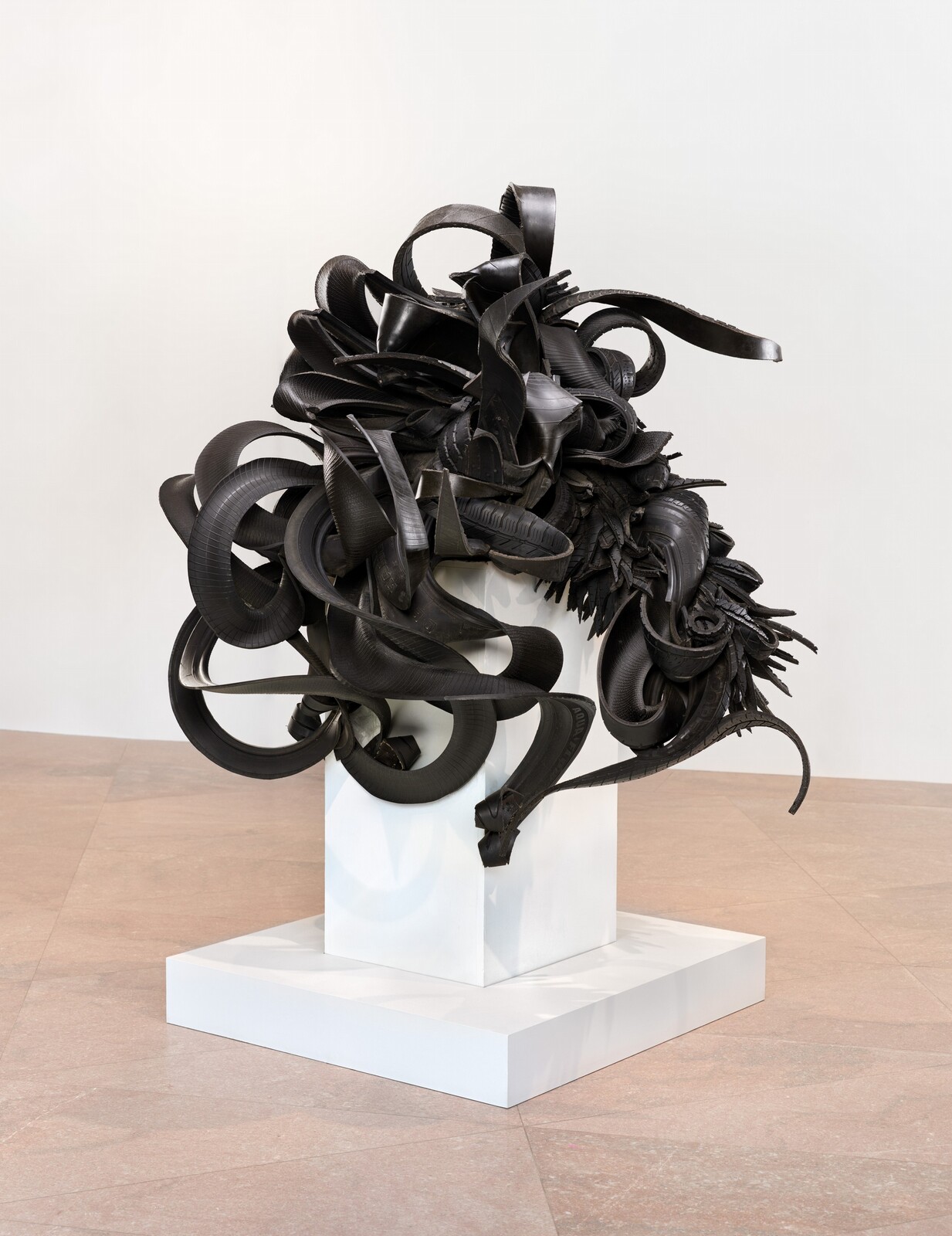

Image context: the cover is the National Gallery of Art's photograph of the exact sculpture discussed here, not a generated reconstruction or a generic tire image. Its frontal view keeps the work's material evidence legible: manufactured tread, worn rubber, cut edges, open loops, and the white pedestal that the mass nearly overwhelms.[2]
A used tire does not enter an artwork as neutral matter. Its tread was engineered to meet a road; its curve remembers inflation; its wear records friction without identifying a single journey. When Chakaia Booker cuts that object into bands, she changes its structure but does not wipe it clean. Egress still looks made from tires, and that recognition is the beginning of the sculpture rather than a problem it needs to transcend.
The National Gallery of Art's short film, led by critic Aruna D'Souza, offers a hopeful route into the work. It presents Egress as a transformation of urban waste and connects Booker's practice to struggle, strength, survival, and the possibility of a more empathetic world.[1] That frame is worth watching—and worth slowing down. The sculpture becomes more interesting when “renewal” is treated as one pressure among several, not as a tidy ending in which damaged material becomes beautiful and leaves its history behind.
Made around 2000, Egress is composed of rubber tires and measures 127 by 134.62 by 127 centimeters, or 50 by 53 by 50 inches.[2] Those nearly cubical dimensions matter. This is neither a little found-object exercise nor one of Booker's room-filling walls. It occupies the scale of a body while refusing to resemble one consistently. The film supplies the moving encounter; the annotation below keeps the object's histories, methods, and ambiguities in view.
Begin with the cut, not the rescue story
The easiest account of Egress is circular: society discards tires, an artist rescues them, and waste returns as culture. Booker gives us reasons to resist that smooth loop. She began exploring tires after encountering retreads and melted rubber from car fires on New York streets in the 1980s.[5] The material arrived already tied to a particular urban environment, to mobility and immobility, and to systems of consumption that make tires ordinary until they become difficult to dispose of.
In a long interview with Sculpture, Booker described the tire as a conceptual analogy for mobility, growth, and communication. She also discussed its scars and layered construction in relation to class, race, labor, and cultural diversity.[3] Those associations do not turn every strip into a code with one correct translation. They establish a field of tensions. A tire connects places, but a discarded tire has stopped moving. Rubber can flex, but steel reinforcement resists the hand. Reuse can prevent disposal, but it cannot undo the extraction and industry embodied in the material.
The film's language of transcendence is strongest when understood this way. Booker does not make the tire innocent. She makes its contradictions available to sight.
Black is not one surface
From a distance, Egress can collapse into a single black silhouette. Up close, that description fails. Wide smooth bands catch light in long gradients. Treaded pieces keep their blocky manufactured patterns. Some strips terminate in blunt cuts; others have been sliced into narrow teeth that cluster like fringe or bristles. Loops open pockets of white wall inside the mass, while dense coils refuse the eye entry.[2]
The National Museum of Women in the Arts describes Booker's process through active verbs: she slices, twists, weaves, and rivets tires into new forms. Its profile also notes how differences in rubber tone, tread, and wear let the material carry ideas about human difference and aging.[4] Booker's own account is equally attentive to variation: rust, exposed layers, tread designs, and the marks left by an “explosive moment” can all expand her working palette.[3]
This is why it would be reductive to make black rubber stand for Black identity in one undifferentiated block. The National Gallery film explicitly places Black American struggle and survival inside its interpretation.[1] The sculpture supports that reading by refusing sameness. Its blackness is a population of textures, histories, strengths, wounds, and reflectivities. Difference is not painted onto the material after the fact; it appears through selection, cutting, adjacency, and light.
Egress names an exit that never becomes a doorway
The title encourages spatial language. An egress is a route out, yet the sculpture offers no clear passage through its center. Its loops keep opening and closing. A long band points outward only to bend back toward the cluster. On the pedestal, the work seems caught between expansion and compression: too restless to become a monument, too entangled to behave like an escape diagram.[2]
That ambiguity is where moving images earn their place. A still photograph can preserve detail but privilege one settled outline. A filmed viewing reminds us that the outline changes as the camera or viewer changes position. Watch less for a hidden “correct” angle than for alternations between openness and obstruction. A gap on one side becomes density on another; a graceful ribbon reveals a toothed edge; the object repeatedly revises the first noun it suggested.
The title, then, need not promise release. It can name the desire for an exit while the material demonstrates how difficult leaving a history actually is.
Transformation is work, not magic
Booker's forms can look so fluent that labor disappears into flourish. The sources put it back. Working with tires means acquiring and transporting heavy material, then using machinery as well as hand processes to cut, drill, twist, and fasten it.[4] For the much larger Anonymous Donor, a team of eight, including Booker, spent two weeks on installation.[5] Even when the result resembles ribbon or weaving, rubber does not become cloth. Its resistance is part of the line.
That matters to the video's theme of transformation. “Before” and “after” images can imply a miraculous conversion, but Egress is better read as accumulated decisions: where to split a sidewall, which tread to expose, how tightly to coil a band, when a sharp fringe needs a smooth arc beside it. Booker brings practices associated with textile work into contact with saws, drills, industrial products, and large-scale fabrication.[4] The sculpture does not choose between craft and industry. It makes their boundary labor visibly.
Human scale changes the metaphor
Booker is renowned for monumental tire works. It's So Hard to Be Green spans roughly 12.5 by 21 feet, and Anonymous Donor rose more than ten feet high as a three-walled installation that visitors could walk between.[4][5] Egress compresses that vocabulary into a form roughly four feet in each direction.[2] Instead of entering it, a viewer circles it. Instead of being enclosed by rubber, a viewer meets a dense object elevated on a museum pedestal.
The smaller scale does not domesticate the material. It concentrates it. Long bands reach beyond the central knot, but the pedestal keeps returning the eye to a bounded encounter. The sculpture can appear like a headdress, organism, bouquet, engine, trap, or burst of script, yet none of those comparisons holds for a full circuit. Its scale makes metaphor intimate and unstable: close enough to address as a body, too materially specific to become a character.
That instability is the lesson to carry out of the video. Egress is not moving because a tire has escaped waste and arrived at beauty. It is moving because Booker keeps incompatible truths in the same object. The tire is discarded and durable, scarred and forceful, standardized and singular, environmentally costly and newly useful. The road is gone, but pressure remains—in the curve of the rubber, in the labor of cutting it, and in the histories that transformation cannot simply leave behind.[1][3][4]
Sources
- National Gallery of Art, “See how artist Chakaia Booker turns car tires into transcendence” — YouTube video featuring Aruna D'Souza's interpretation of Egress.
- National Gallery of Art, “Egress” — official object record with date, medium, dimensions, provenance, visual description, and the collection photograph used for the cover.
- Jan Garden Castro, “The Language of Life: A Conversation with Chakaia Booker.” Sculpture, January/February 2003 — primary interview on tires, mobility, scars, labor, cultural diversity, and material process.
- National Museum of Women in the Arts, “Chakaia Booker” — institutional artist profile on tire cutting, weaving, riveting, surface variation, physical labor, and monumental scale.
- Alicia Ault, “Artist Chakaia Booker Gives Tires a Powerful Retread.” Smithsonian Magazine, November 24, 2015 — reporting on Booker's New York material sources, studio palette, physical process, and the installation of Anonymous Donor.