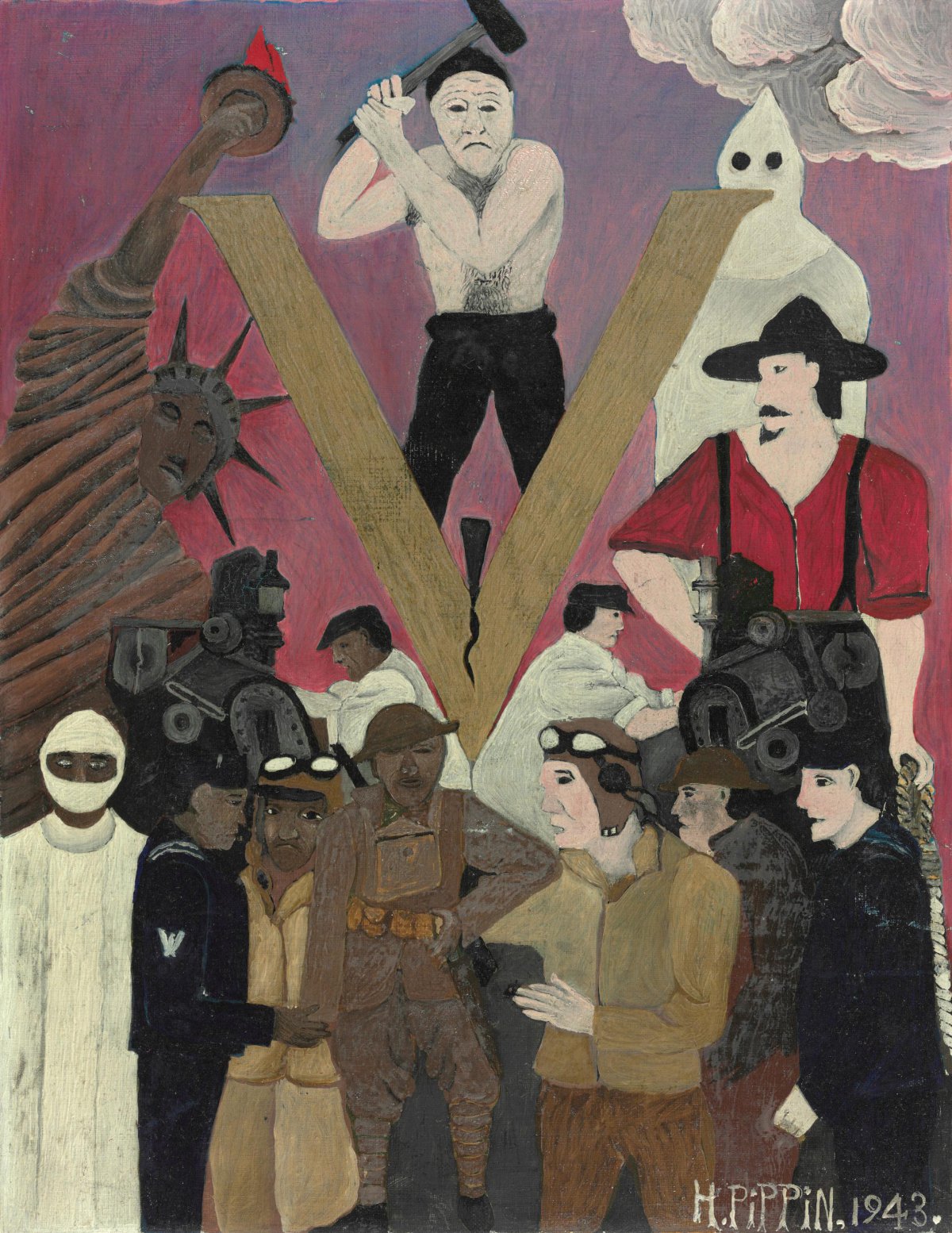
Image context: this is the Philadelphia Museum of Art's direct photograph of Pippin's painting, not a generated reconstruction or an analytical graphic. The image matters as evidence: its central V is at once a letter, a barrier, and an object being forced apart.[1]
The first cut in Horace Pippin's Mr. Prejudice is not into a body. It is into a letter.
A bare-chested white man stands at the top center of the painting, feet planted wide, driving a wedge into a colossal ochre V. The split runs downward between two machinists and then widens toward two groups of uniformed men. The figure's eyes face us rather than his work. He is not a passing vandal caught mid-swing; he presides over a division whose consequences have already reached every person below him.
Pippin made this scene in 1943 on a canvas only 46 by 35.9 centimeters—roughly the area of an open magazine.[1] Its smallness sharpens the encounter. The painting compresses the Statue of Liberty, a Ku Klux Klan hood, a noose, two world wars, industrial labor, military segregation, and a tentative gesture of interracial contact into one vertical field. Nothing recedes into atmospheric distance. Symbols and people are pressed toward the surface as if they all have to answer the same question at once: what can “victory” mean in a country organized by racial separation?
The slogan has become a piece of machinery
The V dominates before any face does. Its arms begin near the painting's upper corners and narrow toward the machinists, giving the composition the blunt symmetry of a poster. In wartime visual culture, V promised a conclusion: victory over the Axis, freedom secured, national purpose unified. Pippin turns that confident sign into a material structure. It has thickness, weight, and a visible grain-like surface. It can be struck, cracked, and used to sort bodies.
That transformation is the painting's first act of precision. If the V remained only a printed slogan behind the figures, prejudice would appear as hypocrisy layered over an otherwise intact ideal. Here prejudice works on the ideal itself. The wedge enters at the letter's joint, the point where its two arms are supposed to become one. The national symbol does not hover safely above segregation; segregation determines its shape.
The executioner-like figure is equally important. Pippin does not paint prejudice as a fog, an inherited mood, or a disagreement between the groups below. He gives it a body engaged in labor. Its hands grip a tool. Its feet brace. Its force travels through a wedge. Prejudice is shown as something actively made and maintained.
Even the title shifts how we see him. Mr. Prejudice sounds almost ordinary, as though prejudice could have a surname, an occupation, and a place in public life. Yet the figure is also larger than everyone else. Pippin lets the personification work in two directions: this is one accountable actor, and it is a system big enough to organize the whole field.
Matching jobs make the separation harder to excuse
Below the V, Pippin arranges difference through repetition. A Black machinist works on the left and a white machinist on the right. Black servicemen occupy the lower-left corner; white servicemen answer them across the divide. Uniforms distinguish sailor, airman, medical worker, and soldier, but the basic capacities repeat: manufacture, serve, fight, heal.[1]
The symmetry refuses the racist fiction that separation follows from unequal ability. These are corresponding workers performing corresponding national roles. The wedge does not reveal a natural difference between them. It manufactures distance between people whose work has already established their equivalence.
Pippin places himself among the Black servicemen in his First World War uniform, his injured right arm hanging straight at his side.[1] The detail makes the allegory autobiographical without turning the canvas into a conventional self-portrait. Pippin had enlisted in the all-Black unit that became the 369th Infantry Regiment, served in France, and suffered a sniper wound to his right shoulder. He returned from war with lasting impairment, later learning to guide the injured arm as he worked.[1][3]
The National Archives places that experience inside a broader contradiction. Black men served in segregated units, often with inferior training and restricted assignments; those who returned home faced diminished opportunity alongside intensified racial violence. The 369th was one of the Black units that fought on the front lines and became the most decorated regiment of its kind, but battlefield distinction did not dissolve the color line at home.[4]
Pippin therefore paints his disabled arm as more than a credential of sacrifice. It is evidence held against the composition. The man who fought for democracy is physically present inside a “victory” that still allocates bodies by race. His arm hangs down while Mr. Prejudice raises both of his. One body bears the past cost of service; the other is busy preserving the terms under which that service remains unequal.
Liberty and terror occupy the same sky
The upper corners turn the division into a contest over national guardianship. On the left, the Statue of Liberty enters diagonally, her skin painted brown, her red-orange torch held high. She leans toward the Black servicemen rather than standing in remote monumental balance. On the right, a white Klan hood floats above a large man in red who holds a noose.[1]
Pippin does not need conventional perspective to establish the stakes. The hovering figures behave like rival emblems. Liberty claims the left group as part of the nation; white supremacy claims authority over the right. The contrast is severe, but the painting does not simply assign virtue to every figure on one side and guilt to every figure on the other. The people below do not fully obey the symbols above them.
A Black sailor reaches across the V. A white aviator reaches back. Their arms echo one another, but their hands stop short of contact.[1] This is the painting's smallest action and its most important refusal of fatalism. If the hands met, the gesture could become an easy emblem of reconciliation, a sentimental cure placed inside an unchanged structure. If nobody reached, the wedge would appear to have completed its work. Pippin chooses the charged interval between those outcomes.
The gap shows that solidarity is imaginable but not self-executing. The men can recognize one another across the divide; recognition cannot by itself remove the structure separating them. Their extended hands also reverse the action above. Mr. Prejudice exerts downward force to widen a split. The servicemen send a horizontal impulse across it. One action is mechanically effective; the other remains incomplete.
That difference keeps the painting from congratulating good intentions. The white aviator's reach matters, but it has not yet altered the V, displaced the executioner, or brought the machinists onto common ground. Pippin gives cooperation moral presence without pretending it already has institutional power.
One V has to carry two victories
In January 1942, James G. Thompson wrote to the Pittsburgh Courier asking why Black Americans should sacrifice their lives while living as partial citizens. The newspaper developed his appeal into the Double V campaign: victory over fascism abroad and victory over racism at home. Double V clubs, pins, newspaper coverage, and public advocacy spread the formulation nationally.[5]
Pippin's painting appeared the next year. It does not reproduce the campaign's paired-letter emblem. Instead, one enormous V bears the pressure of both claims.[1][5] That is a visual inference rather than a documented statement of the artist's intent, but the composition supports it: military and civilian workers share the field, while a World War I veteran stands among Second World War uniforms. Foreign war and domestic order have been forced into the same sign.
The single V makes it impossible to imagine that America could complete one victory while postponing the other without damage. The wedge does not split a secondary promise attached to the bottom of the letter. It attacks the point that holds the whole symbol together. Pippin's argument is not merely that racism tarnishes an otherwise successful war effort. Racism breaks the unity on which the claim of democratic victory depends.
His own career makes that critique more deliberate than the old label “self-taught” can imply. Pippin did not attend art school, but he was an observant maker who built a distinctive practice from war memory, domestic scenes, biblical subjects, Black history, and American political imagery. He gained national attention rapidly after 1937, and institutions that once promoted him through the limiting language of “naïve” or “primitive” art later emphasized the sophistication and independence of his vision.[2][3] Mr. Prejudice is not blunt because its maker lacked complexity. It is blunt because a public symbol has been engineered to carry a complex historical indictment at poster speed.
The crack is not the final movement
The painting offers no repaired V. The wedge remains lodged at its joint; the machinists remain on separate sides; Pippin's injured arm cannot be restored by the democracy it served. A close reading should not manufacture resolution where the object refuses it.
Yet the composition is not motionless. The crack descends, but the hands reach across. Liberty leans inward. Matching jobs answer one another. Pippin makes segregation brutally legible and then fills the segregated field with correspondences that contradict its logic.
That is why the almost-touching hands matter more than a completed handshake would. They do not announce that unity has arrived. They identify where work must occur. The distance between them is small enough to see across and structural enough that goodwill alone cannot close it.
Mr. Prejudice finally turns a patriotic letter into a test of who is allowed to inhabit its meaning. The executioner thinks victory can survive division because the V remains recognizable even while he splits it. Pippin's painting argues the opposite. A symbol can stay readable after its promise has been broken. The work of looking is to notice the break—and to distinguish the force widening it from the hands still trying to cross.
Sources
- Philadelphia Museum of Art, “Horace Pippin, Mr. Prejudice, 1943” — official object record and linked education resource for the painting's image, dimensions, composition, figures, accession history, and interpretation.
- Anne Monahan, Horace Pippin, American Modern, Yale University Press (2020) — scholarly reassessment of Pippin as a disabled combat veteran and deliberate modern artist, with emphasis on autobiography, Black labor, process, and the racial dynamics of his career.
- Brandywine Museum of Art, “Horace Pippin: The Way I See It” (2015) — retrospective overview of Pippin's war injury, working method, rapid recognition, artistic range, and the limits of the period's “naïve” label.
- U.S. National Archives, “World War I: African American Research” — archival context for segregated service, the 369th Infantry Regiment, Black wartime participation, and the discrimination and violence veterans encountered after returning home.
- Jennifer Putnam, “V for Victory: A Sign of Resistance,” National WWII Museum (February 1, 2024) — historical account of James G. Thompson's 1942 letter, the Pittsburgh Courier, and the Double V campaign's linked demands for victory abroad and at home.