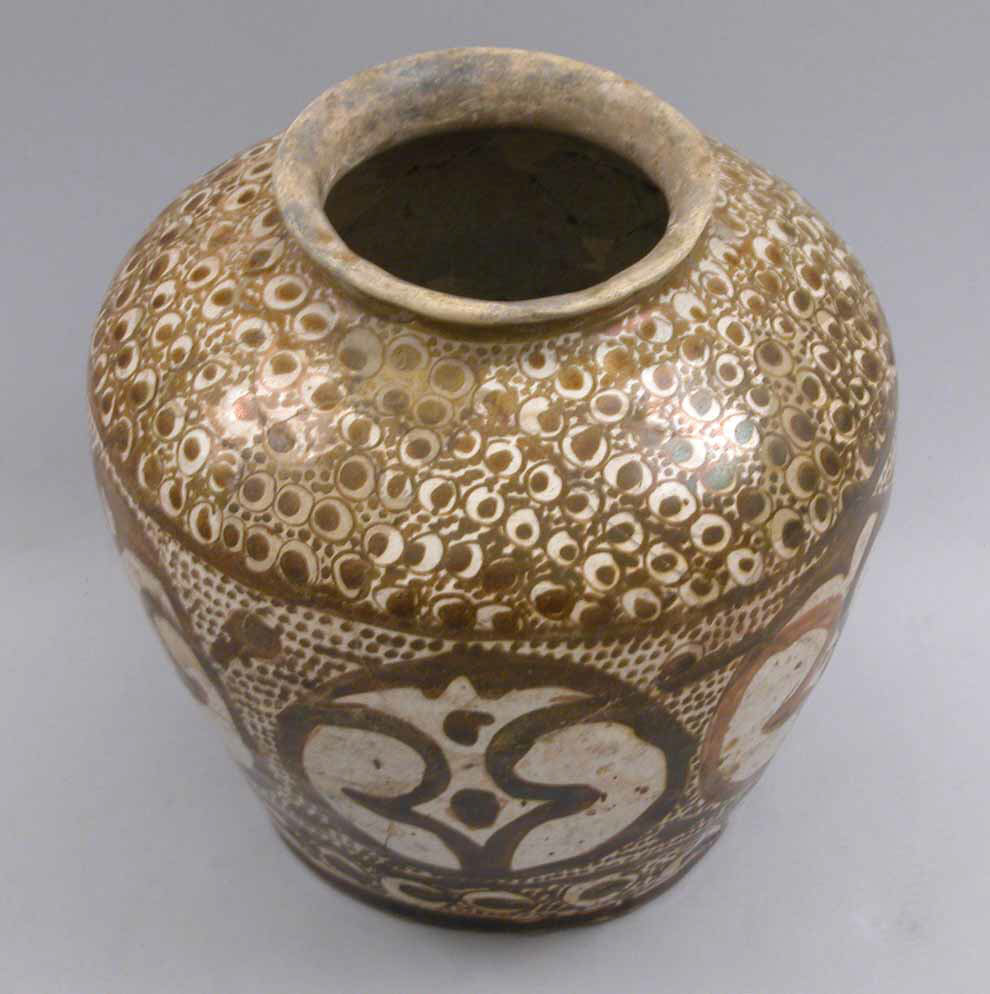
A small Iraqi jar in the Metropolitan Museum of Art seems to offer a stable arrangement: medallions around its belly, smaller peacock-eye patterns at the shoulder and base. The museum dates it to the tenth century. Yet its decoration was made to change with the encounter. The Met's account emphasizes how handling and shifting illumination would alter the sheen of such vessels.[1] The pattern stays put; its brightness does not.
Lustreware gives fired clay an unexpected second identity. From one position it reads as painted pottery; from another, passages can catch a metallic flash. That behavior begins with an unusual sequence in the workshop: the pot is glazed and fired before the lustre decoration receives a further, carefully controlled firing.[2] What looks like a finishing touch asks the kiln to do a different job.
The pot returns to the fire
In the traditional reduced-lustre process, the decorator paints a mixture containing copper or silver compounds onto an already fired glaze. The next firing takes place at a lower temperature with a restricted air supply. Carbon monoxide in this atmosphere can remove oxygen from the metal compounds, helping turn them into metal. This is the meaning of reduction in the process: a chemical change produced through the firing atmosphere.[2]
The sequence matters aesthetically. The decorator is working on a surface that has already become glassy. The lustre firing must develop a new effect in that surface. The brush determines where the pattern goes; the atmosphere helps determine what the painted areas become. Drawing and firing share responsibility for the finished ornament.
A scientific account of medieval Iranian tiles describes the subsequent transformation more precisely. Silver and copper ions enter the glaze, exchanging with sodium ions. Reduction and the growth of minute metal particles produce a thin layer near its surface. After firing, the remaining paint residue is rubbed away to expose the decoration.[3] The visible reward survives the removal of the material that delivered it.
That last action changes how one imagines the painter's work. A brushstroke can serve as a temporary supply of ingredients. The enduring mark is the region of glaze those ingredients have altered. Looking at the finished vessel, we see the result of a relationship between the painted mixture and the surface beneath it.
Tiny particles, different kinds of light
Microscopy has given that relationship a scale. In a study published in 2006, Josep Roqué and colleagues examined experimental lustre reproductions on lead-glazed tiles. Their results connected changes in color and shine to the arrangement of copper and silver nanocrystals within glass. As the particles grew and their spacing changed, so did their optical behavior.[4]
The researchers also distinguished diffuse color from the color of the reflected metallic sheen. Copper strongly affected the former; the distribution of silver contributed to a purplish reflection.[4] This helps explain why a color name alone can be a poor description of lustre. A brown-looking passage and a brilliant reflection can belong to the same decorated surface. These experimental results explain a mechanism; they are not a chemical analysis of the Iraqi jar pictured here.
For the viewer, the distinction has a practical consequence. The decorative shape and the light it returns need separate attention. Follow the contour of a medallion first, then watch which parts catch the light as your position changes. The eye is doing two kinds of reading: recognizing a painted form and noticing a material response.
The historical palette was also broader than a single golden finish. The Met's ninth-century Ruby Luster Bowl with Large Palmette, attributed to Iraq, combines ruby and golden lustres. Its curators identify this polychrome decoration as an early approach and note the unusual extent of the surviving ruby color.[5] The bowl supplies a useful counterweight to the idea that lustre was simply a way of making clay resemble gold. Potters could use its effects to differentiate passages within a design.
The workshop had more than one author
The difficulty of controlling those effects reappears in the career of William De Morgan. According to the V&A, his experiments began with an attraction to the iridescent silver paint used in stained glass. He wanted a related beauty on tiles. Later, at his pottery, Frank Iles managed the kiln, while painters including the brothers Fred and Charles Passenger translated designs onto ceramic surfaces.[6]
De Morgan's name now gathers those objects together, but the division of work deserves attention. A design could travel from the designer's drawing through another person's brushwork and another person's management of fire. The V&A describes his mature lustre production as the result of persistent experimentation with demanding pigments and firing conditions.[6]
This workshop history gives a human dimension to the chemistry. An explanation in terms of particles does not make the craft automatic. Someone still has to prepare materials, apply them, and bring a particular kiln through a successful firing. Nor can a striking design guarantee a striking surface. The collaboration reaches all the way from the visible motif to the conditions under which it becomes visible.
What the photograph holds still
The museum photograph preserves the jar's proportions and the distribution of its ornament. It gives us one arrangement of object, camera, and light. It cannot reproduce the changing reflection that accompanies movement around the vessel. The photograph is useful precisely when we remember which encounter it records.
Survival adds another complication. In the Iranian tile study, the analyzed lustre layers were less than a micrometer thick. The authors explain that scratches and weathering can disproportionately affect this extremely thin decoration.[3] A durable ceramic body therefore does not guarantee an equally durable optical surface. This finding concerns those tiles, but it makes a valuable general question possible: how much of a historical object's original brilliance remains available to sight?
Return to the jar's rows of ornament with that question in mind. The medallions organize the curved body; the smaller motifs give the eye a repeated beat. Lustre adds another rhythm, one that a stationary reproduction can only suggest. The maker fixed the pattern in the kiln, then left the light to keep changing its emphasis.
Sources
- The Metropolitan Museum of Art, “Luster Jar with Medallions and Peacock-Eye Pattern,” object 56.96 — dating, attribution, changing sheen, and photograph.
- Victoria and Albert Museum, “An A–Z of Ceramics,” section “L is for lustre” — painted compounds, separate firing, and reduction.
- Trinitat Pradell, Judit Molera, Moujan Matin, and Keelan Overton, “Microanalytical and Microstructural Analysis of Thirteenth-Century Luster Tiles Attributed to the Emamzadeh Yahya in Varamin…” — sections on lustre formation and surface vulnerability, University of Michigan, Khamseen.
- Josep Roqué and colleagues, “Copper and silver nanocrystals in lustre lead glazes: Development and optical properties,” Journal of the European Ceramic Society 26 (2006), 3813–3824 — research abstract and bibliographic record, University of Girona.
- The Metropolitan Museum of Art, “Ruby Luster Bowl with Large Palmette,” object 22.49.1 — ninth-century Iraqi polychrome lustre.
- Victoria and Albert Museum, “William De Morgan – an introduction” — stained-glass experiments, workshop collaborators, and lustre production.