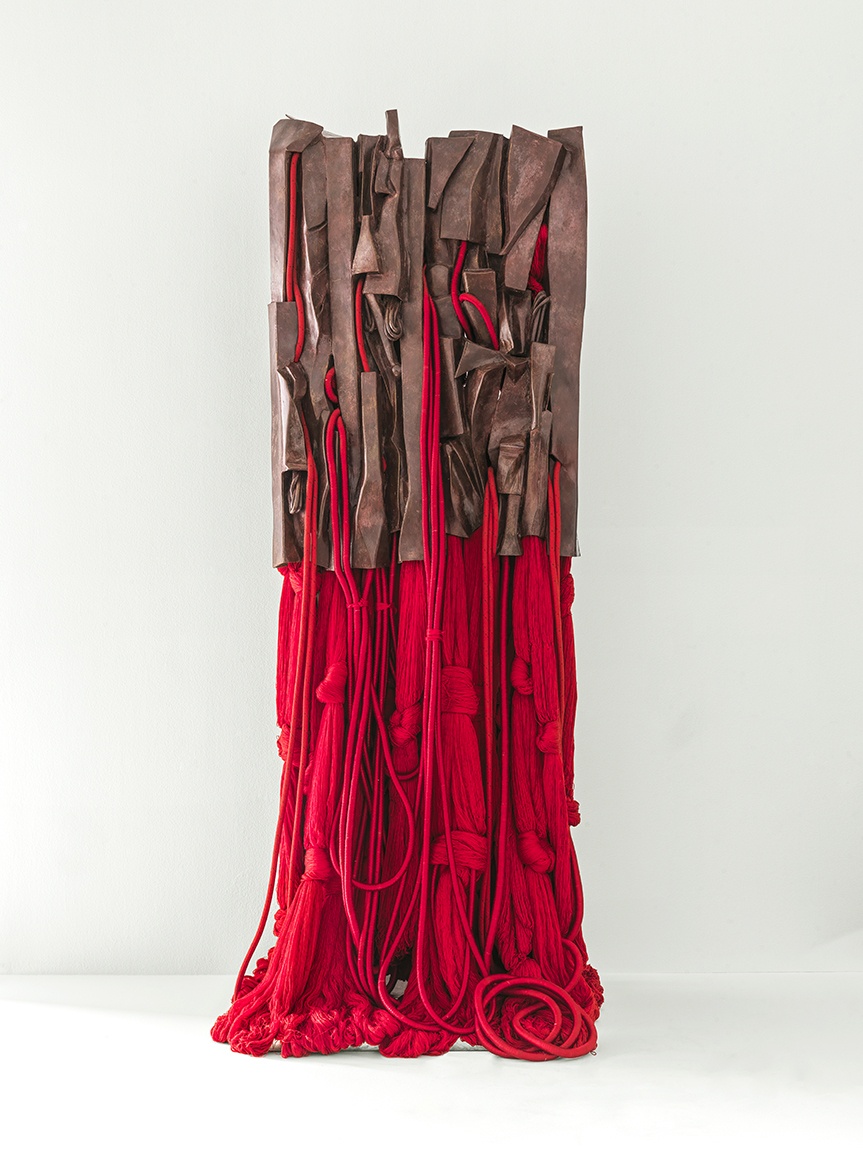
The bronze seems to have learned a textile’s habits. In Barbara Chase-Riboud’s Malcolm X #16 (2016), metal folds occupy the upper part of a tall red sculpture, while bundled fibers descend toward the floor. Its materials include silk and wool, but also cotton, synthetic fibers and a steel support. The apparent ease is carefully constructed: something heavy seems to rest on something yielding.[1]
That uncertainty is an inviting way into Chase-Riboud’s career. She makes the eye revise what the hand thinks it knows about weight and texture. Then a title supplies a name—Malcolm X—and the material encounter becomes an encounter with memory. How can a sculpture commemorate someone when it offers no face to recognize?
From Philadelphia to a different kind of monument
Born in Philadelphia in 1939, Chase-Riboud graduated from Temple University’s Tyler School of Art in 1956. By late 1960 she had moved to Paris. The geographical distance did not loosen her attention to the civil rights struggle in the United States: the Philadelphia Museum of Art connects her Malcolm X sculptures to the impact of his assassination in 1965.[1][2][4]
Her route into sculpture also passed through Rome. MoMA records that she made her first lost-wax bronze casting there at nineteen, while studying at the American Academy. About a decade later she began introducing fiber, deliberately unsettling the familiar appearances of hard metal and soft thread.[3]
She conceived the first Malcolm X in Paris in early 1969. The series takes the form of steles: upright commemorative structures whose ancestry lies in monuments marking people and events.[2][5] That choice gives the works a historical function before it gives them a recognizable subject. They stand for someone; they do not need to stand in his bodily shape.
Malcolm X #3, made in 1969 and now in Philadelphia, combines angled bronze with wrapped and knotted fibers. The museum describes the tribute as an evocation of Malcolm X’s character and achievements rather than his appearance.[4] This is a useful distinction, because abstraction can otherwise be mistaken for vagueness. The name is exact. What remains open is the visual experience through which the viewer approaches it.
A portrait lets us begin with recognition: there he is. Chase-Riboud delays that reassurance. We encounter an upright presence, a density of material, a meeting of surfaces. Only then do we work out how those sensations might carry dignity, grief or force. These are possibilities of looking, rather than a code in which each knot has one authorized meaning.
What holds the weight?
Serpentine’s account of her practice describes metal folds meeting fibers that are braided, knotted, looped and woven. It also emphasizes her attention to the sculptural base.[7] This last point can get lost in the pleasure of the surfaces. The lower part of a sculpture determines how it meets our world: whether it stands apart on a pedestal, seems planted in the ground or appears to hover above it.
Chase-Riboud makes that meeting difficult to take for granted. Follow the material downward and the anticipated solidity breaks into strands. Follow it upward and the metal begins to resemble something gathered or creased. Your eye can travel across the change, even while your knowledge of the materials insists on their difference.
The effect depends on construction. The Nasher Museum’s Malcolm X #5 (2003), for example, is catalogued as polished bronze and silk with steel support.[6] Fiber can appear to carry a bronze mass without literally doing all the structural work. Keeping that distinction clear makes the illusion more interesting: the sculpture reorganizes our perception of support while retaining the engineering it needs to stand.
The series also resists becoming one fixed memorial image. Philadelphia’s early work, the Nasher’s later bronze and silk version, and the red Malcolm X #16 pictured here belong to different moments across decades.[1][4][6] Repetition preserves the dedication while allowing the material encounter to change. Remembering becomes an activity the artist returns to.
A form can have another life
Chase-Riboud’s work as a poet and writer enters this sculptural practice through titles as well as through historical subjects. MoMA’s The Albino dates from 1972; in 1994 she reinstalled it as All That Rises Must Converge/Black. The museum explains that the work can appear in two configurations, including one with its “arms” raised toward the ceiling. One title comes from her own poem; the other refers to a Flannery O’Connor story concerned with race and class.[3]
Here, naming and positioning both participate in the work. A changed arrangement redirects the viewer’s encounter, and a changed title places it beside another text.
Return to the red stele and look first at the transition between bronze and fiber. The materials do not disappear into a seamless whole; their differences remain available to the eye. Yet they share an upright presence. Chase-Riboud’s memorial gains its force from that difficult cooperation: the name stays with us while the form keeps asking to be seen again.
Sources
- Pulitzer Arts Foundation, “Barbara Chase-Riboud Monumentale: The Bronzes” (2022–2023), exhibition overview and photograph with full materials, dimensions and credit for Malcolm X #16.
- Tyler School of Art and Architecture, Temple University, “Barbara Chase-Riboud (BFA ’56),” education and the commemorative tradition of the steles.
- The Museum of Modern Art, “The Albino” (1972; reinstalled in 1994), collection record and gallery label on bronze casting, fiber, literary titles and alternate configurations.
- Philadelphia Museum of Art, “Malcolm X #3” (1969), collection record on materials, Paris and the series’ historical dedication.
- Philadelphia Museum of Art, “Barbara Chase-Riboud: The Malcolm X Steles” (2013–2014), exhibition account dating the first work’s conception to early 1969.
- Nasher Museum of Art at Duke University, “Barbara Chase-Riboud, Malcolm X #5, 2003,” collection account specifying polished bronze, silk and steel support.
- Serpentine Galleries, “Barbara Chase-Riboud: Infinite Folds” (2022–2023), institutional account of metal folds, textile techniques and the sculptural base.