Luminism is easy to flatten into tasteful quiet. The paintings look calm, the horizons look low, the water often barely moves, and the first temptation is to treat the whole style as refined scenery for people who wanted to rest their eyes.[1][2] The National Gallery of Art's landmark American Light project points to a stronger reading. What later came to be called luminism gathered pictures with a shared interest in radiant light, atmosphere, and measured ways of recording nature across painting, drawing, and photography.[1] That range matters. Luminism was not only about pretty sunsets. It was about control.
The style's real achievement was to make stillness feel constructed rather than empty. Instead of building landscape around cliffs, storms, heroic incident, or moral allegory, luminist painters often thinned the world down to a few governing elements: horizon line, tonal interval, reflective water, weather held in suspension, and a surface disciplined enough that the eye could move slowly without losing its grip.[1][2] The result was not passive calm. It was a new kind of visual pacing.
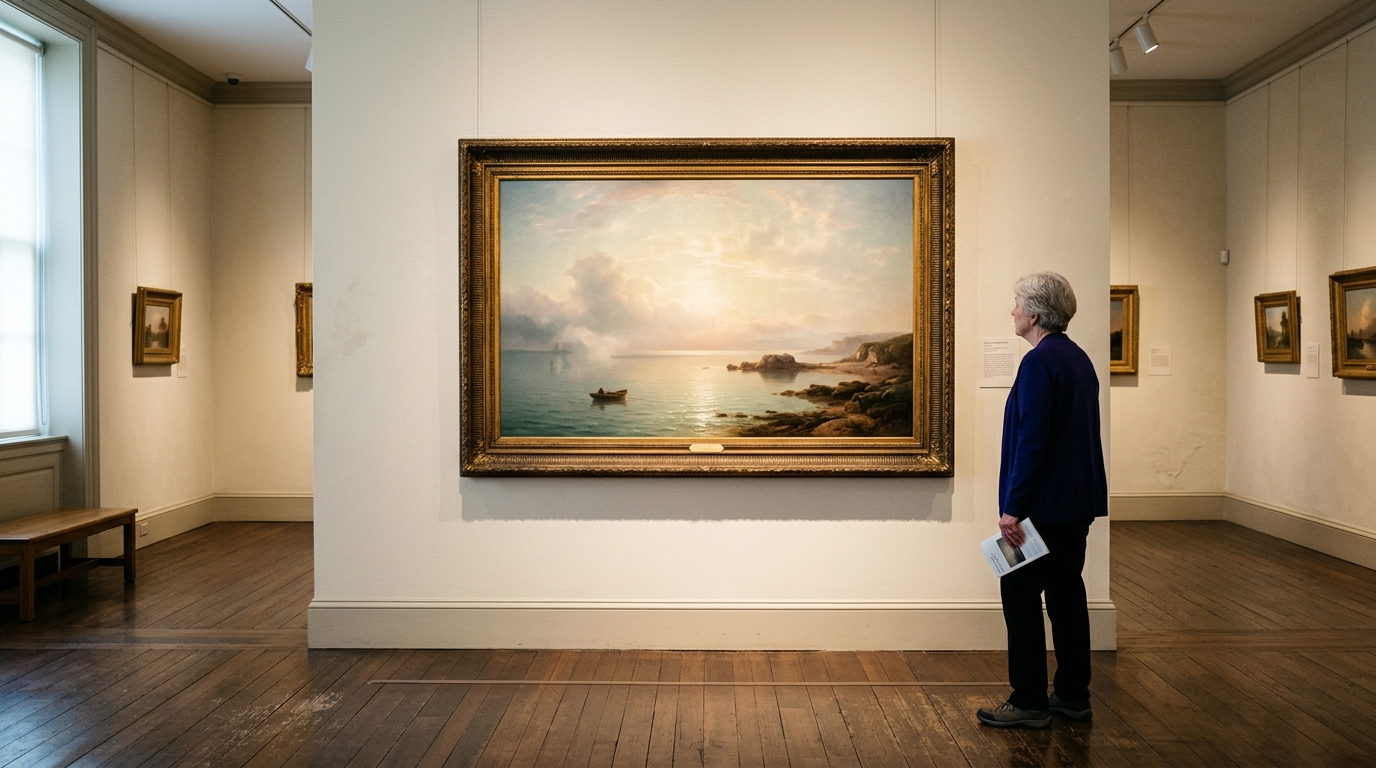
Image context: the cover now uses a quiet gallery viewing scene because the essay turns on the qualities luminist painting makes visible: measured horizons, radiant air, viewing distance, and dark silhouettes that keep drama in reserve.[3]
Luminism reduced the event without reducing the picture
The NGA publication describes luminism as a culminating phase of Hudson River painting, while the exhibition history calls it a newly identified period in nineteenth-century American landscape painting.[1][2] Both descriptions help. They suggest that luminism was less a manifesto group than an art-historical recognition that several painters had begun solving the same problem in related ways. How do you hold a landscape together once you stop relying on theatrical incident? How do you keep a viewer looking when almost nothing "happens"?
Luminist painters answered by shifting weight away from narrative and toward conditions. Light became a structural device rather than an atmospheric accessory. Water became a field for pacing vision. Distance stopped functioning as mere backdrop and became one of the painting's active materials. The point was not to deny weather, labor, or topography. It was to keep those things inside a highly controlled calm.[1][2]
That is why luminism often feels both intimate and impersonal. The scenes can be very specific, tied to named coasts, marshes, coves, and hours of day, yet their compositional logic strips away clutter until the motif reads almost as a proposition. A shoreline is no longer just a place. It becomes a boundary across which tone, depth, and attention are tested.
Kensett turned the horizon into an instrument
John Frederick Kensett is one of the clearest cases because the Metropolitan Museum of Art's late coastal pictures show how much he could do with very little.[3][4] In Twilight on the Sound, Darien, Connecticut, the Met says that in the summer of 1872 Kensett explored sunrise, sunset, dawn, and twilight more liberally than before, focusing on the uninflected contours of water and coastal topography while rendering the tones and tints of a crimson sky and its reflection.[3] That description is exact enough to function almost like a recipe for luminist vision.
Nothing in the picture needs to be noisy. The shoreline barely interrupts the field. The boat and islands arrive as silhouettes. Color does not explode; it spreads. The painting persuades by withholding. It asks the viewer to register tiny differences in saturation and edge rather than chase a central event. Stillness here is not emptiness. It is compression.
The Met's The Sea, also from 1872, states the principle even more starkly. The museum describes the picture as a boldly simplified composition in which Kensett distilled nature to its most essential elements, with land, sea, and sky and the last covering two-thirds of the canvas.[4] That kind of reduction is the movement's deeper logic. Luminism does not merely observe calm weather. It edits the world until calm becomes legible as form.
The same Met record adds an important social clue: such views appealed to urban collectors who sought meditative idealizations of nature as antidotes to fast-paced city life.[4] That helps explain why the style feels so self-possessed. These pictures are not wilderness epics. They are counter-rhythms. They slow the metropolitan eye without giving up modern compositional intelligence.
Heade let weather move sideways
Martin Johnson Heade's marsh paintings show that luminism did not require static emptiness or polished seascapes alone.[1][5] The Met's Newburyport Meadows record stresses two things at once: Heade moved away from the mountainous subjects favored by fellow New York landscape painters, and the wide horizontal view of marshland gave him room to capture transient effects of light and weather.[5] That second phrase is crucial. Heade's weather is active, but it does not usually arrive as melodrama. It slides across the marsh.
In marsh pictures, the horizon is lower, flatter, and more vulnerable than in mountain painting. There is less vertical release, so the eye has to travel laterally across haystacks, channels, clouds, and damp ground. That spatial fact changes the emotional temperature. Tension no longer depends on a peak or a waterfall or a storm breaking open at center stage. It can live in the movement from sun to shadow across open land.[5]
The NGA's page for Sunlight and Shadow: The Newbury Marshes sharpens that point by naming sunlight and shadow as the painting's primary motif and by describing the first marsh pictures as rooted in Newbury and Newburyport near the Merrimack River.[6] Heade is not using weather as a backdrop for some other subject. Weather is the subject's organizing motion. In a luminist context, that means atmosphere has become compositional architecture.
This is one reason luminism should not be mistaken for mere serenity. Heade's marshes are calm enough to study, but they are never inert. They breathe through transitions: wet to dry ground, bright to overcast air, near haystack to distant band of cloud, stable horizon to changing light. The pictures keep event inside modulation.
Bricher proves the calm was exacting, not bland
Alfred Thompson Bricher helps show that luminist calm could travel across marine painting without collapsing into formula. The NGA writes that at his best, in the radiant A Quiet Day near Manchester, Bricher could equal fellow marine painters such as Kensett, Sanford Robinson Gifford, and Martin Johnson Heade, and that this 1873 Massachusetts coast scene seems especially inspired by Kensett, who had died the year before.[7] The painting's meticulously delineated rocks at left and expansive sweep of sea and sky make the inheritance visible.[7]
That inheritance matters because it clarifies what luminism borrowed and what it refused. Bricher keeps description sharp. Rocks remain rocks. Coast remains coast. Yet the painting's true force lies in distribution: hard detail anchoring one side, open air and water carrying the rest. The eye moves from texture into breadth. Exactness and quiet cooperate.
Seen beside Kensett and Heade, Bricher makes luminism look less like a single formula than a shared discipline. Different artists can keep different balances among shoreline, weather, texture, and tone, but all of them rely on restraint. The canvas does not need a climactic incident if the intervals between forms are organized with enough precision.[1][7]
Why luminism still holds
The style still matters because it teaches a demanding lesson about visual attention. Luminism shows that a picture can grow stronger by reducing declaration. Horizon, reflection, cloud band, haystack, tidal flat, and the long delay between one tone and the next can hold a painting together as firmly as narrative action.[1][3][5][7]
That lesson also explains why the movement emerged across paintings, drawings, and photographs in the NGA's account.[1][2] What united these works was not simply a preference for scenery. It was a pressure toward disciplined seeing. Light had to be recorded without dissolving form. Form had to stay clear without becoming hard or loud. Space had to feel expansive without spilling into vagueness.
Luminism, then, was never just calm for calm's sake. It was a method for making attention slow down and hold. Kensett's reduced sea, Heade's marsh weather, and Bricher's radiant coast all arrive by different routes, but they converge on one insight: stillness can be built. In these paintings, quiet is not the absence of structure. Quiet is the structure.
Sources
- John Wilmerding et al., American Light: The Luminist Movement, 1850–1875. National Gallery of Art publication page.
- National Gallery of Art, American Light exhibition overview.
- The Metropolitan Museum of Art, John Frederick Kensett, Twilight on the Sound, Darien, Connecticut (1872).
- The Metropolitan Museum of Art, John Frederick Kensett, The Sea (1872).
- The Metropolitan Museum of Art, Martin Johnson Heade, Newburyport Meadows (ca. 1876–81).
- National Gallery of Art, Martin Johnson Heade, Sunlight and Shadow: The Newbury Marshes (c. 1871/1875).
- National Gallery of Art, Alfred Thompson Bricher, A Quiet Day near Manchester (1873).