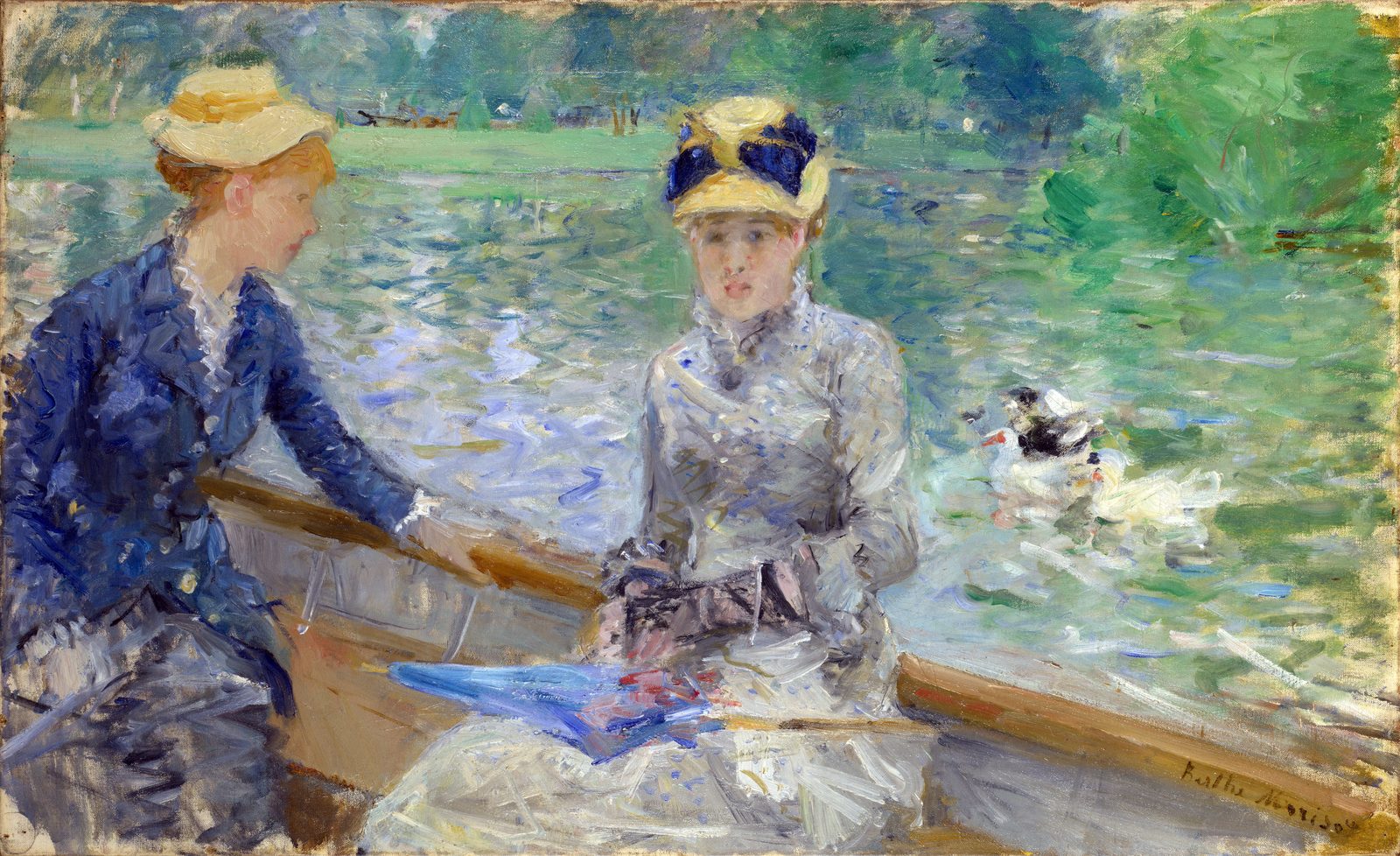
Berthe Morisot's Summer's Day can look, at first glance, like a perfect Impressionist permission slip: water, hats, pale dresses, a Paris park, and two women afloat in bright weather.[1][2][3] But the painting is much tighter and stranger than that summary. It refuses the broad, panoramic satisfactions that a boating picture usually promises. The boat edges are cut off. The horizon is shoved upward. One woman turns away into profile while the other faces us without quite offering a social anecdote in return.[1] What ought to feel relaxed instead feels delicately suspended. Morisot gives leisure a surface of ease and an inner structure of uncertainty.
That tension is what makes the painting modern. The National Gallery notes that the picture was almost certainly shown in 1880 under the title The Lake in the Bois de Boulogne and paired with another Morisot image using the same two women in the same clothes.[1] That fact matters because it shifts the work away from casual reportage. Morisot is not simply recording one afternoon on the lake. She is constructing a portable social situation: two bourgeois women, close to the viewer, framed by an artificial park that nineteenth-century Paris had already turned into a managed scene of recreation.[1][3] The painting is about how that scene feels from inside.
Image context: the lead image is a Wikimedia Commons file-page reproduction of the painting itself. That is the only image that makes sense for this essay, because the argument depends on Morisot's exact arrangement of hats, boat edges, water, and withheld eye contact rather than on a portrait of the artist or a later exhibition photograph.[4]
1) The boat is too close to become scenery
The first decisive choice is distance. The National Gallery's catalogue stresses that Morisot presents the women up close, almost as if the viewer were in the boat with them, and pushes the tree line to the very top of the picture.[1] That compositional pressure changes everything. A conventional leisure scene might open space around the sitters so that park, lake, sky, and costume can settle into a readable social tableau. Morisot does the opposite. She compresses the view until the outing feels half overheard.
The cropping matters especially at the lower edge. Bits of wood from the boats cut in from both sides and from the center, so the women seem surrounded by hulls and water rather than neatly placed inside an elegant vignette. The scene reads less like a framed excursion and more like a temporary balance among floating bodies, planks, cloth, and reflected light. The picture therefore keeps one foot in intimacy and one in instability. We are near the sitters, but not admitted into a completed story.
That closeness also helps explain why the painting still feels vivid now. Morisot does not let the viewer stand at a polite observational distance. She turns a fashionable Paris pastime into a compressed encounter. Leisure is not a distant spectacle; it is something negotiated at arm's length.
2) The women are visible, but not fully available
Morisot's two women are dressed for visibility: pale hats, gloves, dark blue and white clothing, upright posture, a boat on public water.[1] Yet the picture does not convert that visibility into easy legibility. The woman at left is given to us in profile, her face largely absorbed into the direction of her own looking. The woman at right appears more frontal, but even she does not quite stabilize as a portrait. Her expression is soft, guarded, and unresolved. The pair share a space without turning the painting into a cheerful exchange.
That reserve is central to the work's intelligence. The National Gallery's artist biography notes that Morisot spent much of her career painting women and children in gardens, interiors, and the Bois de Boulogne near her home, in part because bourgeois femininity sharply limited where women could move and what kinds of public life they could occupy.[2] Nationalmuseum's page on Morisot's related In the Bois de Boulogne makes the same point from another angle: parks were among the few public settings in which bourgeois women could appear respectably, and Morisot repeatedly used these settings to study relations between women up close.[3]
In Summer's Day, that social constraint does not become a thesis statement. It becomes atmosphere. Hats and gloves do not simply decorate the scene; they regulate it. They mark the outing as acceptable, proper, visible, and still somewhat controlled. Morisot gives us public leisure without public looseness. The women are present to view, yet they hold back from becoming available types.
3) The water borrows the same brush language as the dresses
The painting's other great decision is technical. The National Gallery emphasizes Morisot's vigorous zig-zag brushwork and notes that the same textured mesh of strokes binds women, water, and foliage into one animated surface.[1] That is exactly what keeps the picture from separating figure from setting in the usual way. The water is not a backdrop laid behind the sitters. It keeps touching them, almost repainting them.
Look at the dark dress on the left figure. Its blue-violet brushstrokes are broad, fast, and directional. Then look at the lake around her: the same energy appears there in green, white, and blue. The woman in white at right is built from a lighter version of the same principle. Morisot does not switch into a polished descriptive mode for faces and clothing and then retreat into broken marks for the environment. She lets the same unstable, luminous handling move across everything.[1] The result is that the two women seem integrated with the afternoon rather than planted on top of it.
This is where Morisot's so-called "unfinished" quality becomes a strength instead of a deficiency. The National Gallery records how critics complained about her lack of finish, while others praised the subtlety of her tones.[1][2] In this painting, finish would actually weaken the idea. If the figures were outlined more firmly against the water, the scene would become safer and more illustrative. Morisot wants something riskier: a social image in which bodies and atmosphere stay in contact.
4) The painting makes leisure feel constructed
The Bois de Boulogne in the picture is not untouched nature. The National Gallery points out that Napoleon III and the landscape architect Adolphe Alphand had transformed the area into a seemingly natural woodland with lakes, islands, paths, and pleasure activities for city dwellers.[1] One contemporary observer, quoted there, joked that the place was so artificial that only a mechanical duck was missing.[1] Morisot's painting quietly keeps that artificiality in play.
She does it first by omission. Despite the park's popularity, she removes the crowds and reduces the shore to a summary blur.[1] She does it second by repetition: the same two women recur in a companion painting, suggesting not an accidental sighting but a carefully worked motif.[1] She does it third through sheer pictorial construction. The close crop, the elevated horizon, the linked brushwork, and the refusal of anecdotal chatter all insist that modern leisure is something staged and felt, not simply enjoyed.
That is why Summer's Day lasts. It is certainly an Impressionist image of outdoor life, but it is not content to be pleasant evidence of it. Morisot turns the boating scene into a threshold picture. The women occupy a public park, yet remain inward. The water sparkles, yet keeps breaking form apart. The boats hold the figures, yet their cut edges make the whole setting feel provisional. What remains after the first glance is not just summer brightness. It is the subtle pressure of being seen in public while still keeping part of oneself turned sideways.[1][2][3]
Sources
- National Gallery, London, "Berthe Morisot, Summer's Day" - collection page with exhibition history, Bois de Boulogne context, close-up composition, and brushwork analysis.
- National Gallery, London, "Berthe Morisot (1841-1895)" - artist page covering Morisot's role in Impressionism, Passy and Bois de Boulogne context, and the gendered limits on her subjects.
- Nationalmuseum, "In the Bois de Boulogne" - collection page for Morisot's related Bois de Boulogne motif, with notes on her close-up treatment of two women and the park as a bourgeois public space.
- Wikimedia Commons, "File:A summers day by Berthe Morisot.jpg" - file page for the photographic reproduction used to prepare the article image.