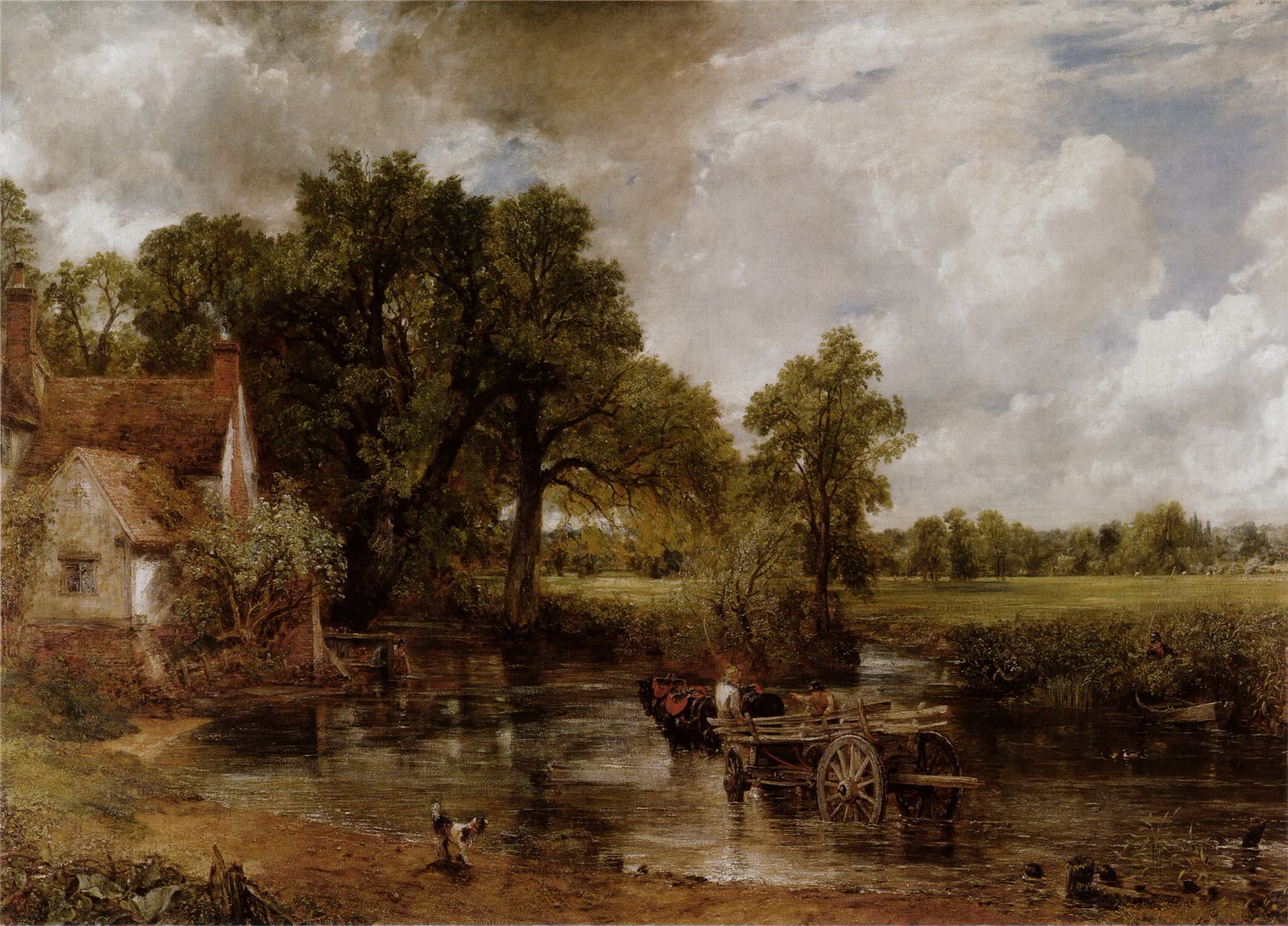
John Constable's The Hay Wain has been reproduced so often that it is easy to stop seeing what kind of picture it actually is.[1][3][4] The usual shorthand calls it the English countryside at peace: a wagon, a farmhouse, trees, water, and one of the most famous summer skies in British painting. That description is not false, but it is too soft. Constable's real achievement is that the scene never settles into pure repose. The wagon is not rolling forward. It is paused in shallow water. The horses are not straining, but they are not decorative either. Haymakers are already at work in the meadow beyond. What looks like pastoral rest is really labor held at a threshold.[1][2]
That threshold matters because the whole image is built around suspension. On the left stands Willy Lott's farmhouse, white-walled and red-roofed, specific enough to anchor the scene in Flatford on the River Stour.[1][2] In the center the wain sits in the ford, neither arriving nor leaving. To the right the meadow opens outward, promising the work the cart is there to serve. Above all this, the sky expands so generously that the eye keeps wanting to call the picture tranquil. Yet tranquility is not the same thing as stillness. Constable makes every element feel as if it has paused only briefly, as if weather, labor, and memory have all been asked to wait together for a moment.[1][3]
Image context: the cover uses the painting itself because this article depends on the exact arrangement of motion held back. A crop of the sky would make the work atmospheric. A crop of the cart would make it anecdotal. The pressure lives in the full structure.[1][5]
The cart matters because it stops the picture mid-task
The National Gallery's object page is unusually clear about the basic action: the title refers to the wooden wagon used for transporting cut and dried grass, and in this scene the empty wagon is making its way through the shallow water toward the meadow where haymakers are at work.[1] That one detail changes the entire mood of the painting. The cart is empty, so the work has not yet been completed. The crossing is practical, not ceremonial. This is not harvest triumph. It is a working interval.
Once that is in view, the painting's calm becomes more interesting. Constable does not dramatize the labor. There is no muddy struggle, no theatrical strain, no peasant sentimentality. Instead he shows rural work as a sequence of pauses, crossings, and small adjustments. The horses stand in the water long enough for reflection, but not so long that the task disappears. The scene breathes inside work rather than outside it.[1][2]
That is one reason the painting resists turning into pure nostalgia, even though later viewers often use it that way.[3][4] Its peace is not the peace of a world without labor. It is the peace of work temporarily slowed to the rhythm of heat, water, and distance. The meadow has to be reached. Hay has to be moved. The wagon will continue. Constable paints the exact interval before continuation.
The local specificity keeps the scene from dissolving into pastoral myth
The view is not generic countryside. The National Gallery identifies it as the millpond at Flatford, about a mile from Constable's birthplace in East Bergholt, with Flatford Mill tied to the Constable family for nearly a century.[1] The house at left, still standing today, was occupied in Constable's time by tenant farmer Willy Lott.[1][2] Those facts matter because they give the picture a dense local memory. Constable was not inventing a symbolic cottage for atmosphere. He was returning to a place he knew intimately and had studied repeatedly.
The catalogue entry reinforces that intimacy. Over the years, Constable made many drawings and oil sketches of Willy Lott's farmhouse, returning to its red roofs, chimneys, whitewashed walls, and brick buttresses across several Stour scenes.[2] The building is therefore more than backdrop. It is a storehouse of recurrence. The painting's authority comes partly from this repeated looking: Constable knows how the house sits against the trees, how the bank bends toward the water, how utility can become form without losing its ordinary character.
That repeated looking also keeps the image from becoming a generalized national fantasy. Yes, The Hay Wain later entered collective memory as a quintessential picture of English rural life.[3][4] But inside the canvas the effect is more precise and less foggy. The place is particular before it becomes emblematic. Its durability begins in knowledge, not stereotype.
Red harness fringes keep the calm from going numb
One of the catalogue's most revealing observations concerns color. Judy Egerton notes Constable's fondness for touches of red, especially the thick red fringes decorating the leather housen worn above the horses' neck-harnesses.[2] This detail can sound minor until you look at the painting with it in mind. Those red accents are small, but they are decisive. Without them, the greens, browns, and silvery sky might drift too easily into a single pastoral hush. The red keeps the scene alert.
This is where Constable's compositional intelligence becomes visible. The painting is often praised for naturalism, but its naturalism is constructed. The red does not behave like random observation. It behaves like punctuation. It quickens the horses, sharpens the center, and gives the eye a note of warmth against the watery crossing and the heavy greens around it.[2] The scene stays peaceful, yet it no longer risks turning slack.
That color logic also fits the article's larger claim about suspended labor. Red belongs to equipment and use. It is attached to harness, to contact, to the practical work of moving through water. So even in purely visual terms, Constable keeps linking beauty to task. The painting's loveliness does not float free of farm life. It is threaded through it.
The picture looks immediate because it was carefully built in the studio
Another crucial correction comes from the National Gallery and Britannica alike: although the scene evokes lived Suffolk experience, the final painting was made in Constable's London studio from open-air sketches gathered over several years.[1][3] Britannica adds that Constable developed the unusual practice of making a full-size oil sketch for these large exhibition landscapes, helping him resolve the composition before executing the final work.[3] In other words, The Hay Wain is not an accidental window onto nature. It is a composition that has worked hard to preserve the feeling of freshness.
That matters because the picture's naturalness can otherwise be misread as innocence. Constable knew exactly what he was doing. The National Gallery calls this the third of the large River Stour landscapes he exhibited at the Royal Academy between 1819 and 1825.[1] The work belongs to an ambitious public sequence, not a private sigh of remembrance. It had to carry local truth into the formal space of exhibition painting.
This is part of what made the painting radical to early viewers. The National Gallery's 2024 exhibition framing notes that the work is now treated as a symbol of traditional British countryside, even though some early nineteenth-century viewers found Constable's truthful vision of landscape surprisingly bold.[4] The radicalism sits in the refusal to stage the land as grand classical theater. Instead, Constable gives viewers a worked place, humid and ordinary, yet large enough to claim serious art.
Why the painting endured
Britannica records the irony cleanly. When The Hay Wain was first exhibited in 1821, it failed to gain much recognition in England. In 1824 the dealer John Arrowsmith took it to Paris, where it won a gold medal and attracted admiration from artists including Delacroix and Gericault.[3] That later success helps explain the painting's afterlife, but not its real staying power. The work lasts because it never lets beauty become inert.
Everything in it is in a state of poised continuation: the wagon crossing toward the meadow, the horses waiting in water, the house holding the bank, the sky opening and pressing downward at once.[1][2][3] Constable finds peace not by removing labor from the landscape, but by slowing labor until it can be seen as structure. That is a much harder achievement than rural sweetness. It is why the picture still feels alive after two centuries of reproduction.
What remains most persuasive is the painting's discipline of pause. The Hay Wain does not deny work, weather, or history. It composes them into one held instant and lets that instant feel complete without pretending it will last forever.[1][2][4] The scene is calm. It is also busy with what comes next. Constable's genius is that he makes those two conditions occupy the same air.
Sources
- The National Gallery, London, "John Constable | The Hay Wain | NG1207" - object page covering Flatford, Willy Lott's farmhouse, the wagon crossing, and the work's place in Constable's River Stour sequence.
- Judy Egerton, "The Hay Wain," National Gallery Catalogues: The British Paintings - scholarly catalogue entry discussing Willy Lott's house, Constable's repeated studies, exhibition history, and the red-fringed horse housen.
- Encyclopaedia Britannica, "The Hay Wain" - overview of the painting's 1821 studio production, full-size preparatory sketch practice, and 1824 Paris Salon reception.
- The National Gallery, London, "Discover Constable and The Hay Wain 2024" - exhibition framing on the work's once-radical truthfulness and later status as a British icon.
- Wikimedia Commons, "File:John Constable 013.jpg" - source page for the photographic reproduction used to prepare the article image asset.