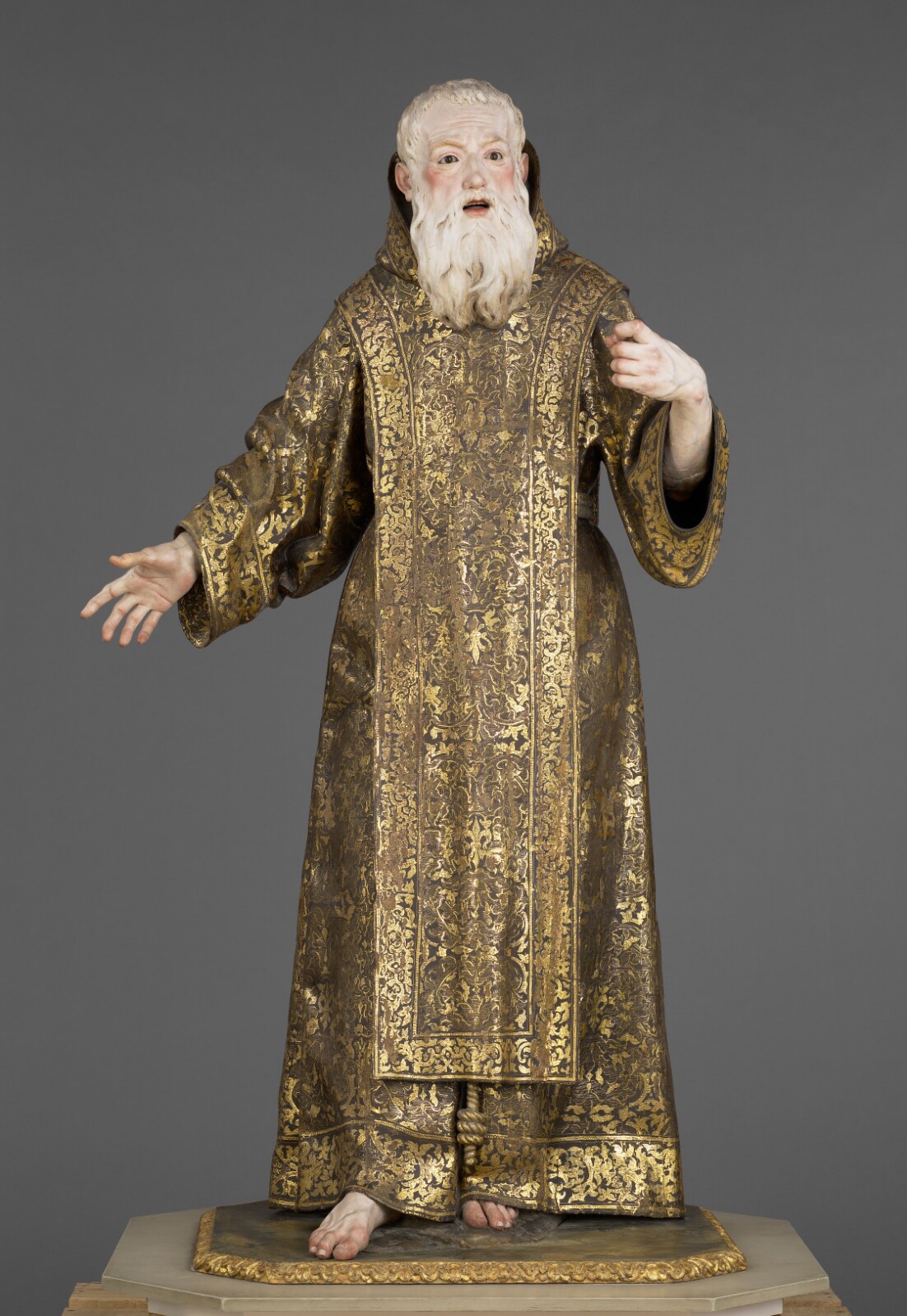
Image context: the cover is the Getty Museum's full-front collection photograph of the work itself, not a diagram or a reconstruction. The forward foot, open mouth, suspended hands, glassy gaze, and black-and-gold robe make the article's question visible before the technical explanation begins: how does joined, hollow wood acquire the pressure of a living encounter?[2][4]
The most revealing view of Luisa Roldán's Saint Ginés de la Jara is the one a gallery visitor cannot ordinarily see: the underside. From there, the saint is unmistakably a construction. Pine and cedar boards make two hollow forms; carved sections attach with joints, dowels, glue, and nails. Yet from the front, the life-size figure appears to step forward and speak. His mouth is open, his right hand reaches outward, and the skin over his knuckles seems thin enough to disclose blood and bone.[2][3][4]
Getty's twelve-minute film, Making a Spanish Polychrome Sculpture, is worth watching because it does not treat this transformation as a single artist's magic trick.[1] Roldán carved the architecture of the body and robe. Her brother-in-law Tomás de los Arcos painted the sculpture, turning gold, gesso, tempera, and oil into brocade and flesh. Glass eyes—probably imported from Venice as prostheses—add another specialized material to the collaboration.[3][4] Lifelikeness emerges not from hiding craft, but from coordinating several crafts so precisely that their boundaries disappear at viewing distance.
That coordination also sharpens Roldán's achievement. Trained in her father Pedro Roldán's Seville workshop, she established an independent operation after marrying and ultimately became sculptor to the royal chamber in Madrid. Saint Ginés, made around 1692 and probably connected to royal patronage, belongs to the moment when her authority was legible both in her title and in her command of monumental wooden form.[3][5] Watch the film first for the sequence of decisions beneath the saint's presence; then look again at the finished figure and notice that every illusion remains materially specific.
The hollow core is a performance technology
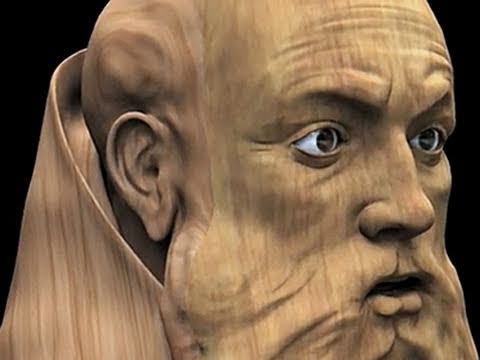
The film's construction sequence overturns the modern expectation that a serious sculpture must begin as one solid mass. Saint Ginés is closer to built architecture. A smaller upper form sits over a larger box; boards carved as heavy folds are assembled around that core; the hands, feet, and face are worked separately and joined. The head's front was carved in place, removed so its interior could be hollowed for the eyes, and then returned.[3]
Hollowness is therefore not an embarrassing secret behind a truthful exterior. It is what lets a figure of this scale be made, handled, and balanced without turning a life-size saint into an immovable timber block. More importantly, construction and expression solve the same problem. The projecting hands can be carved with the delicacy their gesture requires because they are separate pieces. The forward leg can pull the robe into diagonal movement because the body is built as an arrangement, not merely released from a trunk.
That is the first annotation to carry back to the photograph: do not read the joints as evidence against artistic unity. The unity is achieved through joints. Roldán makes assembly serve continuity, just as the open mouth turns a static material into the beginning of speech.
At 5:02, paint becomes excavation
Around the 5:02 mark, the film turns to estofado, the technique used for the saint's robe.[1] The sequence matters because the gold pattern is not simply painted onto a dark surface. De los Arcos first prepared and gilded the carved garment, covered the gold with brown tempera, then incised and punched the upper layer so brilliance reappeared from below.[3][4]
This is painting organized like controlled removal. Roldán had already cut wood to imitate the weight and fall of cloth; de los Arcos then cut through color to make its fictive weave catch light. The robe's realism depends on a productive contradiction: viewers recognize flexible brocade, but the effect comes from some of the least flexible materials in the object—timber, gesso, and metal leaf. The gold does not merely advertise luxury. As the viewer moves, it changes with the light, giving the carved folds a second, optical mobility.
The broader Spanish tradition makes this technical ambition easier to place. The National Gallery's display on seventeenth-century polychrome sculpture emphasized that carving, gesso, flesh painting, drapery decoration, glass eyes, and even ivory teeth operated together in a sustained quest for naturalism.[6] Saint Ginés is extraordinary within that tradition, not outside it. Its illusion is powerful because Roldán and de los Arcos inherited a mature division of skills and pushed those skills toward one coherent presence.
At 8:57, flesh becomes depth
Near 8:57, the film shifts from cloth to encarnaciones, the layered painting of flesh.[1] Thinness is the crucial idea. Glue and gesso prepare the surface; pinkish beige oil establishes skin; blue indicates veins; a translucent flesh-colored layer passes over them; warmer touches return to the knuckles and other living accents.[3] Getty's later close look identifies a palette that included lead white, indigo, cochineal, and charcoal.[4]
The result is not realism through maximum detail. It is realism through selective depth. Veins sit beneath rather than on top of the apparent skin. Red gathers where circulation would become visible. Paint does not cover Roldán's carving indiscriminately; it preserves the modeled bones and tendons while changing how close they seem to the surface. The hand looks vulnerable because carving and color agree about what lies underneath it.
The glass eyes follow the same logic. They are foreign bodies inside the wooden head, yet they make the gaze feel internal. This reverses a simple opposition between authentic material and deceptive addition. The sculpture becomes most convincing where it is most composite. Wood performs as flesh because it is allowed to collaborate with substances that behave differently from wood.
Authorship remains visible inside the illusion
In its closing moments, the film returns the techniques to the family-workshop model, describing this as one of seventeenth-century Spain's tightest collaborative relationships.[1] That ending could have collapsed the work into the familiar story of a lone genius overcoming exclusion. The surviving evidence asks for a more interesting account. Roldán did achieve unusual independence and court status as a woman in seventeenth-century Spain, but her practice grew from family workshops, and Saint Ginés bears the expertise of de los Arcos as polychromer.[3][5]
Naming him does not diminish her. It clarifies what authorship meant in a medium where the desired effect crossed carving, construction, gilding, painting, and inserted materials. Roldán determined the bodily drama: the step, the turn, the carved pressure of veins and bones, the folds that gather and fall. De los Arcos made that drama change register at the surface. The museum's dual credit lets viewers see coordination as part of the accomplishment rather than treating collaboration as noise around a famous name.[2][3]
This is why the hollow underside deserves to remain in mind after the video ends. It does not expose the saint as fake. It reveals presence as engineered: an open structure carrying a carved gesture, an incised field catching light, cool veins held under warm paint, prosthetic eyes aimed beyond the viewer. Spanish Baroque naturalism sought an emotional encounter intense enough to make sacred history feel near.[4][6] Roldán's sculpture achieves that nearness without ceasing to be an object. The saint seems ready to speak precisely because every layer has already learned its part.
Sources
- Getty Museum, “Making a Spanish Polychrome Sculpture” — official YouTube film demonstrating the construction, estofado, and encarnaciones of Saint Ginés de la Jara.
- J. Paul Getty Museum, “Saint Ginés de la Jara” — collection record, object dimensions, materials, maker credits, and Open Content image.
- J. Paul Getty Museum, “La Roldana's Saint Ginés: The Making of a Polychrome Sculpture” — institutional dossier on Roldán's career, hollow construction, glass eyes, estofado, and encarnaciones.
- Meg Butler, “The Startling Realism of a 17th-Century Sculpture,” Getty, 2024 — close visual and material account of the hands, eyes, hollow body, pigments, robe, and animated pose.
- Getty, “The Trailblazing Career of Spanish Baroque Sculptor Luisa Roldán,” 2021 — interview and transcript with Catherine Hall-van den Elsen on Roldán's training, independent workshop, court career, and collaboration with Tomás de los Arcos.
- National Gallery, London, “The Making of a Spanish Polychrome Sculpture” — institutional context on seventeenth-century Spanish carving, gesso, painted flesh, decorated drapery, and the tradition's quest for realism.