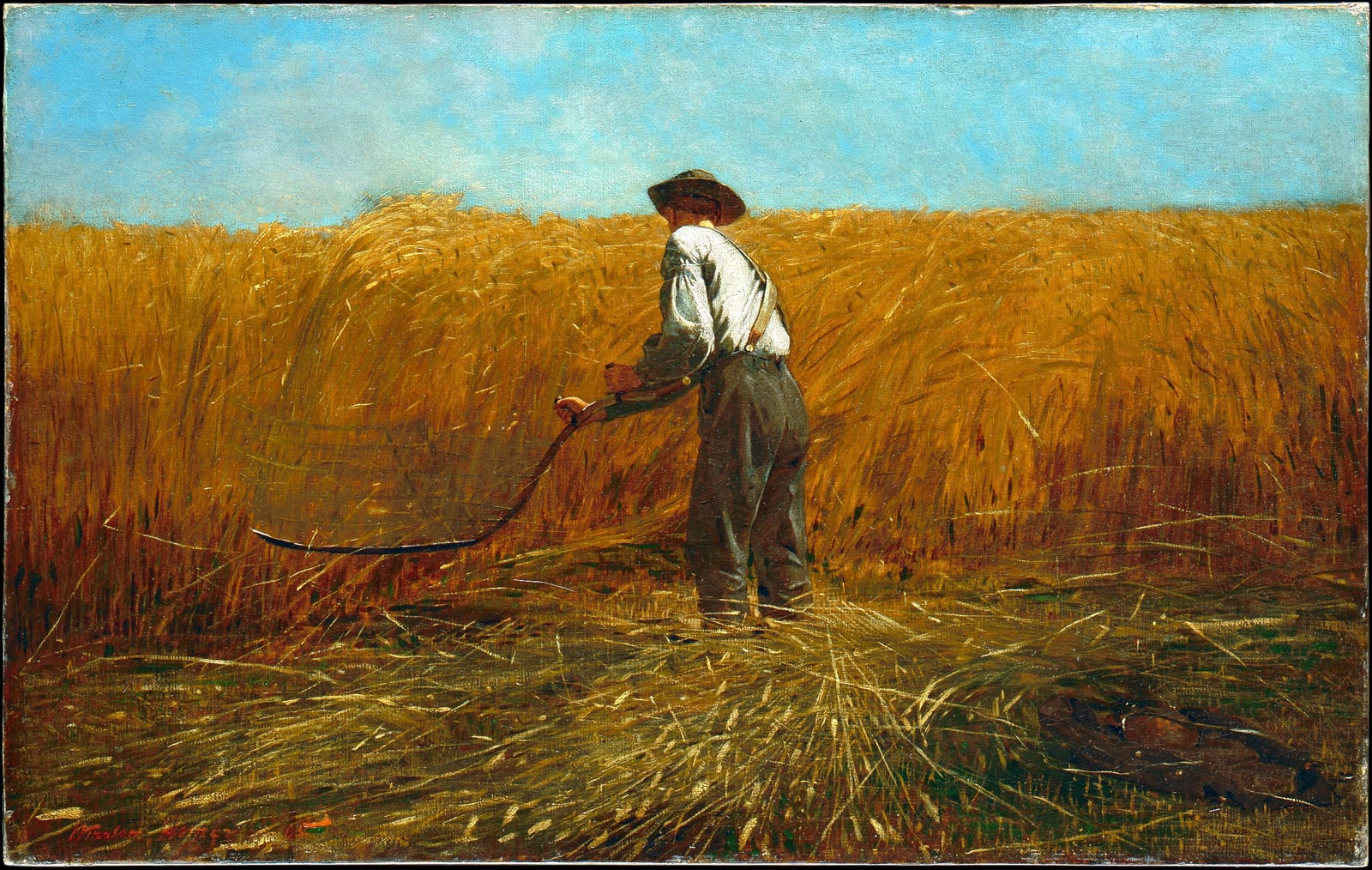
Image context: this is The Met's real photograph of the exact painting, not a generated visual or an analytical graphic. The full-width view matters because Homer's argument is spatial: the uniform almost disappears at the edge, the worker has no face, and wheat occupies far more of the canvas than sky or body.[1]
At first, the painting looks almost indecently clear. A blue sky sits over a yellow field. One man in a white shirt works with his back to us. There is no smoke, no ruined building, no weapon, no second figure. Nothing in the main bands of color announces that the American Civil War has just ended.
Then the lower-right corner changes the scene. A dark Union Army jacket and canteen lie among the cut stalks. The farmer is a veteran; the field is “new” because his former field was a battlefield. The Metropolitan Museum of Art dates Winslow Homer's canvas to 1865 and places its completion after both the Confederate surrender and Abraham Lincoln's assassination.[1] Peace has arrived, but it has not arrived empty.
That distinction is the painting's real subject. The Veteran in a New Field does not show war giving way to innocence. It shows civilian labor beginning while the shape of violence remains inside the work: in an abandoned uniform, a body denied a face, a crop that must be cut, and—most deliberately—in a harvesting tool that Homer revised until it looked less efficient and more like death.
A landscape with nowhere else to look
The canvas is modest in height and emphatically wide: about 61 by 97 centimeters.[1] Homer uses that proportion to establish three blunt elements—wheat, sky, worker—rather than to open a picturesque vista. There is no farmhouse to promise domestic welcome, no tree to offer shade, no fence to measure property, and no road leading home. The field runs laterally beyond both edges.
The horizon sits high enough that wheat dominates. Uncut grain rises behind the veteran to his waist, while a broad apron of fallen stalks opens around his legs in the foreground. He does not stand cleanly outside the landscape; he occupies the seam his work creates. The difference between those two textures supplies the picture's quiet action.
Homer centers the man but withholds the ordinary rewards of a central figure. The broad hat shades his head, his turned back blocks his face, and his trousered legs stand amid the cut straw. We cannot turn him into a psychological portrait by reading an expression. Nor does he strike a commemorative pose. His angled shoulders matter because they belong to work, not display.
This is why the painting's solitude feels double. One person can embody a return to productive life, a reading The Met has emphasized in connecting the image to renewal and to the biblical conversion of weapons into agricultural tools.[1] Yet no family, neighbor, or fellow veteran shares the field. The composition gives recovery the dignity of concentration and the burden of having to begin alone.
The uniform is set down, not erased
The jacket and canteen are small enough to miss on a quick view. They do not sit on a table as attributes in a formal portrait; they have been dropped at the edge of the cut grain. Their low placement makes military identity feel physically shed. The man no longer wears the institution that made him a soldier.
But the objects remain inside the frame. Homer could have identified the worker only through the title, or removed the military trace altogether. Instead, the uniform lies in the same field that is supposed to represent the future. Its darkness catches against the yellow crop, a compressed remainder of another life.
The title performs a similar operation. “Veteran” fixes the past to the body even when the uniform comes off. “New field” promises a changed occupation while repeating the old noun. The veteran has moved from one field to another, but language prevents a clean break between them.
That is more exact than a generic allegory of national healing. Healing suggests that damage closes. Homer's picture shows a change of activity. The soldier can harvest, the jacket can be put down, and the season can continue; none of those acts proves that memory has disappeared.
Homer painted the useful part away
The most consequential evidence lies beneath the visible blade.
The Met's material study explains that Homer first painted a cradled scythe. Parallel wooden fingers attached to the handle would catch the cut wheat and help lay it in a manageable row. He then painted those parts out. As the upper paint film became more transparent with age, the alteration—the pentimento—began to show.[2]
This was not a minor correction to anatomy. It changed what kind of labor the picture describes. A cradle made the tool specific to contemporary grain harvesting and made the worker's movement easier to understand as agricultural technique. Removing it left a single curved blade with an older and more immediately symbolic silhouette. The museum connects that revision to the Grim Reaper and to the death the veteran would have witnessed.[2]
Art historian Randall Griffin pushes the contradiction further. He describes the single blade as anachronistic: it can evoke an older, Arcadian ideal of rural life, yet it can also recall the savagery of battle.[5] The same simplification therefore points both toward an imagined peaceful past and back toward recent violence.
What the painting loses as an account of efficient farming, it gains as an account of memory. Homer did not merely find a peaceful tool that happened to resemble a weapon. He began with the more workmanlike form and chose to suppress its useful framework. The act of revision made reaping harder to separate from killing.
That choice unsettles the wheat itself. A ripe field conventionally promises food, continuity, and abundance. Here, its beauty depends on readiness to be severed. The worker's arc divides standing grain from fallen grain just as surely as the composition divides blue from gold. Harvest is renewal, but renewal proceeds by cutting. Homer lets both meanings remain active.
Two calendars occupy the same summer
The painting belongs to the summer of 1865, an intensely compressed historical moment. The Met situates it after surrender and assassination; its curatorial account reads the harvest as recovery while acknowledging the scythe's mortal association.[1] Those are not competing captions pasted onto an otherwise neutral farm scene. Homer builds them into different timescales.
Agricultural time is cyclical. Seed, growth, harvest, and planting imply another season. The field offers futurity without needing a monument or flag. Political time, however, has just broken: a four-year war has ended, the president has been killed, and millions of people must negotiate new legal and social realities. The discarded jacket belongs to that irreversible sequence.
The bright sky intensifies rather than resolves the clash. Weather shows no sign of history. Wheat grows without acknowledging whether the man cutting it has returned from victory, captivity, injury, or grief. The apparent calm is therefore not proof that the world has healed; it is the impersonal condition under which he must work.
Stephanie Herdrich's meditation for The Met rightly finds solace in the predictable seasons and the veteran's return to nourishing labor.[3] The painting can sustain that response. But solace here is not amnesia. The field is reassuring because growth continues, and haunting because continuation is not the same thing as restoration.
A national image with a visible boundary
It is tempting to promote this lone veteran into “the nation” and let his harvest stand for Reconstruction as a whole. The picture is too bounded for that claim.
The Smithsonian American Art Museum's exhibition The Civil War and American Art placed Homer within a larger visual field in which genre and landscape painting addressed emancipation, reconciliation, and the war's transformative impact, while battlefield photography carried the immediate record of carnage.[6] The Met's later Crosscurrents catalogue likewise frames Homer's Civil War and Reconstruction work as an exploration of unresolved effects on landscapes, soldiers, and formerly enslaved people.[7]
The Veteran in a New Field touches two parts of that history with great force: a landscape and a returning Union soldier. It does not show formerly enslaved people, the defeated Confederacy, political institutions, bereaved families, or the struggle over citizenship. Its specificity is a strength only if the viewer preserves that limit. One man's return cannot certify a reconciled country.
The Union jacket also resists a placeless reading. However anonymous the back-turned worker becomes, he is not an abstract veteran of every army. His discarded clothing identifies a side. The painting's quiet cannot be detached from the result of the war without discarding evidence Homer deliberately left in view.
Print tried to make the return more certain
The image soon entered a different public life. A wood engraving after the painting appeared in 1867; the Brooklyn Museum preserves an impression and notes that its accompanying periodical text treated soldiers' return to civilian usefulness as evidence of republican strength.[4] In print, the solitary worker could serve a confident civic story: the army disbands, citizens resume productive roles, government endures.
The Met's 1982 Homer bulletin records a revealing change in that translation. The printed version omitted the insignia on the canteen, making the veteran less specifically identifiable as a Union soldier.[8] Reproduction widened the image's usefulness by smoothing away some of its historical particularity.
The oil painting remains less settled. Its uniform persists. Its altered scythe preserves a decision to make death more visible. Even the pentimento complicates finality: the tool Homer tried to revise still carries a faint record of what it used to be.
That material afterimage is the painting in miniature. Civilian life is real, productive, and bright; war is no longer the visible occupation. Yet the former structure has not vanished. It shows through.
Homer gives the veteran no face because the work does not need a private confession to make that condition legible. The back, the blade, the uniform, and the divided wheat do enough. Peace is not pictured as forgetting what happened in the old field. It is pictured as the difficult work of entering a new one while the blade still remembers.
Sources
- The Metropolitan Museum of Art, “Winslow Homer, The Veteran in a New Field, 1865” — official object record, curatorial interpretation, dimensions, collection data, and source page for the museum photograph used as the cover.
- Katie Steiner, “Material Changes,” The Metropolitan Museum of Art (2010) — museum account of the visible pentimento, the original cradled scythe, Homer's removal of its parallel fingers, and the resulting Grim Reaper association.
- Stephanie L. Herdrich and The Digital Editors, “Art for Solace: Winslow Homer's The Veteran in a New Field and More,” The Metropolitan Museum of Art (2020) — curatorial reading of seasonal continuity, wartime context, discarded uniform, labor, and solace.
- Brooklyn Museum, “The Veteran in a New Field,” 1867 — official record for the wood engraving and its accompanying periodical framing of demobilization and civilian usefulness.
- Penn State University Press, Randall C. Griffin, Homer, Eakins, and Anshutz: The Search for American Identity in the Gilded Age — publisher overview of the painting's contradictory national meanings and the single-bladed scythe's Arcadian and violent associations.
- Smithsonian American Art Museum, “The Civil War and American Art” — official exhibition framework for genre painting, landscape, battlefield photography, emancipation, reconciliation, and the war's visual aftermath.
- Stephanie L. Herdrich and Sylvia Yount, eds., Winslow Homer: Crosscurrents, The Metropolitan Museum of Art (2022) — official publication overview situating Homer's Civil War and Reconstruction paintings within unresolved effects on land, soldiers, and formerly enslaved people.
- Natalie Spassky, “Winslow Homer at The Metropolitan Museum of Art,” The Metropolitan Museum of Art Bulletin 39, no. 4 (1982) — museum publication on the painting's place in Homer's early career and the Union insignia omitted from its wood-engraved version.