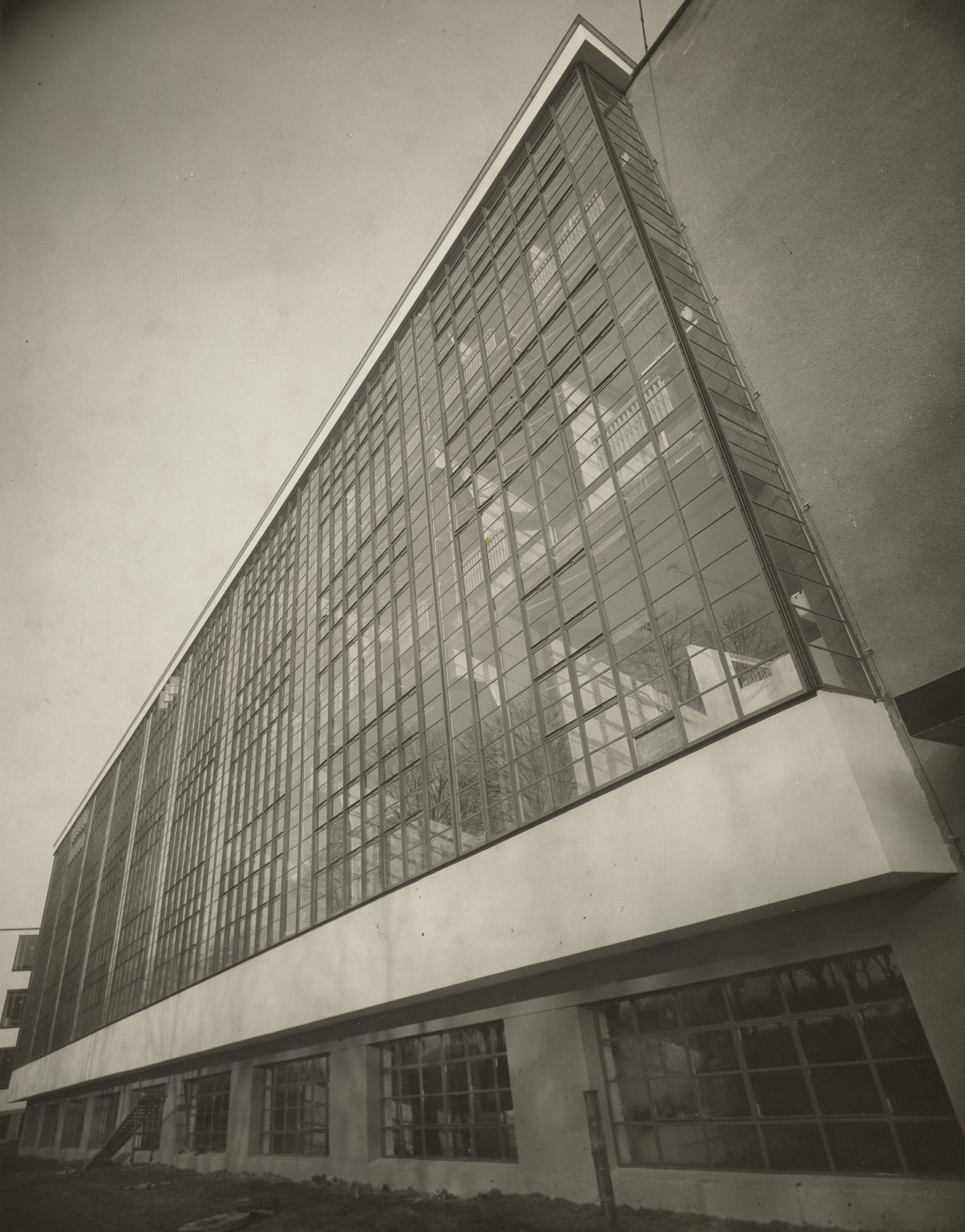
The building rises; the camera refuses to stand politely in front of it. In Lucia Moholy's Bauhaus Workshop Building from Below. Oblique View, the glass facade becomes a steep field of intersecting lines. The low viewpoint makes looking at architecture feel physical: we seem to tip our heads back before we have finished identifying the windows. Moholy made the negative in September 1926. MoMA dates its print to 1926–35.[1]
That distinction between an exposure and a print will become consequential. A photograph can be made once, printed again, and sent into another life in a book or exhibition. Its subject may acquire a reputation with each appearance. Its photographer may gain nothing.
Moholy's career makes those different fortunes painfully visible. Her pictures helped establish the Bauhaus's public identity, yet her own place in that identity became difficult to recover. Looking closely at her work means following both the decisions inside the frame and the material that allowed the frame to circulate.[3][4]
A photographer with an editor's experience
Born Lucia Schulz in Prague in 1894, Moholy worked in publishing before she became associated with the Bauhaus. She edited for several houses, including Rowohlt, and published literary work under the name Ulrich Steffen. She married László Moholy-Nagy in 1921; when he joined the Bauhaus in Weimar in 1923, she began a photographic apprenticeship while photographing the school's workshop objects for publication. Further training in photographic and printing techniques followed in Leipzig.[2]
This was a practical education in how an object becomes an image and how an image reaches a reader. The editor's work and the photographer's work meet at the page: selection, arrangement, legibility. Her subsequent photographs of buildings, products and people gave the school a visual record suited to reproduction.[2]
Her institutional position was less secure than that importance suggests. She was not employed by the Bauhaus, as the Bröhan Museum stresses in its retrospective account. Yet the same museum identifies her technical command and architectural compositions as central to the school's public reputation.[3] The familiar institution depended on work performed from its margins.
The building has a photographer
Return to the workshop facade. The structure supplies the grid; Moholy decides how that grid reaches us. Seen from below and off to one side, repetition becomes acceleration. Window divisions that might look reassuring in a level view seem to pull the eye upward and away.
This is my reading of the photograph's effect, rather than a claim about a recorded instruction from Moholy. The distinction matters because architectural photography can look so informative that its choices become invisible. We learn what the building looks like and forget that someone chose where to stand.
Try imagining a photograph taken from farther away, with the whole building comfortably contained. It could explain the arrangement of the wings more readily. Moholy's closer, oblique view gives us another experience: the relationship between a body near the wall and a facade extending beyond its reach. Her photograph makes modern architecture available as a sensation as well as a design.
There is a smaller, firmer statement of authorship on the physical print. MoMA records a stamp on its reverse naming Lucia Moholy and prohibiting reproduction without permission.[1] The museum's description lets us connect the exhilarating view on the front with a working photographer's claim on the back. She understood that making the picture and controlling its reproduction belonged together.
An archive separated from its maker
When Moholy fled Nazi Germany in 1933, she left her glass negatives behind. They eventually came under Walter Gropius's control. MoMA's 1938 Bauhaus exhibition catalogue reproduced 49 of her photographs without naming her.[4]
Robin Schuldenfrei's archival research reconstructs the dispute. In February 1954, Gropius acknowledged possessing the negatives and offered contact prints. Moholy maintained that she had never given the originals away. Legal negotiations brought a partial return in 1957. Schuldenfrei's 2013 account records 230 surviving Bauhaus negatives against 560 in Moholy's catalogue.[4]
Her insistence had a practical basis. A contact print supplies an image to look at; the negative is the working source for further prints. Retaining it withheld part of her practice. The loss affected her ability to use her own work.[4]
Another life for the document
The dispute was only one part of a much longer career. In London, Moholy published A Hundred Years of Photography: 1839–1939. Museum Ludwig's account emphasizes the book's intellectual ambition: she placed photographic abstraction alongside abstract painting and connected contemporary photograms with the medium's earlier experiments. Her knowledge of photographic processes supported an argument about creative expression.[5]
A photogram makes an image through objects and light acting directly on sensitive material. Moholy had experimented with the process alongside Moholy-Nagy. In her history, such work belonged to photography's possibilities, rather than occupying an embarrassing fringe beyond useful description.[5] The woman whose architectural pictures could be mistaken for transparent information also wrote about the medium's capacity to invent.
Her later work gave reproduction another purpose. Following the destruction of her London studio and apartment in the Blitz, she moved into documentary services, eventually directing ASLIB's microfilm service. She established her own Documentation Service in 1946. As a UNESCO expert in Ankara in 1952–53, she helped set up a microfilm centre and laboratory for the National Library; a later assignment included manuscript preservation.[6]
These activities suggest a continuity worth keeping in view: photographs could preserve something, make it available elsewhere, and change who had access to it. That is an interpretation of the career, not evidence that she designed every move around a single principle. Exile and destruction forced changes that no elegant retrospective should smooth away.
Look once more at the rising facade. Its precision can make the photograph seem inevitable, as though the building delivered its own image. The angle breaks that illusion. Someone stood there. Someone chose the frame. The building's history is richer when we remember hers.
Sources
- The Museum of Modern Art, “Bauhaus Workshop Building from Below. Oblique View,” Object:Photo — negative and print dates, reproduction of the photograph, collection record and verso stamp.
- Bauhaus Kooperation, “Lucia Moholy” — biographical record covering publishing, photographic training and work in Weimar and Dessau.
- Bröhan Museum, “Lucia Moholy – The Image of Modernity,” 2022–23 — exhibition account of her architectural photography and institutional position.
- Robin Schuldenfrei, “Images in Exile: Lucia Moholy's Bauhaus Negatives and the Construction of the Bauhaus Legacy,” History of Photography 37, no. 2 (2013), especially pp. 194–197 — archival correspondence, uncredited publication and the return of the negatives.
- Museum Ludwig, “Lucia Moholy: Writing Photography's History,” 2019–20 — her 1939 book, photograms and argument for photography as creative expression.
- Fotostiftung Schweiz, Lucia Moholy – Exposures, exhibition leaflet (2025), English text — London, wartime losses, documentary services and UNESCO work in Ankara.