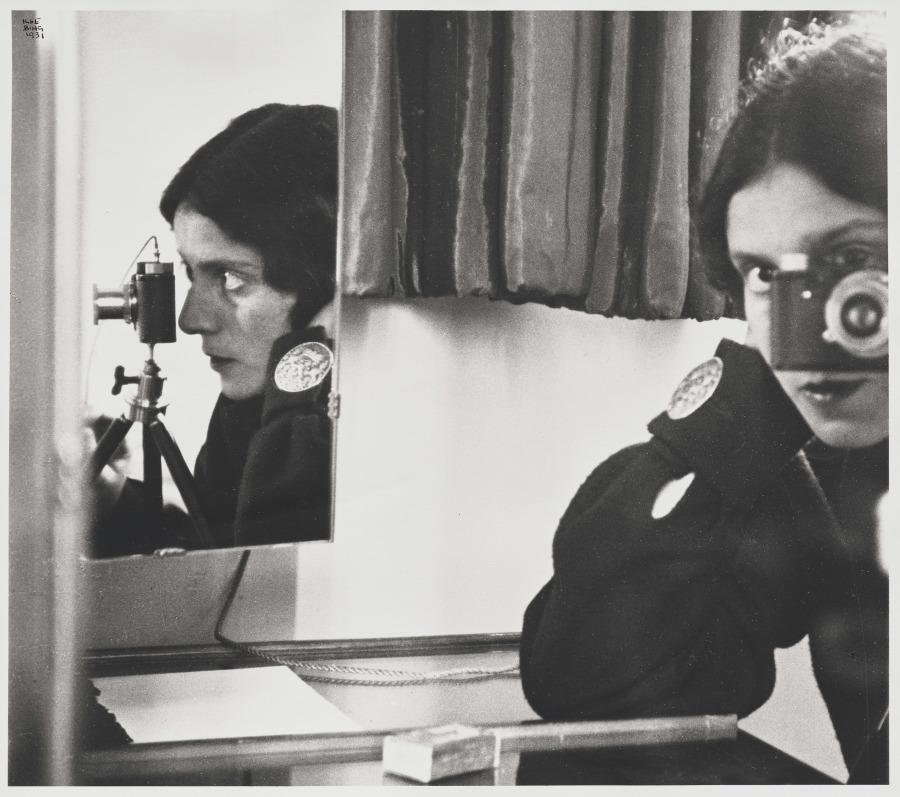
Ilse Bing looks out from behind a camera, then appears again to the left, in profile. The second face offers a way around the obstruction of the first. Follow it, however, and the camera reappears too. In her 1931 Self-Portrait with Mirrors, the instrument belongs to the likeness as insistently as the eyes do.[1]
There is an elegant complication here: both views are reflections. The face that seems to meet us directly has no special claim to being the unmediated original. Bing arranged two mirrors to put frontal and profile views into the same photograph, a construction the Cleveland Museum of Art describes as a meeting of photography’s documentary and illusion-making capacities.[1] The picture shows a real person at a real camera. It also makes our access to that person visibly dependent on an arrangement.
Two faces, one exposure
Begin with the larger face. Its proximity to the Leica makes looking seem like work: an eye must find its position, a hand must remain near the mechanism, a head must accommodate the apparatus. The camera interrupts the conventional pleasure of reading a portrait through an unobstructed expression.
Now shift left. The smaller mirror supplies another angle, but it also draws a rectangle inside the photograph’s rectangle. It gives us more information while emphasizing a boundary. We can see around part of the larger view only by accepting another frame.
The two images do different jobs. The frontal view brings the photographer close to the viewer; the profile lets us examine the relationship between face and equipment from the side. Our attention travels between recognition and observation. We encounter a person, then inspect how that encounter is being produced.
This is a reading of the composition, rather than a claim about Bing’s private state of mind. The doubled face need not mean a divided personality. Its more immediate achievement is spatial: a single exposure holds together views that an ordinary portrait would keep apart. The pleasure lies in being able to understand the trick without exhausting what it does.
The tool earns its place
The University of Notre Dame’s collection commentary connects Bing’s visible camera with the brushes, palettes, and easels of painters’ self-portraits.[2] Those objects identify a profession while showing what the profession requires. Here, the Leica does more than announce that Bing is a photographer. It occupies space we might otherwise devote entirely to her face.
That placement changes the terms of the portrait. A viewer accustomed to having a sitter available for inspection must reckon with a sitter who is also directing the inspection. Bing supplies the image, operates its means of production, and appears within it. Read this way, the photograph makes professional authorship part of what a likeness can disclose.
The work sits at an early point in her commitment to that profession. According to the V&A, Bing bought a Leica in 1929, abandoned her doctoral thesis that summer, and moved to Paris in 1930. There she worked across photojournalism, architecture, theatre, advertising, fashion, and portraiture.[3] The small camera in the self-portrait was a working instrument within that varied practice.
Its presence also introduces a productive pause. The Leica’s portability helped photographers respond to movement; the V&A identifies Bing as an early adopter of its small format.[4] Here she uses it for a carefully arranged encounter in a room. The technology’s freedom includes the freedom to stop, set something up, and examine the conditions of looking.
The picture never becomes a bare demonstration of optics. Dark clothing, the curtain, and the pale face keep the geometry attached to surfaces and a body. Notre Dame’s account calls attention to the large cuff button and to the objects along the lower edge, details that complicate the arrangement’s formality.[2] The room remains inhabited even while its reflections become an experiment.
A photograph has more than one date
“1931” identifies the making of the image, but individual prints can carry later histories. Cleveland dates the gelatin silver print reproduced here to 1931, printed in the 1980s.[1] The V&A reproduces a self-portrait photographed in 1931 and printed in 1988.[4] These records should not be collapsed into one physical object with one printing date.
The distinction matters because a photographic work can return to view through a newly made print. The V&A notes that renewed interest in Bing’s work prompted printing in the 1980s and 1990s, and that her bequest included both early and later prints.[4] A youthful self-portrait could therefore become an object made and circulated much later in the artist’s life.
That history gives the image another kind of doubleness, separate from the mirrors: the moment pictured and the moment of its material return. It does not change where Bing placed the camera. It changes what it means to encounter that placement as a surviving photograph.
Go back to the space between the two faces. The eye crosses it easily, but each crossing changes our position toward the photographer. We look at her, look alongside her, and become aware of the machine through which she has made herself available. The camera never leaves the portrait. Bing has given it a place we cannot comfortably look past.
Sources
- Cleveland Museum of Art, “Self-Portrait with Mirrors” — image source, accession 2019.177; two-mirror construction, reflection, and the distinction between the 1931 image and its 1980s print.
- University of Notre Dame, Raclin Murphy Museum of Art, “Self-Portrait with Mirrors” — collection commentary drawn from David Acton’s A History of Photography at the University of Notre Dame: Twentieth Century (2019), on artists’ tools and the picture’s material details.
- Victoria and Albert Museum, “Ilse Bing – life and work” — updated April 17, 2024; purchase of the Leica, departure from doctoral work, move to Paris, and commercial practice.
- Victoria and Albert Museum, “Ilse Bing – working methods” — updated April 17, 2024; camera use, printing, renewed interest in her work, and the museum’s 1988 self-portrait print.