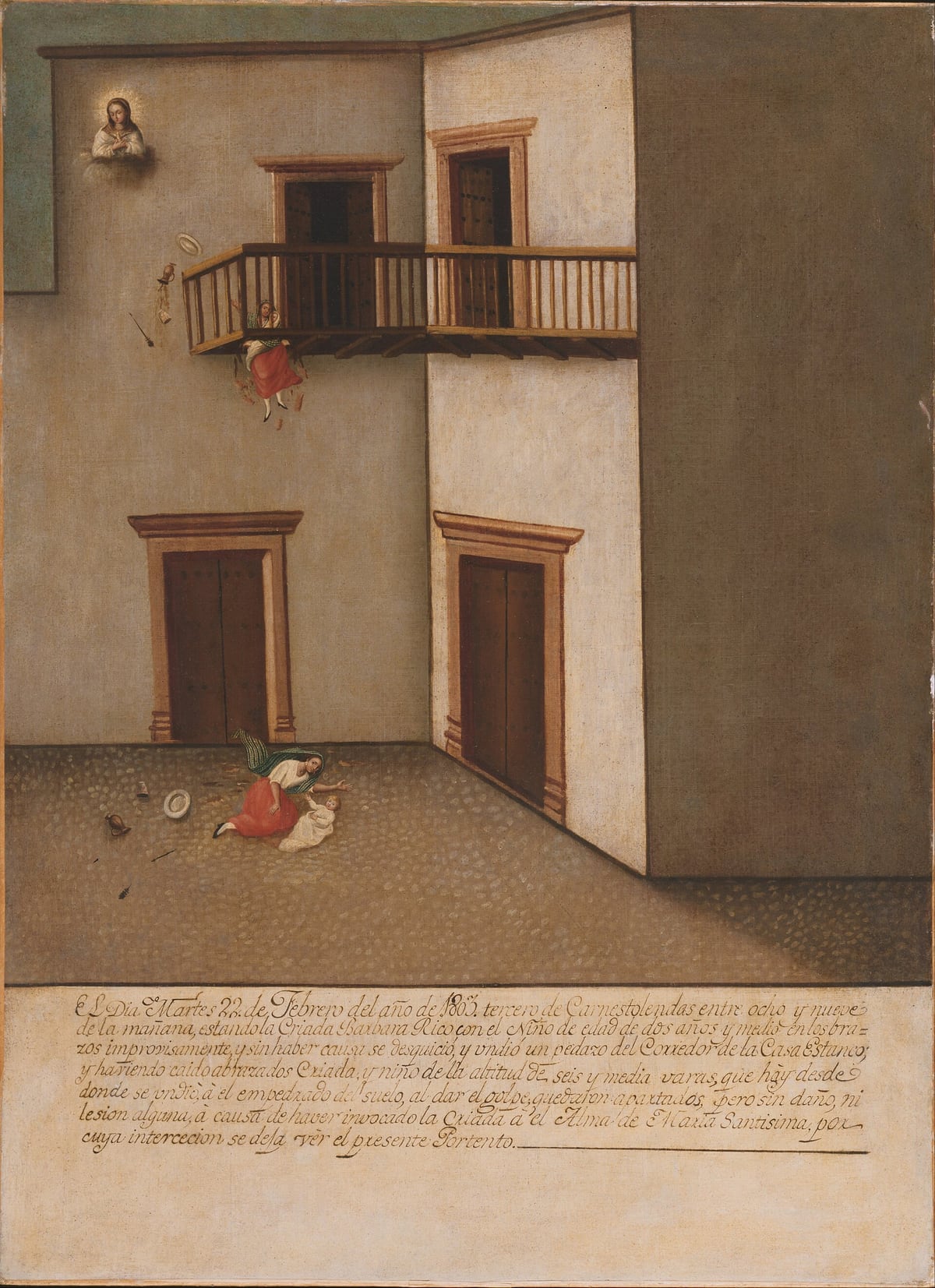
The balcony gives way in the upper half of the painting. A maidservant in a red skirt drops through its broken corner with a small child in her arms. Dishes, utensils, and splinters scatter around them. Then, without a border or a second panel, the same woman appears again below, kneeling beside the child on the cobbles. The dishes have landed too, and none appears broken.
The anonymous Mexican painting known as Fall from a Balcony, made around 1803, does not ask what will happen next. Its inscription has already supplied the ending: Bárbara Rico and the two-and-a-half-year-old child survived a fall of six and a half yards without injury after she appealed to the Virgin Mary.[1] Suspense has been replaced by testimony. We see danger because danger has passed, and the picture exists because someone considered survival a debt that needed a visible form.
That backward pressure is the distinctive force of the painted ex-voto. The Latin phrase means, in essence, an offering made in fulfillment of a vow. In Mexico, such works were given to Christ, the Virgin, or saints in thanks for aid received; they joined image and words, then entered a church or shrine where private crisis became publicly legible gratitude.[1][2] An ex-voto therefore begins where a disaster story usually stops. Its subject is not simply the fall, illness, gunshot, or dangerous journey. Its subject is the act of returning to the event after survival and assigning that survival meaning.
The picture holds two times without dividing the surface
The painter could have shown the instant of rescue as one frozen scene. Instead, Fall from a Balcony makes the eye perform a sequence. Rico first hangs beneath the snapped balcony, her body nearly vertical, while fragments and household objects describe several small trajectories through the air. Below, her second body bends toward the child. The repeated red skirt connects the two moments faster than any written instruction could. We register one person twice and understand that time—not identity—has changed.[1]
The architecture refuses to share the panic. Four brown doorways, pale walls, and a steep cobbled floor build a shallow, boxlike courtyard. Their rigid verticals make the broken left corner of the balcony feel more abrupt. Yet the building is also strangely empty. No neighbor rushes out; no crowd witnesses the fall. The scene's only earthly adult is Rico herself, doubled into victim and survivor. This visual economy makes her body carry both the accident and its proof.
The Virgin occupies a small patch of cloud at upper left. She is much smaller than the falling woman and child, but she sits outside the courtyard's perspective and outside its sequence. Her scale does not measure physical distance. It marks a different order of presence. The composition lets causation move diagonally: an appeal rises from the accident, divine attention enters from above, and the eye lands on the unharmed pair below. Whether a viewer accepts that causation as belief or studies it as material culture, the painting makes the claim with remarkable clarity.
Most striking is what this image does not erase. The moment of terror remains suspended beside its harmless end. In Fall from a Balcony, gratitude becomes legible through the preservation of what almost happened. The painting refuses to let safety blur the exact shape of danger.
The inscription is part of the event
Beneath the courtyard, a broad band of cursive writing fixes the episode to a Tuesday morning: February 22, 1803, between eight and nine. It identifies Rico as a maidservant, gives the child's age, measures the height, names the cobbled ground, and attributes their escape from injury to Mary's intercession.[1] Those particulars do more than caption the picture. They change its voice.
Without the inscription, the doubled woman, unharmed child, and hovering Virgin would still make accident and deliverance broadly legible. We would not know Rico's name and occupation, the child's age, the hour and height of the fall, or the precise claim about whom she invoked. Without the image, the account would retain those facts but lose the impossible simultaneity that makes danger and safety available in one glance. The ex-voto is not illustration plus label. Word and image divide the work of witnessing: the painting compresses a sequence, while the text makes its claim accountable.
That partnership complicates authorship at the level of the genre, but the boundary matters. The maker of Fall from a Balcony is unknown, as are the precise circumstances of its commission. In later Mexican practice, the specialist painter could be called a retablero or milagrero. An INAH account notes that, in some cases, such a painter made the image while the devotee who ordered it supplied the written story.[2] There is no evidence that this was the division of labor here. The later practice instead shows how a painted ex-voto could join different kinds of knowledge: a practitioner's compact visual grammar and a patron's names, measures, and remembered sequence.
Calling the work anonymous should not make its voice seem generic. It is almost aggressively specific. The woman has a name and an occupation. The child has an age. The fall has a height and an hour. The ground has a texture. Individual authorship recedes, but individual experience does not.
Canvas becomes tin, and the form moves closer to everyday life
At roughly 34 by 24½ inches, Fall from a Balcony is larger and more costly than the small tin ex-votos that later became strongly associated with the form. The Philadelphia Museum of Art places it in the colonial-era practice of oil painting on canvas, affordable chiefly to wealthier patrons. After Mexican independence in 1821, inexpensive sheets of tin helped painted ex-votos become far more widespread.[1] A recent UNAM study likewise describes a nineteenth-century broadening of the form as old guild structures weakened and painted votive offerings entered popular visual culture.[3]
The change of support mattered aesthetically. A small metal sheet encourages compression: holy figure, crisis, beneficiary, landscape or room, and inscription must coexist in a hand-scaled field. It also brought the form into contact with a wider range of ordinary hazards. The Museo Amparo's survey describes generations commissioning thanks for release from dangers, illnesses, and other misfortunes.[4] One work in that collection records Luis Méndez's 1936 fall from an automobile and the recovery he attributed to the Señor del Hospital on a modest sheet painted in oil.[5]
The comparison reveals how little the form depended on a single storytelling formula. Fall from a Balcony shows the accident twice and lets the Virgin hover at its edge. Museo Amparo's description of the Méndez retablo, by contrast, places the Señor del Hospital between two kneeling figures with candles; the automobile fall survives in the inscription rather than in a painted action scene.[5] One work organizes its narrative around the endangered body, while the other gives its painted action to the completed act of thanks. Image and text remain partners, but they renegotiate which one carries the crisis.
These are not interchangeable miracle scenes. Their shared structure makes difference visible. One person falls through domestic architecture; another falls from an automobile more than a century later. Across collections, sickrooms, city and country accidents, illness, migration, and violence enter the pictures.[2] The format repeats, but the pressures that enter it change. Their specificity lets historians approach ex-votos as cultural memory and evidence of social organization without setting aside their devotional purpose.[2][3]
Still, treating them only as data would flatten them. An ex-voto is not an accidental census form with charming pictures. It was made to complete a relation: help was requested, help was believed to have arrived, and thanks had to be offered. The practical details carry historical information because devotion insisted that the event be particular.
What the collection photograph leaves outside
Painted ex-votos were made to be offered, commonly in a church or shrine, where they thanked the sacred figure credited with intervention and made that intervention visible to other visitors.[1][2][4] Their public life was part of what they did, not merely where they happened to hang. An individual emergency entered a field of other appeals and thanks.
The sources cited here do not establish where Fall from a Balcony was first displayed or what surrounded it. That uncertainty is worth keeping visible. The museum and its archival photograph preserve another kind of access: attribution where possible, measurements, inscription, and a surface that can be studied far from the object. At the same time, a collection page trains the viewer to treat the painting as a self-contained composition. The genre asks for a second reading—as one completed gesture in a devotional exchange, potentially seen beside other offerings rather than alone.[1][2][4]
The museum viewer should resist converting belief into quaintness or visual ingenuity into naïveté. The painting is controlled. Its empty walls make a stage; its repeated red makes time readable; its zones allocate earthly danger, divine agency, and verbal record with precision. The archival image can show all of that. What it cannot reproduce is the social and ritual setting in which an offered picture of thanks acquired its full address.
The work's deepest reversal happens after looking. At first, the picture seems to turn a miracle into a scene. In fact, it turns a scene into an obligation. Bárbara Rico falls forever, but she falls inside an object made only because she also rose. The ex-voto keeps catastrophe present without granting it the final word.
Sources
- Philadelphia Museum of Art, Fall from a Balcony educational object resource — work metadata, visual account, inscription translation, and history of Mexican painted ex-votos.
- Violeta Tavizón Mondragón, “El exvoto: intercesor entre lo divino y lo humano,” Instituto Nacional de Antropología e Historia — devotional function, popularization, workshop roles, and ex-votos as records of everyday life.
- Araceli Herrera Cruz, “Exvotos mexicanos: Análisis iconográfico e importancia de su preservación en la memoria cultural,” Universidad Nacional Autónoma de México, 2025 — historical development and cultural-memory argument.
- Clara Bargellini Cioni, Testimonios de fe: Colección de Exvotos del Museo Amparo, Museo Amparo, 2018 — digital collection study of painted thanks for deliverance from danger, illness, and other misfortune.
- Museo Amparo, “Retablo al Señor del Hospital” — collection record for an anonymous 1936 oil-on-metal ex-voto concerning Luis Méndez's fall from an automobile.
- Wikimedia Commons, “Maker unknown, Mexican — Fall from a Balcony — Google Art Project” — public-domain archival reproduction from the Philadelphia Museum of Art used as the article image.