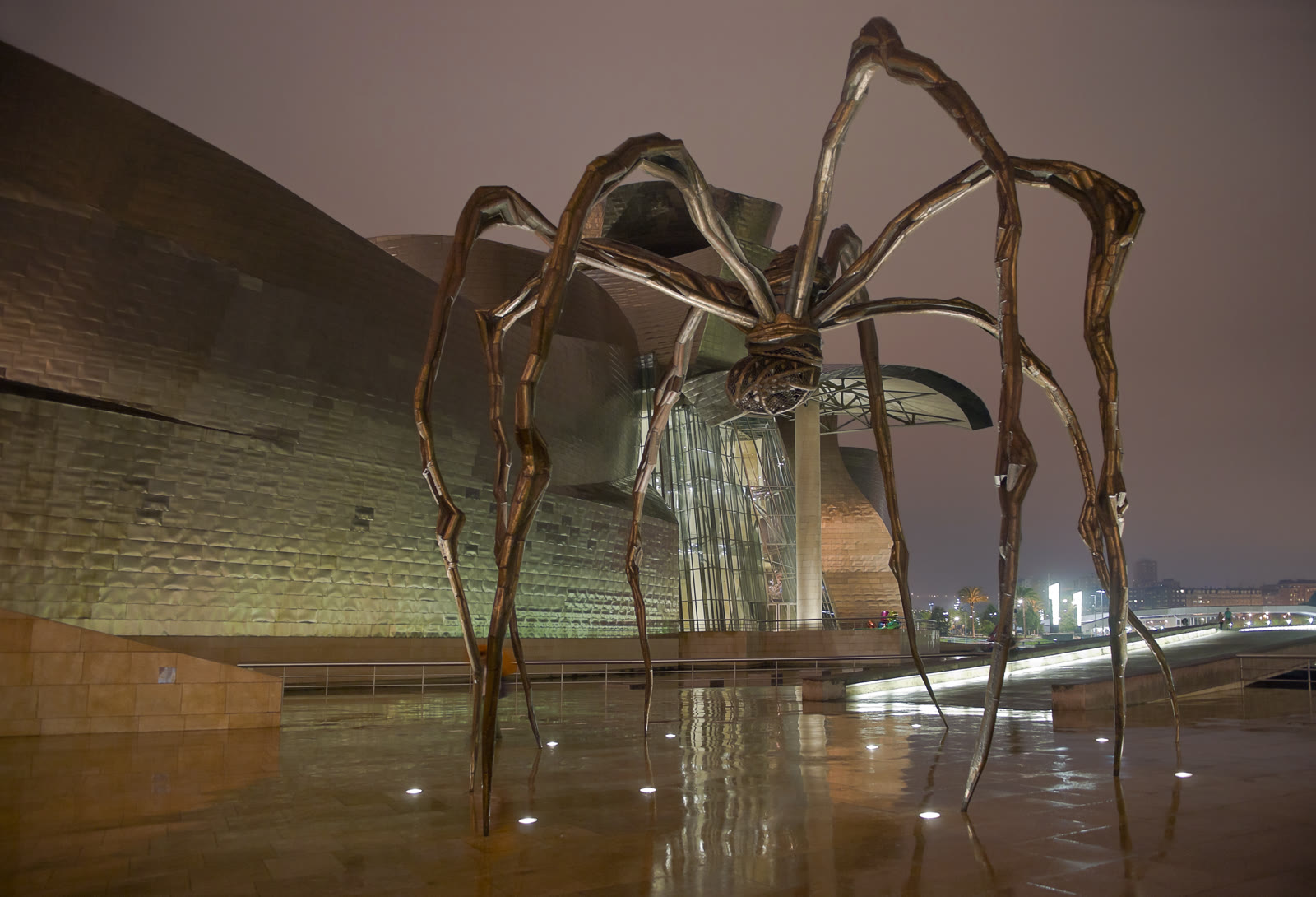
Louise Bourgeois is one of those artists whose fame is almost too efficient. Mention her name and many people can already picture the spider. The image is so strong that it threatens to flatten everything around it: the drawings, the hanging fabric, the cells, the stacked emotional weather of rooms that feel half domestic and half judicial.[1][4][5] But the spider only makes full sense when it is placed back inside the larger Bourgeois project. She was not simply making confessional sculpture at monumental scale. She was building structures in which memory could behave like architecture.
That is what gives her work its peculiar force. In Bourgeois, memory is never soft background. It has doors, corners, bars, cloth, needles, cages, spirals, and suspended bodies. The private world does not stay private. It becomes spatial, public, and material.[1][2][3] A childhood feeling can return as a room you enter. A parent can return as a creature. Repair can return as an aesthetic method that still leaves the seam exposed.
Image context: the cover uses a documentary photograph of Maman outside the Guggenheim Museum Bilbao. That is the right image for this profile because the sculpture is not only one late masterpiece; it is a clean visual summary of Bourgeois's whole method: terror and tenderness sharing one engineered form.[6][7]
1) Repair came first
Bourgeois was born in Paris in 1911 and grew up around her family's tapestry restoration business, a fact that matters far beyond biographical color.[1][5] Restoration is not the same thing as innocence. It means damage is already assumed. It means the task is to handle breakage without pretending it never happened. Bourgeois carried that logic into art. Even when the work is not literally sewn or patched, it thinks in terms of mending, replacing, suspending, and reassembling.
She studied in Paris, then moved to New York in 1938, where the early career quickly began to split away from any narrow definition of painting or sculpture.[1][2][5] The Met's exhibition on her paintings is useful here because it restores how early the key tensions already were. Houses fuse with bodies. interiors behave like psychology. Female identity appears as both enclosure and construction.[2] Bourgeois did not arrive at the "cell" late by accident. The room was already there in embryo.
That is why the usual trauma shorthand is too small for her. Yes, the work is charged by family history and betrayal, and Bourgeois herself repeatedly invited psychoanalytic reading.[1][5] But what makes the art endure is formal intelligence. She could take a loaded subject and give it a durable structure. The feeling becomes legible because the form has been built hard enough to hold it.
2) From standing figures to rooms you cannot quite leave
In New York, Bourgeois's Personages already suggest that human presence could be treated architecturally: upright, totemic, arranged in relation, hovering between body and built environment.[1][4] The later Cells make that insight unmistakable. By the time she begins constructing cages, chambers, doors, and enclosed scenes in the 1990s, the work is not turning away from the body. It is showing how the body stores itself in spaces.[1][4]
The Reina Sofia's Memory and Architecture framing is crucial because it catches Bourgeois thinking through architecture not as neutral setting but as existential pressure.[3] Buildings in that project are never only buildings. They are states of mind, social distances, moral jokes, and loneliness given vertical form.[3] That same logic later expands in the Cells: a room can be a memory theater, but it can also be a trial chamber in which memory refuses to settle into one meaning.
This is where Bourgeois separates herself from more decorative ideas of installation. Her spaces are not immersive for the sake of spectacle. They are diagnostic. A doorframe, a mirror, a steel grid, a hanging garment, or a bed frame becomes a way to test what remains of a person after experience has been stored and replayed too many times.[2][3][4]
3) Why the spider is more than menace
Then there is the spider, the work that made Bourgeois unavoidable even for people who do not follow contemporary art. The Guggenheim Bilbao's page on Maman anchors the basics: a monumental spider from 1999, towering but also strangely poised, an outdoor work that feels both animal and engineered object.[6] The sculpture's fame is deserved, but its meaning is often reduced too quickly to fear.
Bourgeois's spiders are frightening, certainly. Their height, thinness, and improbable balance make them feel like structures that could suddenly become predators. But Bourgeois also tied the spider to her mother: patient, protective, intelligent, and associated with weaving and repair.[5][6] That double charge is exactly why the image lasts. The spider is not a single symbol. It is an argument about intimacy. What protects you may also dwarf you. What mends may also trap. What appears monstrous may in fact be the most faithful keeper of damaged things.
Seen that way, Maman is not just a public-art icon dropped outside a museum. It is Bourgeois's whole emotional grammar in one silhouette. The body becomes a sheltering machine. Maternal memory becomes a skeletal architecture. Care arrives with sharp points attached.[5][6]
4) Late Bourgeois learned to sew memory directly into the work
The late work sharpens the same argument rather than softening it. Glenstone's To Unravel a Torment makes this plain by tracing a long arc across sculpture, drawings, cells, and textile work.[4] In the last decades, Bourgeois increasingly used fabric, old clothes, and sewn elements, which allowed memory to enter the work not just as subject but as substance.[4][5] Cloth carries touch differently from bronze or marble. It comes already shaped by use.
This material shift matters because Bourgeois never used softness to become sentimental. The sewn works remain severe. Seams show. fragments remain fragments. A body implied by hanging garments or stitched forms feels vulnerable precisely because it has been pieced together rather than idealized.[4][5] Repair in Bourgeois is never a return to wholeness. It is a way of admitting that brokenness has a structure, and that structure can still be made beautiful enough to confront.
The bridge back to the paintings is now easier to see. Early Bourgeois fused body and house.[2] Mid-career Bourgeois made standing and suspended forms that behave like presences under pressure.[1][4] Late Bourgeois enclosed memory inside cells and stitched it into fabric.[4][5] The mediums change, but the governing question does not: what shape does a life take once emotion has occupied a room?
5) Why Bourgeois still feels contemporary
Bourgeois still feels current because she refused clean emotional categories. She did not choose between vulnerability and aggression, domesticity and danger, motherliness and menace, confession and construction.[1][4][5][6] She made those pairs live together in the same object until viewers had to stop asking which single meaning was the right one.
That is also why the work still teaches younger art how to handle autobiography. Bourgeois shows that private experience becomes durable art only when it is transformed into a form strong enough to exceed the anecdote. A spider taller than a building entrance, a cell full of objects, a stitched fragment of cloth, a house fused to a woman's body: each work starts in intimate pressure, then becomes a public structure others can enter and read.[2][3][6]
So the spider should remain famous. It has earned that status. But Bourgeois's real achievement lies one level deeper. She made repair, enclosure, and ambivalence into sculptural principles. She built rooms for the feelings people usually try to hide, and then she gave those rooms legs.
Sources
- The Easton Foundation, "Louise Bourgeois" (artist biography and chronology).
- The Metropolitan Museum of Art, Louise Bourgeois: Paintings (exhibition page on the 1938-1949 paintings and recurring house/body motifs).
- Museo Nacional Centro de Arte Reina Sofia, Louise Bourgeois. Memory and Architecture (exhibition page on architecture, memory, and the spatial logic of the work).
- Glenstone, Louise Bourgeois: To Unravel a Torment (publication/exhibition overview spanning major works across five decades).
- SFMOMA, "Artwork Guide: Louise Bourgeois" (overview of Bourgeois's biography, symbols, and recurring emotional structures).
- Guggenheim Museum Bilbao, Maman (collection page for the 1999 spider sculpture).
- Wikimedia Commons, file page for Maman de Louise Bourgeois - Bilbao.jpg (source page for the article image).