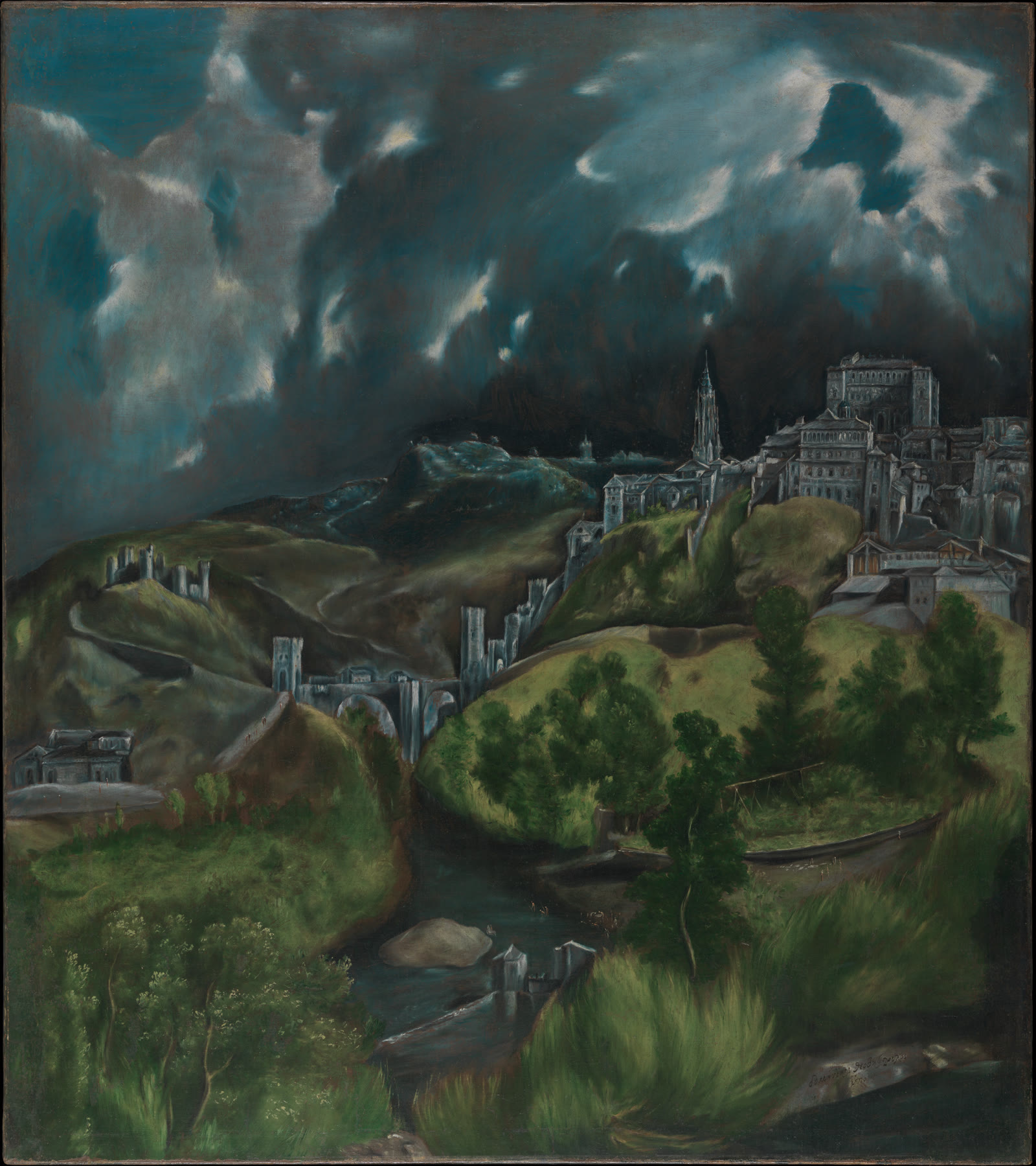
El Greco is still too often explained as an eccentric, as though the elongated bodies and jagged light arrived from private oddness alone. That misses the structural achievement. His art works because it turns ascent into pressure. Figures stretch upward, draperies flicker, space refuses to settle, and even the sky seems to have nerves.[1][2] What looks at first like distortion becomes, on longer viewing, a method for making spiritual intensity physically legible.
That method was assembled across several worlds. Domenikos Theotokopoulos was born in Candia on Crete in 1541, trained first within the post-Byzantine icon tradition, then moved through Venice and Rome before settling in Toledo, where he died in 1614.[1][2][3] Each stop gave him a different tool. Crete gave him frontality and devotional concentration. Venice gave him color and painterly fluency. Rome gave him mannerist artifice and permission to push form away from classical balance. Toledo gave him the setting in which those elements could harden into a singular system.[1][2][3]
Crete first: the discipline of the sacred image
The icon background matters because it explains why El Greco never treated painting as neutral description.[1][3] Icons are built around presence, address, and intensity. Their task is not to imitate ordinary sight but to hold the viewer inside a devotional relation. Even after El Greco absorbed Venetian oil technique and Roman mannerism, he kept that sense that a painted figure should confront the viewer with concentrated purpose.
This is why his later saints and apostles do not feel casually observed. They feel summoned. Faces lengthen, eyes sharpen, hands become signaling instruments. The body stops behaving like ordinary anatomy and starts behaving like a carrier of force. Once that is understood, the so-called strangeness of El Greco looks less like extravagance and more like continuity under transformation: Byzantine concentration rebuilt inside Western oil painting.[1][3]
Venice and Rome: color, speed, and the right to exaggerate
El Greco was documented in Venice by 1568 and in Rome by 1570.[1][3] Those years matter because he did not simply acquire Renaissance polish there; he learned how color, brushwork, and stylization could generate drama. Venetian painting offered saturated hues and a freer handling of paint. Roman mannerism offered elongated proportion, theatrical design, and a willingness to privilege invention over equilibrium.[1][5]
His mature style depends on that fusion. Venetian color keeps the work sensuous. Mannerist design keeps it unstable. The result is neither strictly naturalistic nor purely abstract. El Greco paints as though vision were always being pulled between flesh and revelation. That tension is what gives his pictures their nervous authority. They do not calm the eye; they intensify it.
Toledo: where the style found its proper voltage
Unable to secure the level of public success he wanted in Rome, El Greco moved to Spain in the later 1570s and established himself in Toledo.[1][2][3] This was the decisive turn. Toledo gave him large religious commissions, a serious clerical clientele, and a spiritual climate shaped by Counter-Reformation devotion. In that environment, his refusal of classical calm became an advantage rather than a liability.[2][5]
This helps explain why Toledo is never just a background fact in his career. It is the city in which the style acquires full voltage. Bodies lift beyond plausible proportion because the paintings are built around ecstasy, martyrdom, revelation, penitence, and visionary strain. Space splinters because earthly and heavenly zones have to coexist without blending smoothly. Light falls in abrupt sheets because illumination is treated as an event, not as a neutral atmospheric condition.[1][2]
When viewers call El Greco "spiritual," the word can become vague. In practical visual terms, the spirituality lies in the way he makes instability productive. The figures are stretched so that ordinary bodily weight seems to have been renegotiated. The world holds together, but only barely. That edge condition is the real signature.
Why View of Toledo matters so much
The hero image, View of Toledo, is one of the clearest ways to see the method stripped of narrative.[4] The Met dates it to about 1599-1600 and treats it as one of the very few surviving pure landscapes by El Greco.[4] That alone makes it unusual. More important is what the painting does with the city. El Greco does not simply record Toledo's topography. He edits and rearranges it so the place becomes a charged inner climate.[4]
The land is green with an almost metallic intensity. Buildings rise in sudden accents. The sky does not sit above the city in stable recession; it presses down and flares open at once.[4] In a profile of the artist, that matters because it shows that his famous elongation was never only about bodies. Entire environments can be treated the same way. Landscape becomes visionary pressure. Toledo turns into a psychological and devotional weather system.
Seen from that angle, the portraits, altarpieces, and landscapes all belong to one logic. El Greco's art does not ask what a thing looks like in ordinary daylight. It asks what form must do when emotional and spiritual stakes exceed normal descriptive limits.
Why later artists kept returning to him
Many contemporaries found El Greco puzzling.[1] Later artists saw something else. The Art Story notes that painters including Picasso regarded him as a crucial precursor for modern art.[1] That judgment makes sense once the work is freed from the old accusation of bad drawing. El Greco had already broken the contract that said painting must stabilize the visible world before it can mean anything. He let line, color, and proportion carry thought directly.
That is why he still feels current. Modern painting repeatedly returned to the possibility that representation could be emotionally exact without being optically obedient. El Greco got there centuries early. He discovered that if you heighten form far enough, you do not leave meaning behind. You make it harder to ignore.
60-second museum drill
- Start with the vertical pull: ask how much of the figure or city seems to be rising against ordinary weight.
- Then check the space: notice where foreground, background, and sky refuse to settle into clean depth.
- Finish with the light: track whether it describes surfaces calmly or arrives like an intervention.
Sources
- The Art Story, El Greco Artist Overview and Analysis (career arc, stylistic synthesis, and later influence on modern art).
- The National Gallery, London, El Greco (1541-1614) artist page (Toledo context, major commissions, and stylistic overview).
- The Metropolitan Museum of Art, Keith Christiansen, El Greco (1541-1614) (Heilbrunn Timeline essay on training, migration, and mature style).
- The Metropolitan Museum of Art, View of Toledo collection entry (date, medium, and interpretive notes for the work used as the article image).
- Khan Academy, El Greco, The Opening of the Fifth Seal (late style, visionary distortion, and formal intensity).